 Add to Chrome
 Add to Firefox
 Add to Edge
Knowledge Graph Re-engineering Along the Ontological Continuum (extended version)
May 21, 2026
Knowledge graphs have become the primary vehicle for data integration and are critical to the success of modern AI, but the diversity of KG modelling practices, from lightweight vocabularies to richly axiomatised ontologies, makes integration and reuse expensive and brittle. This challenge is particularly acute in neuro-symbolic AI, where bridging neural and symbolic components depends on the ability to reengineer KGs to fit new requirements; GenAI now offers unprecedented automation capability, but without a principled understanding of the KG space, such automation remains conceptually ungrounded. We introduce the ontological continuum as that missing conceptualisation, a theoretical construct a theoretical construct whose characterisation framework is defined by two orthogonal distinctions: semantics vs pragmatics, and properties vs affordances; together these define a vocabulary to describe, compare, navigate, and transform KGs across the full range of modelling practices. The methodological stance is empirical: rather than prescribing how KGs should be modelled, the continuum aims to define a theory of the existent, derived from observation of real-world KG engineering practices and whose structure can be made formally explicit, for example, through Formal Concept Analysis (FCA). We ground the vision through a case study on provenance knowledge, showing how a single concern manifests differently across the continuum. We articulate five open research challenges and invite the community to develop the ontological continuum as a shared research agenda.

Integrating emotional intelligence, memory architecture, and gestures to achieve empathetic humanoid robot interaction in an educational setting
May 26, 2025This study investigates the integration of individual human traits into an empathetically adaptive educational robot tutor system designed to improve student engagement and learning outcomes with corresponding Engagement Vector measurement. While prior research in the field of Human-Robot Interaction (HRI) has examined the integration of the traits, such as emotional intelligence, memory-driven personalization, and non-verbal communication, by themselves, they have thus-far neglected to consider their synchronized integration into a cohesive, operational education framework. To address this gap, we customize a Multi-Modal Large Language Model (LLaMa 3.2 from Meta) deployed with modules for human-like traits (emotion, memory and gestures) into an AI-Agent framework. This constitutes to the robot's intelligent core mimicing the human emotional system, memory architecture and gesture control to allow the robot to behave more empathetically while recognizing and responding appropriately to the student's emotional state. It can also recall the student's past learning record and adapt its style of interaction accordingly. This allows the robot tutor to react to the student in a more sympathetic manner by delivering personalized verbal feedback synchronized with relevant gestures. Our study investigates the extent of this effect through the introduction of Engagement Vector Model which can be a surveyor's pole for judging the quality of HRI experience. Quantitative and qualitative results demonstrate that such an empathetic responsive approach significantly improves student engagement and learning outcomes compared with a baseline humanoid robot without these human-like traits. This indicates that robot tutors with empathetic capabilities can create a more supportive, interactive learning experience that ultimately leads to better outcomes for the student.
An Experiment in Retrofitting Competency Questions for Existing Ontologies
Nov 09, 2023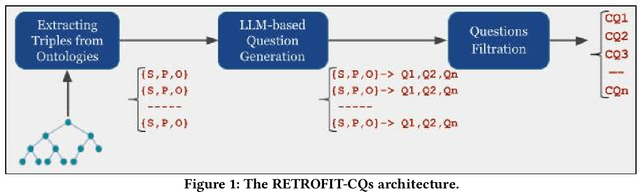
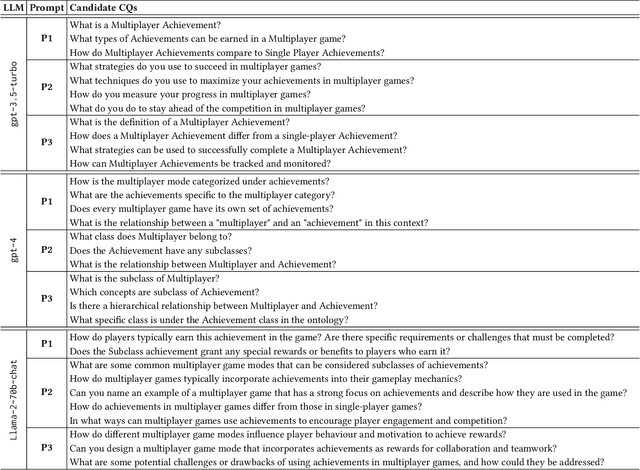
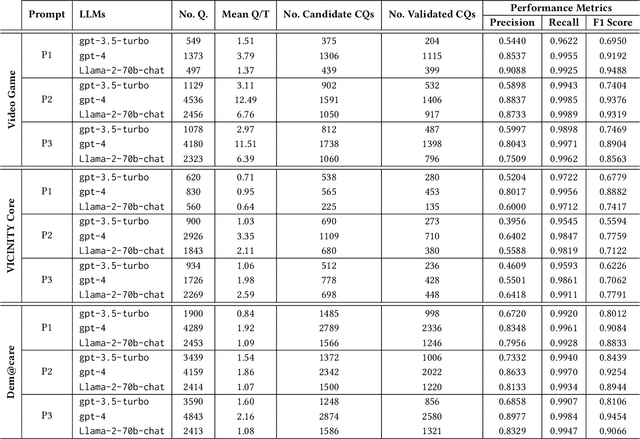
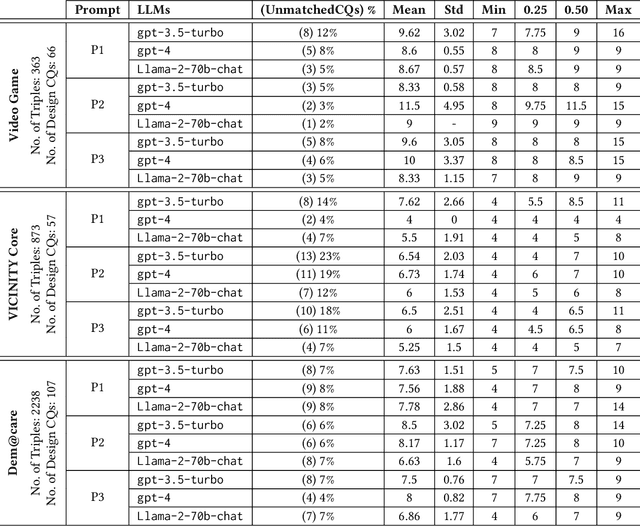
Competency Questions (CQs) are a form of ontology functional requirements expressed as natural language questions. Inspecting CQs together with the axioms in an ontology provides critical insights into the intended scope and applicability of the ontology. CQs also underpin a number of tasks in the development of ontologies e.g. ontology reuse, ontology testing, requirement specification, and the definition of patterns that implement such requirements. Although CQs are integral to the majority of ontology engineering methodologies, the practice of publishing CQs alongside the ontological artefacts is not widely observed by the community. In this context, we present an experiment in retrofitting CQs from existing ontologies. We propose RETROFIT-CQs, a method to extract candidate CQs directly from ontologies using Generative AI. In the paper we present the pipeline that facilitates the extraction of CQs by leveraging Large Language Models (LLMs) and we discuss its application to a number of existing ontologies.