 Add to Chrome
 Add to Firefox
 Add to Edge
Anti-Aliasing Snapshot HDR Imaging Using Non-Regular Sensing
Mar 05, 2026
Snapshot HDR imaging is essential to capture the full dynamic range of a scene in a single exposure, making it essential for video and dynamic environments where motion prevents the use of multi-exposure techniques or complex hardware set-ups. This work presents a snapshot HDR imaging sensor that is based on spatially varying apertures, implemented by combining two differently sized prototype pixels. The different light integration areas physically extend the dynamic range towards the lower end, compared to a standard high resolution sensor. A non-regular pixel arrangement is suggested, to mitigate aliasing and overcome a loss in spatial resolution that is associated with increased light integration area of the larger prototype pixel. Subsequent reconstruction in the Fourier domain, where natural images can be sparsely represented allows to recover the image with high detail. The image acquisition approach with the proposed non-regular HDR sensor is simulated and analysed with special emphasis on the spatial resolution. The results suggest the snapshot HDR sensor layout to be an effective way to acquire images with high dynamic range and free from aliasing artefacts.

Design Space Exploration at Frame-Level for Joint Decoding Energy and Quality Optimization in VVC
Oct 01, 2024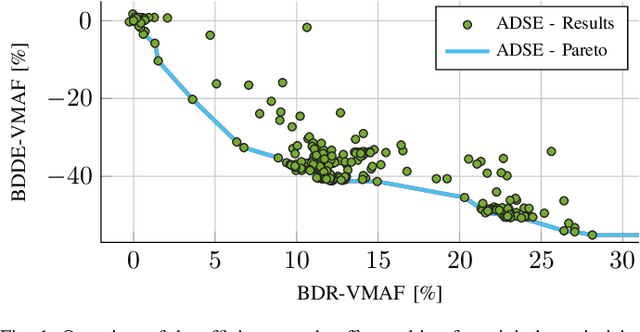
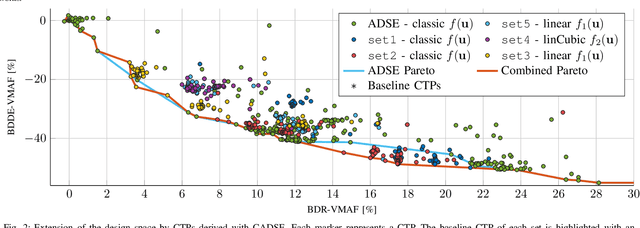
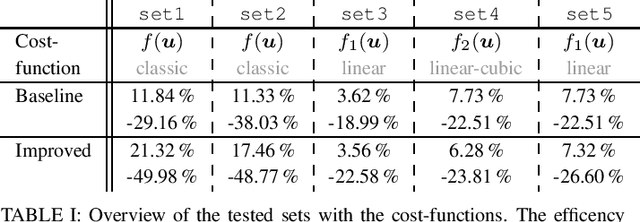
In the pursuit of a reduced energy demand of VVC decoders, it was found that the coding tool configuration has a substantial influence on the bit rate efficiency and the decoding energy demand. The Advanced Design Space Exploration algorithm as proposed in the literature, can derive coding tool configurations that provide optimal trade-offs between rate and energy efficiency. Yet, some trade-off points in the design space cannot be reached with the state-of-the-art methodology, which defines coding tools for an entire bitstream. This work proposes a novel, granular adjustment of the coding tool usage in VVC. Consequently, the optimization algorithm is adjusted to explore coding tool configurations that operate on frame-level. Moreover, new optimization criteria are introduced to focus the search on specific bit rates. As a result, coding tool configurations are obtained which yield so far inaccessible trade-offs between bit rate efficiency and decoding energy demand for VVC-coded sequences. The proposed methodology extends the design space and enhances the continuity of the Pareto front.
* submitted, accepted and published at EuSipCo 2024, Special Session on Frugality for Video Streaming