 Add to Chrome
 Add to Firefox
 Add to Edge
AudioSAE: Towards Understanding of Audio-Processing Models with Sparse AutoEncoders
Feb 04, 2026
Sparse Autoencoders (SAEs) are powerful tools for interpreting neural representations, yet their use in audio remains underexplored. We train SAEs across all encoder layers of Whisper and HuBERT, provide an extensive evaluation of their stability, interpretability, and show their practical utility. Over 50% of the features remain consistent across random seeds, and reconstruction quality is preserved. SAE features capture general acoustic and semantic information as well as specific events, including environmental noises and paralinguistic sounds (e.g. laughter, whispering) and disentangle them effectively, requiring removal of only 19-27% of features to erase a concept. Feature steering reduces Whisper's false speech detections by 70% with negligible WER increase, demonstrating real-world applicability. Finally, we find SAE features correlated with human EEG activity during speech perception, indicating alignment with human neural processing. The code and checkpoints are available at https://github.com/audiosae/audiosae_demo.

Improving Diffusion Models's Data-Corruption Resistance using Scheduled Pseudo-Huber Loss
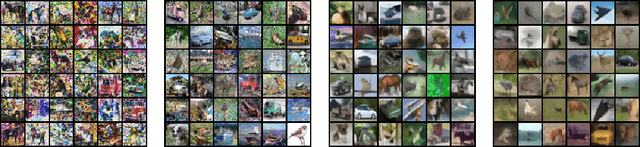
Mar 25, 2024Diffusion models are known to be vulnerable to outliers in training data. In this paper we study an alternative diffusion loss function, which can preserve the high quality of generated data like the original squared $L_{2}$ loss while at the same time being robust to outliers. We propose to use pseudo-Huber loss function with a time-dependent parameter to allow for the trade-off between robustness on the most vulnerable early reverse-diffusion steps and fine details restoration on the final steps. We show that pseudo-Huber loss with the time-dependent parameter exhibits better performance on corrupted datasets in both image and audio domains. In addition, the loss function we propose can potentially help diffusion models to resist dataset corruption while not requiring data filtering or purification compared to conventional training algorithms.
Diffusion-Based Voice Conversion with Fast Maximum Likelihood Sampling Scheme
Sep 28, 2021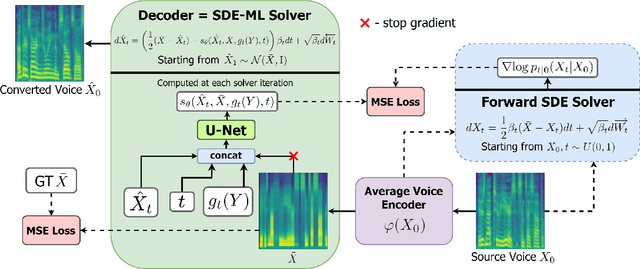

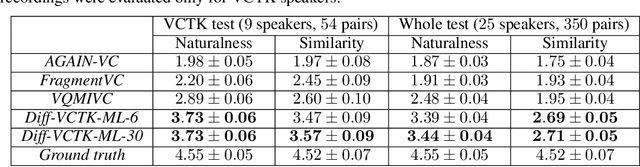
Voice conversion is a common speech synthesis task which can be solved in different ways depending on a particular real-world scenario. The most challenging one often referred to as one-shot many-to-many voice conversion consists in copying the target voice from only one reference utterance in the most general case when both source and target speakers do not belong to the training dataset. We present a scalable high-quality solution based on diffusion probabilistic modeling and demonstrate its superior quality compared to state-of-the-art one-shot voice conversion approaches. Moreover, focusing on real-time applications, we investigate general principles which can make diffusion models faster while keeping synthesis quality at a high level. As a result, we develop a novel Stochastic Differential Equations solver suitable for various diffusion model types and generative tasks as shown through empirical studies and justify it by theoretical analysis.
Grad-TTS: A Diffusion Probabilistic Model for Text-to-Speech
May 13, 2021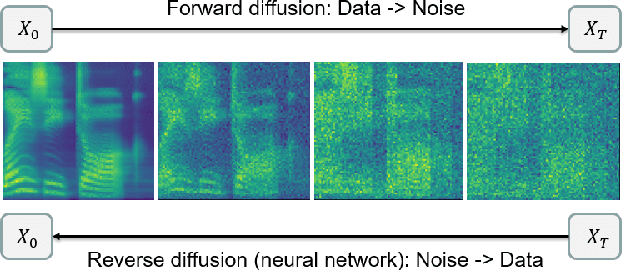
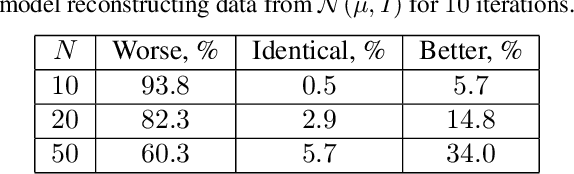

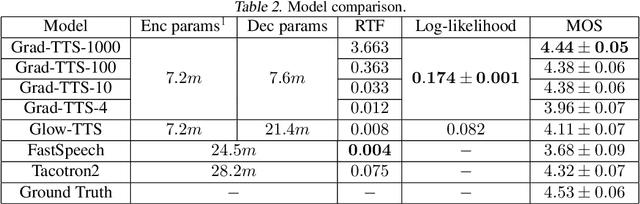
Recently, denoising diffusion probabilistic models and generative score matching have shown high potential in modelling complex data distributions while stochastic calculus has provided a unified point of view on these techniques allowing for flexible inference schemes. In this paper we introduce Grad-TTS, a novel text-to-speech model with score-based decoder producing mel-spectrograms by gradually transforming noise predicted by encoder and aligned with text input by means of Monotonic Alignment Search. The framework of stochastic differential equations helps us to generalize conventional diffusion probabilistic models to the case of reconstructing data from noise with different parameters and allows to make this reconstruction flexible by explicitly controlling trade-off between sound quality and inference speed. Subjective human evaluation shows that Grad-TTS is competitive with state-of-the-art text-to-speech approaches in terms of Mean Opinion Score. We will make the code publicly available shortly.