 Add to Chrome
 Add to Firefox
 Add to Edge
Can LLMs interpret figurative language as humans do?: surface-level vs representational similarity
Jan 14, 2026
Large language models generate judgments that resemble those of humans. Yet the extent to which these models align with human judgments in interpreting figurative and socially grounded language remains uncertain. To investigate this, human participants and four instruction-tuned LLMs of different sizes (GPT-4, Gemma-2-9B, Llama-3.2, and Mistral-7B) rated 240 dialogue-based sentences representing six linguistic traits: conventionality, sarcasm, funny, emotional, idiomacy, and slang. Each of the 240 sentences was paired with 40 interpretive questions, and both humans and LLMs rated these sentences on a 10-point Likert scale. Results indicated that humans and LLMs aligned at the surface level with humans, but diverged significantly at the representational level, especially in interpreting figurative sentences involving idioms and Gen Z slang. GPT-4 most closely approximates human representational patterns, while all models struggle with context-dependent and socio-pragmatic expressions like sarcasm, slang, and idiomacy.

OpenSync: An opensource platform for synchronizing multiple measures in neuroscience experiments
Jul 29, 2021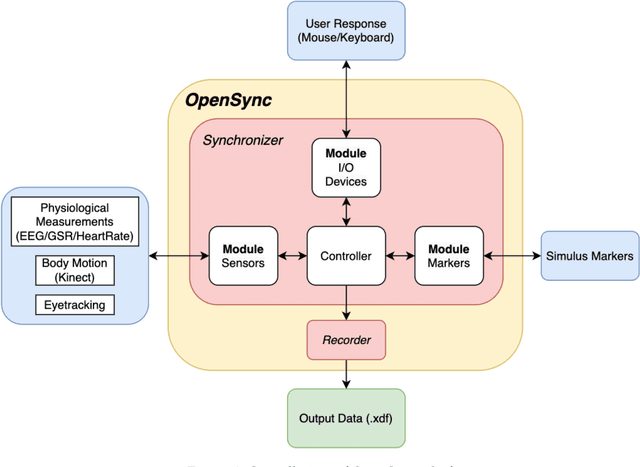
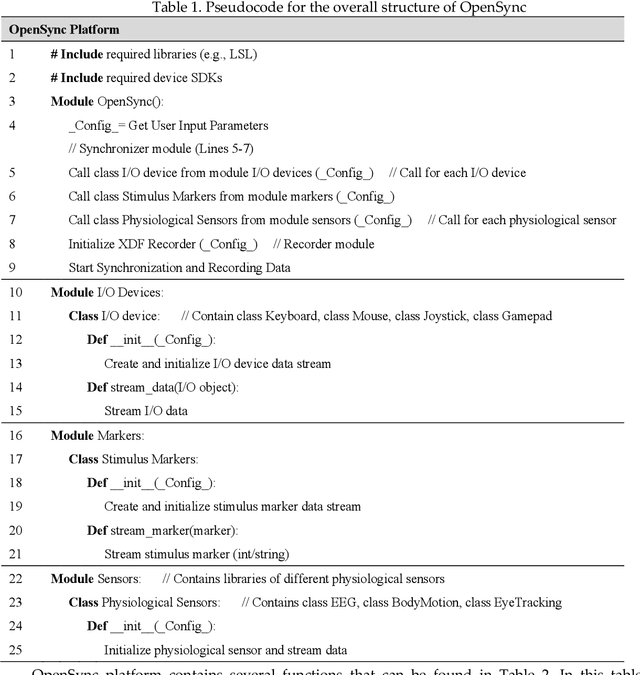


Background: The human mind is multimodal. Yet most behavioral studies rely on century-old measures such as task accuracy and latency. To create a better understanding of human behavior and brain functionality, we should introduce other measures and analyze behavior from various aspects. However, it is technically complex and costly to design and implement the experiments that record multiple measures. To address this issue, a platform that allows synchronizing multiple measures from human behavior is needed. Method: This paper introduces an opensource platform named OpenSync, which can be used to synchronize multiple measures in neuroscience experiments. This platform helps to automatically integrate, synchronize and record physiological measures (e.g., electroencephalogram (EEG), galvanic skin response (GSR), eye-tracking, body motion, etc.), user input response (e.g., from mouse, keyboard, joystick, etc.), and task-related information (stimulus markers). In this paper, we explain the structure and details of OpenSync, provide two case studies in PsychoPy and Unity. Comparison with existing tools: Unlike proprietary systems (e.g., iMotions), OpenSync is free and it can be used inside any opensource experiment design software (e.g., PsychoPy, OpenSesame, Unity, etc., https://pypi.org/project/OpenSync/ and https://github.com/moeinrazavi/OpenSync_Unity). Results: Our experimental results show that the OpenSync platform is able to synchronize multiple measures with microsecond resolution.