 Add to Chrome
 Add to Firefox
 Add to Edge
Deep Unfolded Latent Optimally Partitioned-l2/l1 Networks for Data-driven Block-Sparse Recovery
Jun 10, 2026
The convex Latent Optimal Partition (LOP)-l2/l1 approach enables block-sparse signal recovery with unknown partitions but relies on manual hyperparameter tuning. Additionally, numerical instability in differentiating its proximal operator prevents its automatic parameter tuning via Deep Unfolding (DU). To address these limitations, we propose two architectures: a stable framework utilizing implicit differentiation and a flexible variant leveraging Deep Weight Factorization (DWF). The DWF-based approach also supports nonconvex smooth data fidelity terms. Numerical experiments demonstrate that DU-LOP-l2/l1 yields competitive performance and high resilience against impulsive noise.

Nonconvex Latent Optimally Partitioned Block-Sparse Recovery via Log-Sum and Minimax Concave Penalties
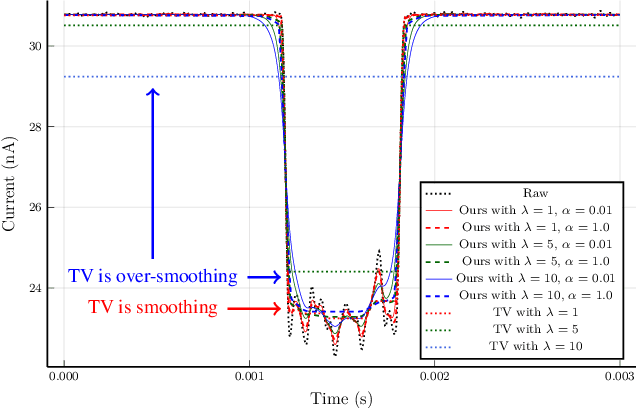
Mar 01, 2026We propose two nonconvex regularization methods, LogLOP-l2/l1 and AdaLOP-l2/l1, for recovering block-sparse signals with unknown block partitions. These methods address the underestimation bias of existing convex approaches by extending log-sum penalty and the Minimax Concave Penalty (MCP) to the block-sparse domain via novel variational formulations. Unlike Generalized Moreau Enhancement (GME) and Bayesian methods dependent on the squared-error data fidelity term, our proposed methods are compatible with a broad range of data fidelity terms. We develop efficient Alternating Direction Method of Multipliers (ADMM)-based algorithms for these formulations that exhibit stable empirical convergence. Numerical experiments on synthetic data, angular power spectrum estimation, and denoising of nanopore currents demonstrate that our methods outperform state-of-the-art baselines in estimation accuracy.
WEEP: A Differentiable Nonconvex Sparse Regularizer via Weakly-Convex Envelope
Jul 28, 2025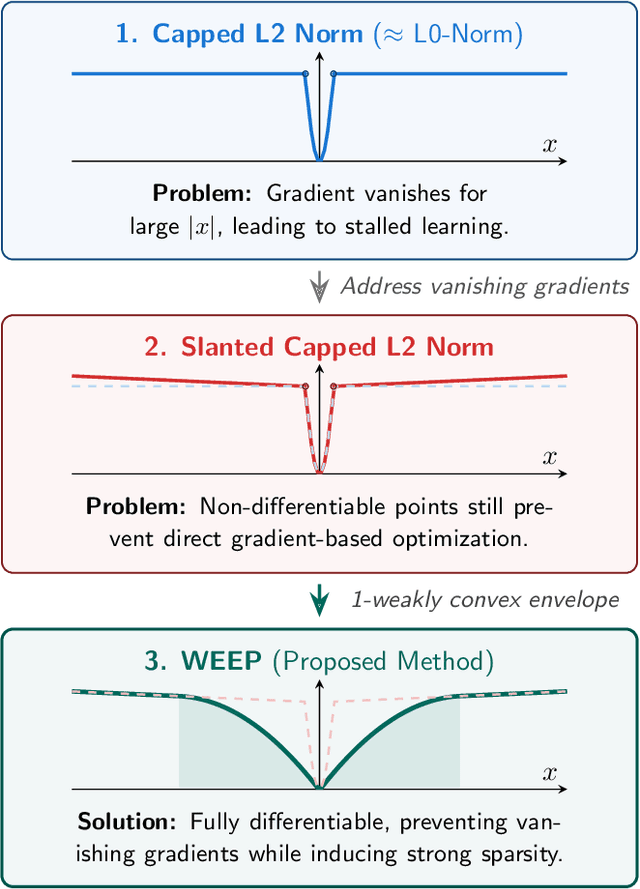
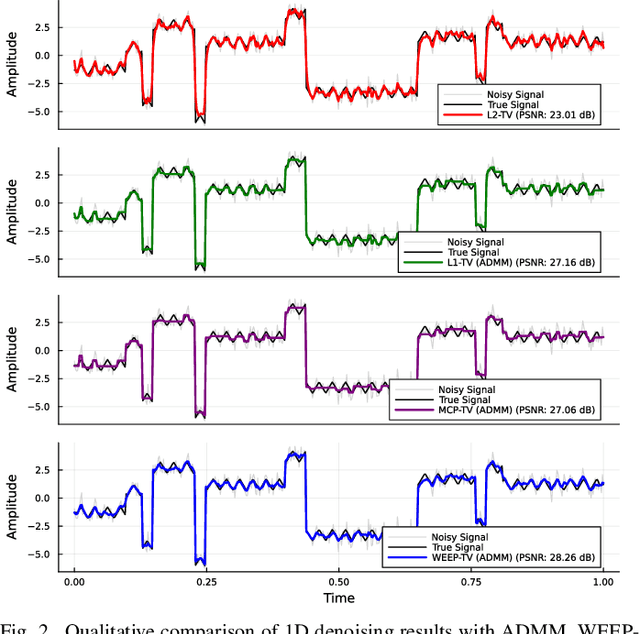
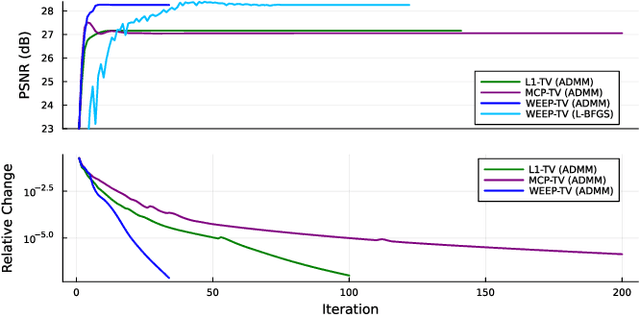
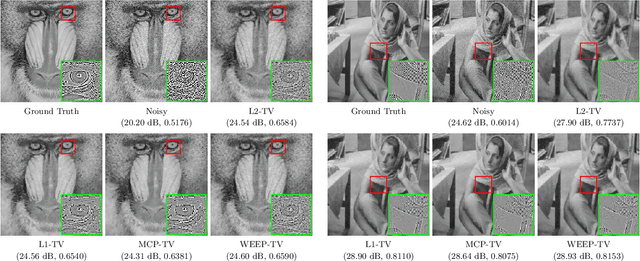
Sparse regularization is fundamental in signal processing for efficient signal recovery and feature extraction. However, it faces a fundamental dilemma: the most powerful sparsity-inducing penalties are often non-differentiable, conflicting with gradient-based optimizers that dominate the field. We introduce WEEP (Weakly-convex Envelope of Piecewise Penalty), a novel, fully differentiable sparse regularizer derived from the weakly-convex envelope framework. WEEP provides strong, unbiased sparsity while maintaining full differentiability and L-smoothness, making it natively compatible with any gradient-based optimizer. This resolves the conflict between statistical performance and computational tractability. We demonstrate superior performance compared to the L1-norm and other established non-convex sparse regularizers on challenging signal and image denoising tasks.
Adaptive Block Sparse Regularization under Arbitrary Linear Transform
Jan 31, 2024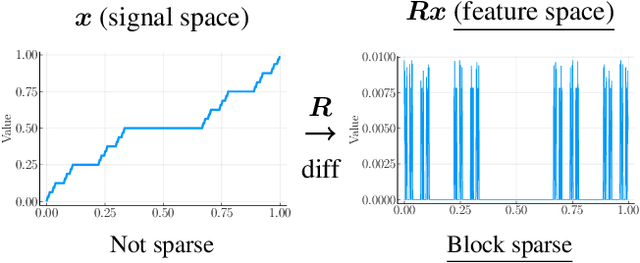
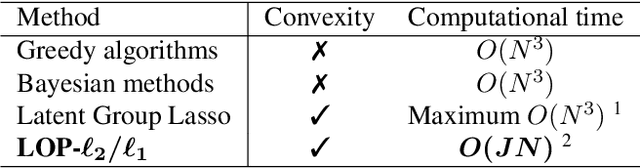
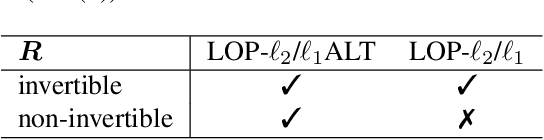
We propose a convex signal reconstruction method for block sparsity under arbitrary linear transform with unknown block structure. The proposed method is a generalization of the existing method LOP-$\ell_2$/$\ell_1$ and can reconstruct signals with block sparsity under non-invertible transforms, unlike LOP-$\ell_2$/$\ell_1$. Our work broadens the scope of block sparse regularization, enabling more versatile and powerful applications across various signal processing domains. We derive an iterative algorithm for solving proposed method and provide conditions for its convergence to the optimal solution. Numerical experiments demonstrate the effectiveness of the proposed method.