 Add to Chrome
 Add to Firefox
 Add to Edge
PUNCH: Physics-informed Uncertainty-aware Network for Coronary Hemodynamics
Jan 23, 2026
Coronary microvascular dysfunction (CMD) affects millions worldwide yet remains underdiagnosed because gold-standard physiological measurements are invasive and variably reproducible. We introduce a non-invasive, uncertainty-aware framework for estimating coronary flow reserve (CFR) directly from standard angiography. The system integrates physics-informed neural networks with variational inference to infer coronary blood flow from first-principles models of contrast transport, without requiring ground-truth flow measurements. The pipeline runs in approximately three minutes per patient on a single GPU, with no population-level training. Using 1{,}000 synthetic spatiotemporal intensity maps (kymographs) with controlled noise and artifacts, the framework reliably identifies degraded data and outputs appropriately inflated uncertainty estimates, showing strong correspondence between predictive uncertainty and error (Pearson $r = 0.997$, Spearman $ρ= 0.998$). Clinical validation in 12 patients shows strong agreement between PUNCH-derived CFR and invasive bolus thermodilution (Pearson $r = 0.90$, $p = 6.3 \times 10^{-5}$). We focus on the LAD, the artery most commonly assessed in routine CMD testing. Probabilistic CFR estimates have confidence intervals narrower than the variability of repeated invasive measurements. By transforming routine angiography into quantitative, uncertainty-aware assessment, this approach enables scalable, safer, and more reproducible evaluation of coronary microvascular function. Because standard angiography is widely available globally, the framework could expand access to CMD diagnosis and establish a new paradigm for physics-informed, patient-specific inference from clinical imaging.

Temporal Consistency Loss for Physics-Informed Neural Networks
Jan 30, 2023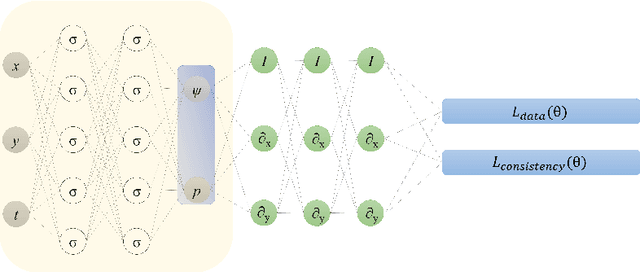
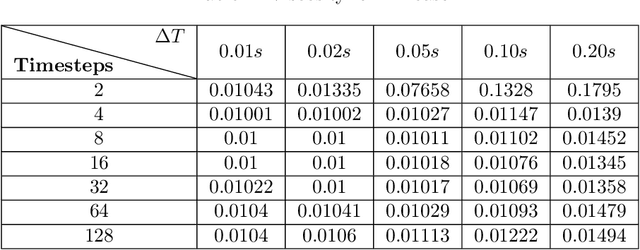
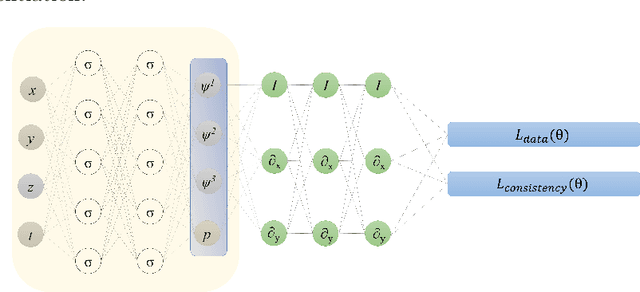
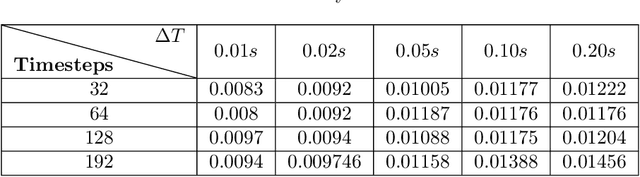
Physics-informed neural networks (PINNs) have been widely used to solve partial differential equations in a forward and inverse manner using deep neural networks. However, training these networks can be challenging for multiscale problems. While statistical methods can be employed to scale the regression loss on data, it is generally challenging to scale the loss terms for equations. This paper proposes a method for scaling the mean squared loss terms in the objective function used to train PINNs. Instead of using automatic differentiation to calculate the temporal derivative, we use backward Euler discretization. This provides us with a scaling term for the equations. In this work, we consider the two and three-dimensional Navier-Stokes equations and determine the kinematic viscosity using the spatio-temporal data on the velocity and pressure fields. We first consider numerical datasets to test our method. We test the sensitivity of our method to the time step size, the number of timesteps, noise in the data, and spatial resolution. Finally, we use the velocity field obtained using Particle Image Velocimetry (PIV) experiments to generate a reference pressure field. We then test our framework using the velocity and reference pressure field.