 Add to Chrome
 Add to Firefox
 Add to Edge
Probabilistic function-on-function nonlinear autoregressive model for emulation and reliability analysis of dynamical systems
Feb 02, 2026
Constructing accurate and computationally efficient surrogate models (or emulators) for predicting dynamical system responses is critical in many engineering domains, yet remains challenging due to the strongly nonlinear and high-dimensional mapping from external excitations and system parameters to system responses. This work introduces a novel Function-on-Function Nonlinear AutoRegressive model with eXogenous inputs (F2NARX), which reformulates the conventional NARX model from a function-on-function regression perspective, inspired by the recently proposed $\mathcal{F}$-NARX method. The proposed framework substantially improves predictive efficiency while maintaining high accuracy. By combining principal component analysis with Gaussian process regression, F2NARX further enables probabilistic predictions of dynamical responses via the unscented transform in an autoregressive manner. The effectiveness of the method is demonstrated through case studies of varying complexity. Results show that F2NARX outperforms state-of-the-art NARX model by orders of magnitude in efficiency while achieving higher accuracy in general. Moreover, its probabilistic prediction capabilities facilitate active learning, enabling accurate estimation of first-passage failure probabilities of dynamical systems using only a small number of training time histories.

Emulating the dynamics of complex systems using autoregressive models on manifolds (mNARX)
Jun 28, 2023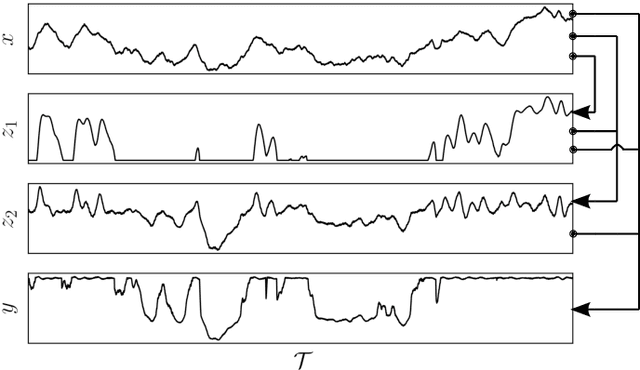
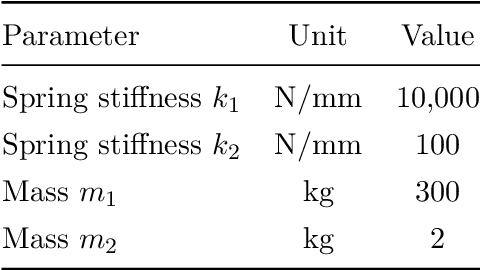
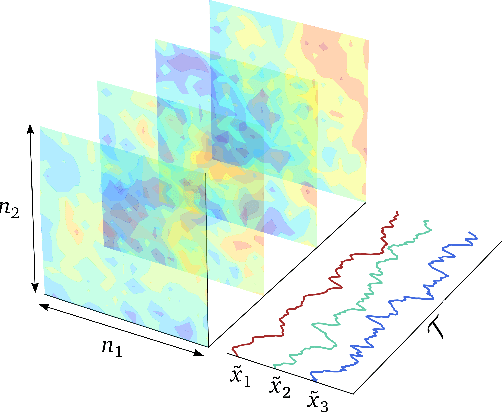
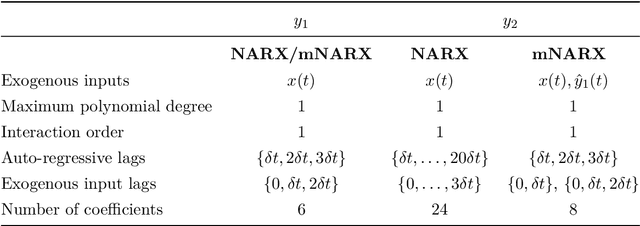
In this study, we propose a novel surrogate modelling approach to efficiently and accurately approximate the response of complex dynamical systems driven by time-varying exogenous excitations over extended time periods. Our approach, that we name \emph{manifold nonlinear autoregressive modelling with exogenous input} (mNARX), involves constructing a problem-specific exogenous input manifold that is optimal for constructing autoregressive surrogates. The manifold, which forms the core of mNARX, is constructed incrementally by incorporating the physics of the system, as well as prior expert- and domain- knowledge. Because mNARX decomposes the full problem into a series of smaller sub-problems, each with a lower complexity than the original, it scales well with the complexity of the problem, both in terms of training and evaluation costs of the final surrogate. Furthermore, mNARX synergizes well with traditional dimensionality reduction techniques, making it highly suitable for modelling dynamical systems with high-dimensional exogenous inputs, a class of problems that is typically challenging to solve.Since domain knowledge is particularly abundant in physical systems, such as those found in engineering applications, mNARX is well suited for these applications. We demonstrate that mNARX outperforms traditional autoregressive surrogates in predicting the response of a classical coupled spring-mass system excited by a one-dimensional random excitation. Additionally, we show that mNARX is well suited for emulating very high-dimensional time- and state-dependent systems, even when affected by active controllers, by surrogating the dynamics of a realistic aero-servo-elastic onshore wind turbine simulator. In general, our results demonstrate that mNARX offers promising prospects for modelling complex dynamical systems, in terms of accuracy and efficiency.