 Add to Chrome
 Add to Firefox
 Add to Edge
Quantitative Rule-Based Strategy modeling in Classic Indian Rummy: A Metric Optimization Approach
Dec 26, 2025
The 13-card variant of Classic Indian Rummy is a sequential game of incomplete information that requires probabilistic reasoning and combinatorial decision-making. This paper proposes a rule-based framework for strategic play, driven by a new hand-evaluation metric termed MinDist. The metric modifies the MinScore metric by quantifying the edit distance between a hand and the nearest valid configuration, thereby capturing structural proximity to completion. We design a computationally efficient algorithm derived from the MinScore algorithm, leveraging dynamic pruning and pattern caching to exactly calculate this metric during play. Opponent hand-modeling is also incorporated within a two-player zero-sum simulation framework, and the resulting strategies are evaluated using statistical hypothesis testing. Empirical results show significant improvement in win rates for MinDist-based agents over traditional heuristics, providing a formal and interpretable step toward algorithmic Rummy strategy design.

Automatic Detection and Classification of Symbols in Engineering Drawings
Apr 28, 2022
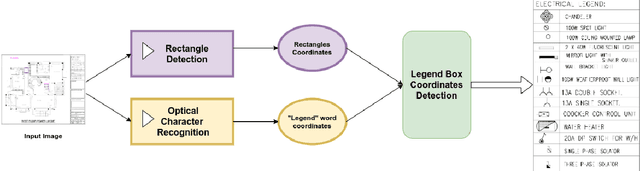


A method of finding and classifying various components and objects in a design diagram, drawing, or planning layout is proposed. The method automatically finds the objects present in a legend table and finds their position, count and related information with the help of multiple deep neural networks. The method is pre-trained on several drawings or design templates to learn the feature set that may help in representing the new templates. For a template not seen before, it does not require any training with template dataset. The proposed method may be useful in multiple industry applications such as design validation, object count, connectivity of components, etc. The method is generic and domain independent.