 Add to Chrome
 Add to Firefox
 Add to Edge
Towards Tensor Network Models for Low-Latency Jet Tagging on FPGAs
Jan 15, 2026
We present a systematic study of Tensor Network (TN) models $\unicode{x2013}$ Matrix Product States (MPS) and Tree Tensor Networks (TTN) $\unicode{x2013}$ for real-time jet tagging in high-energy physics, with a focus on low-latency deployment on Field Programmable Gate Arrays (FPGAs). Motivated by the strict requirements of the HL-LHC Level-1 trigger system, we explore TNs as compact and interpretable alternatives to deep neural networks. Using low-level jet constituent features, our models achieve competitive performance compared to state-of-the-art deep learning classifiers. We investigate post-training quantization to enable hardware-efficient implementations without degrading classification performance or latency. The best-performing models are synthesized to estimate FPGA resource usage, latency, and memory occupancy, demonstrating sub-microsecond latency and supporting the feasibility of online deployment in real-time trigger systems. Overall, this study highlights the potential of TN-based models for fast and resource-efficient inference in low-latency environments.

Quantum-inspired Machine Learning on high-energy physics data
Apr 28, 2020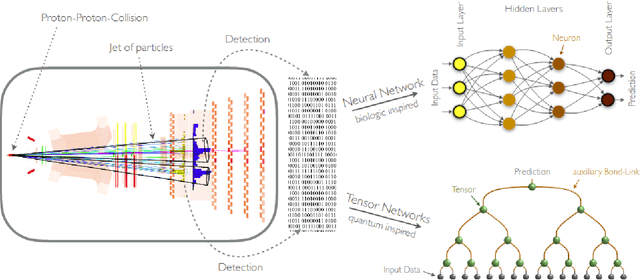
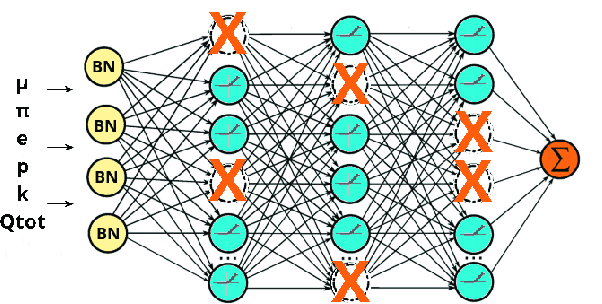
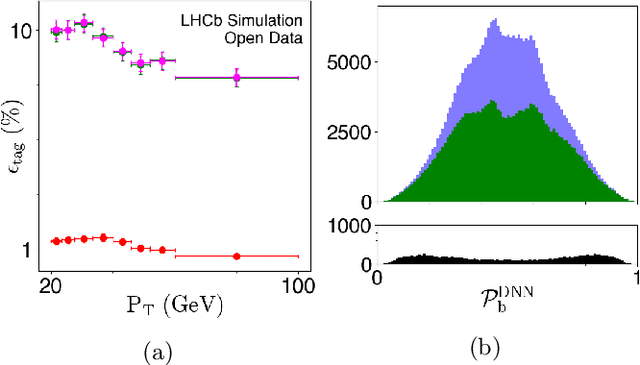
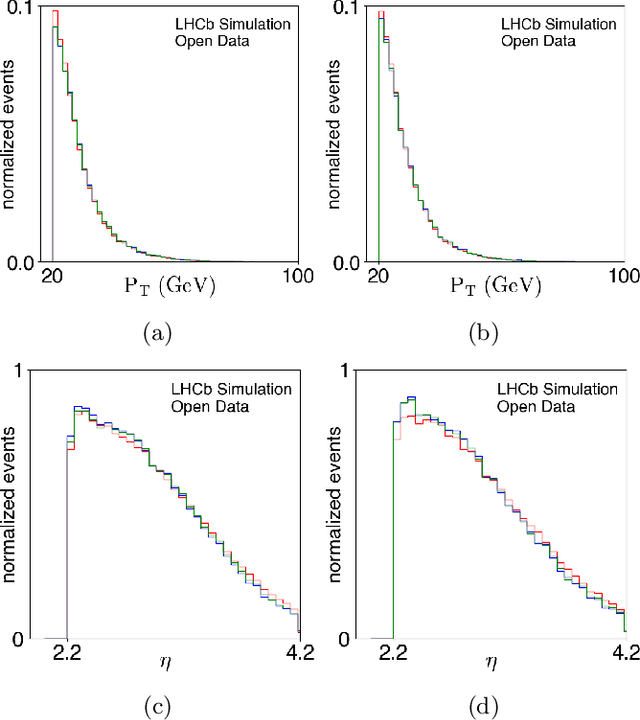
One of the most challenging big data problems in high energy physics is the analysis and classification of the data produced by the Large Hadron Collider at CERN. Recently, machine learning techniques have been employed to tackle such challenges, which, despite being very effective, rely on classification schemes that are hard to interpret. Here, we introduce and apply a quantum-inspired machine learning technique and, exploiting tree tensor networks, we show how to efficiently classify b-jet events in proton-proton collisions at LHCb and to interpret the classification results. In particular, we show how to select important features and adapt the network geometry based on information acquired in the learning process. Moreover, the tree tensor network can be adapted for optimal precision or fast response in time without the need for repeating the learning process. This paves the way to high-frequency real-time applications as needed for current and future LHC event classification to trigger events at the tens of MHz scale.