 Add to Chrome
 Add to Firefox
 Add to Edge
FiMI: A Domain-Specific Language Model for Indian Finance Ecosystem
Feb 05, 2026
We present FiMI (Finance Model for India), a domain-specialized financial language model developed for Indian digital payment systems. We develop two model variants: FiMI Base and FiMI Instruct. FiMI adapts the Mistral Small 24B architecture through a multi-stage training pipeline, beginning with continuous pre-training on 68 Billion tokens of curated financial, multilingual (English, Hindi, Hinglish), and synthetic data. This is followed by instruction fine-tuning and domain-specific supervised fine-tuning focused on multi-turn, tool-driven conversations that model real-world workflows, such as transaction disputes and mandate lifecycle management. Evaluations reveal that FiMI Base achieves a 20% improvement over the Mistral Small 24B Base model on finance reasoning benchmark, while FiMI Instruct outperforms the Mistral Small 24B Instruct model by 87% on domain-specific tool-calling. Moreover, FiMI achieves these significant domain gains while maintaining comparable performance to models of similar size on general benchmarks.

Network Learning Approaches to study World Happiness
Jul 17, 2020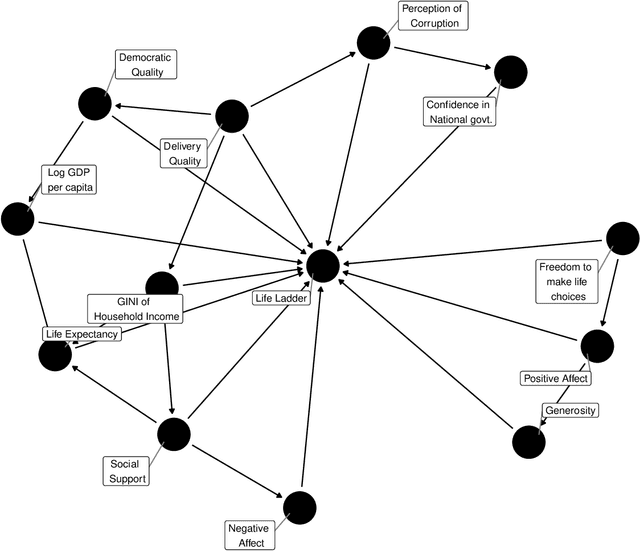


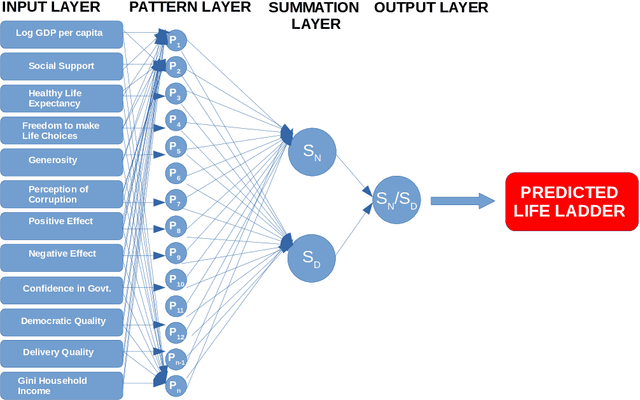
The United Nations in its 2011 resolution declared the pursuit of happiness a fundamental human goal and proposed public and economic policies centered around happiness. In this paper we used 2 types of computational strategies viz. Predictive Modelling and Bayesian Networks (BNs) to model the processed historical happiness index data of 156 nations published by UN since 2012. We attacked the problem of prediction using General Regression Neural Networks (GRNNs) and show that it out performs other state of the art predictive models. To understand causal links amongst key features that have been proven to have a significant impact on world happiness, we first used a manual discretization scheme to discretize continuous variables into 3 levels viz. Low, Medium and High. A consensus World Happiness BN structure was then fixed after amalgamating information by learning 10000 different BNs using bootstrapping. Lastly, exact inference through conditional probability queries was used on this BN to unravel interesting relationships among the important features affecting happiness which would be useful in policy making.