 Add to Chrome
 Add to Firefox
 Add to Edge
A Backbone Benchmarking Study on Self-supervised Learning as a Auxiliary Task with Texture-based Local Descriptors for Face Analysis
Mar 23, 2026
In this work, we benchmark with different backbones and study their impact for self-supervised learning (SSL) as an auxiliary task to blend texture-based local descriptors into feature modelling for efficient face analysis. It is established in previous work that combining a primary task and a self-supervised auxiliary task enables more robust and discriminative representation learning. We employed different shallow to deep backbones for the SSL task of Masked Auto-Encoder (MAE) as an auxiliary objective to reconstruct texture features such as local patterns alongside the primary task in local pattern SSAT (L-SSAT), ensuring robust and unbiased face analysis. To expand the benchmark, we conducted a comprehensive comparative analysis across multiple model configurations within the proposed framework. To this end, we address the three research questions: "What is the role of the backbone in performance L-SSAT?", "What type of backbone is effective for different face analysis tasks?", and "Is there any generalized backbone for effective face analysis with L-SSAT?". Towards answering these questions, we provide a detailed study and experiments. The performance evaluation demonstrates that the backbone for the proposed method is highly dependent on the downstream task, achieving average accuracies of 0.94 on FaceForensics++, 0.87 on CelebA, and 0.88 on AffectNet. For consistency of feature representation quality and generalisation capability across various face analysis paradigms, including face attribute prediction, emotion classification, and deepfake detection, there is no unified backbone.

Investigating the Viability of Employing Multi-modal Large Language Models in the Context of Audio Deepfake Detection
Jan 02, 2026While Vision-Language Models (VLMs) and Multimodal Large Language Models (MLLMs) have shown strong generalisation in detecting image and video deepfakes, their use for audio deepfake detection remains largely unexplored. In this work, we aim to explore the potential of MLLMs for audio deepfake detection. Combining audio inputs with a range of text prompts as queries to find out the viability of MLLMs to learn robust representations across modalities for audio deepfake detection. Therefore, we attempt to explore text-aware and context-rich, question-answer based prompts with binary decisions. We hypothesise that such a feature-guided reasoning will help in facilitating deeper multimodal understanding and enable robust feature learning for audio deepfake detection. We evaluate the performance of two MLLMs, Qwen2-Audio-7B-Instruct and SALMONN, in two evaluation modes: (a) zero-shot and (b) fine-tuned. Our experiments demonstrate that combining audio with a multi-prompt approach could be a viable way forward for audio deepfake detection. Our experiments show that the models perform poorly without task-specific training and struggle to generalise to out-of-domain data. However, they achieve good performance on in-domain data with minimal supervision, indicating promising potential for audio deepfake detection.
Fusion-SSAT: Unleashing the Potential of Self-supervised Auxiliary Task by Feature Fusion for Generalized Deepfake Detection
Jan 02, 2026In this work, we attempted to unleash the potential of self-supervised learning as an auxiliary task that can optimise the primary task of generalised deepfake detection. To explore this, we examined different combinations of the training schemes for these tasks that can be most effective. Our findings reveal that fusing the feature representation from self-supervised auxiliary tasks is a powerful feature representation for the problem at hand. Such a representation can leverage the ultimate potential and bring in a unique representation of both the self-supervised and primary tasks, achieving better performance for the primary task. We experimented on a large set of datasets, which includes DF40, FaceForensics++, Celeb-DF, DFD, FaceShifter, UADFV, and our results showed better generalizability on cross-dataset evaluation when compared with current state-of-the-art detectors.
Self-supervised Auxiliary Learning for Texture and Model-based Hybrid Robust and Fair Featuring in Face Analysis
Sep 29, 2024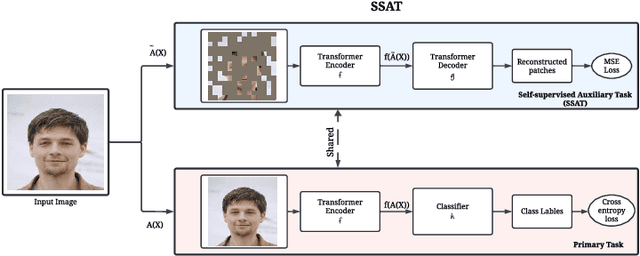
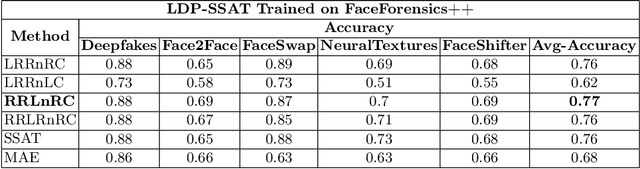
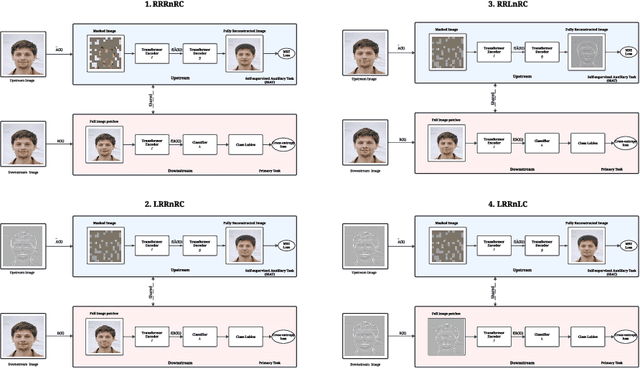
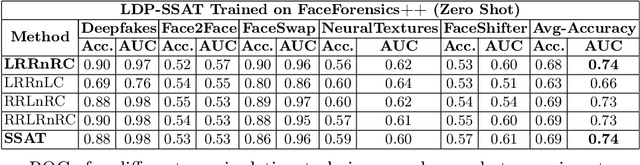
In this work, we explore Self-supervised Learning (SSL) as an auxiliary task to blend the texture-based local descriptors into feature modelling for efficient face analysis. Combining a primary task and a self-supervised auxiliary task is beneficial for robust representation. Therefore, we used the SSL task of mask auto-encoder (MAE) as an auxiliary task to reconstruct texture features such as local patterns along with the primary task for robust and unbiased face analysis. We experimented with our hypothesis on three major paradigms of face analysis: face attribute and face-based emotion analysis, and deepfake detection. Our experiment results exhibit that better feature representation can be gleaned from our proposed model for fair and bias-less face analysis.