 Add to Chrome
 Add to Firefox
 Add to Edge
RIS-Enhanced Information-Decoupled Symbiotic Radio Over Broadcasting Signals
Jan 18, 2026
This paper studies a reconfigurable intelligent surface (RIS)-enhanced decoupled symbiotic radio (SR) system in which a primary transmitter delivers common data to multiple primary receivers (PRs), while a RIS-based backscatter device sends secondary data to a backscatter receiver (BRx). Unlike conventional SR, the BRx performs energy detection and never decodes the primary signal, thereby removing ambiguity and preventing exposure of the primary payload to unintended receivers. In this paper, we formulate the problem as the minimization of the transmit power subject to a common broadcast rate constraint across all PRs and a bit error rate (BER) constraint at the BRx. The problem is nonconvex due to the unit-modulus RIS constraint and coupled quadratic forms. Leveraging a rate-balanced reformulation and a monotonic BER ratio characterization, we develop a low-complexity penalty-based block coordinate descent algorithm with closed-form updates. Numerical results show fast convergence of the proposed algorithm and reduced power consumption of the considered RIS-enhanced information-decoupled SR system over conventional SR baselines.

Symbol-Level Precoding-Based Self-Interference Cancellation for ISAC Systems
Sep 13, 2024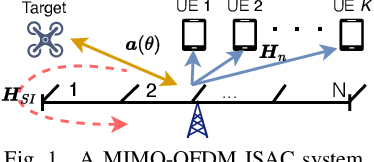
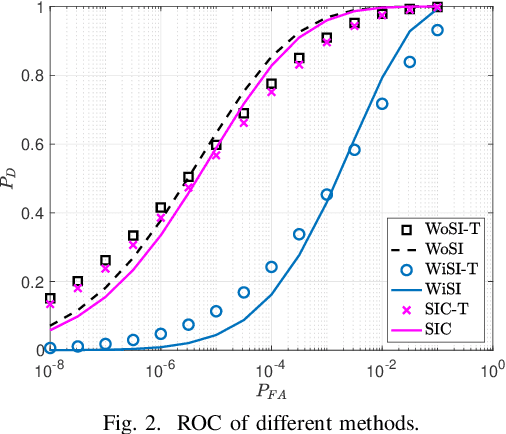
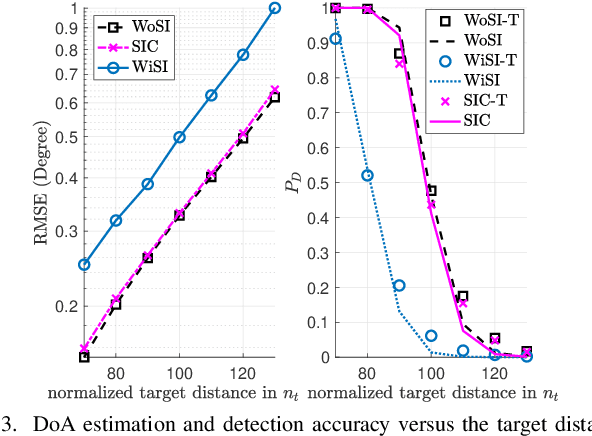
Consider an integrated sensing and communication (ISAC) system where a base station (BS) employs a full-duplex radio to simultaneously serve multiple users and detect a target. The detection performance of the BS may be compromised by self-interference (SI) leakage. This paper investigates the feasibility of SI cancellation (SIC) through the application of symbol-level precoding (SLP). We first derive the target detection probability in the presence of the SI. We then formulate an SLP-based SIC problem, which optimizes the target detection probability while satisfying the quality of service requirements of all users. The formulated problem is a nonconvex fractional programming (FP) problem with a large number of equality and inequality constraints. We propose a penalty-based block coordinate descent (BCD) algorithm for solving the formulated problem, which allows for efficient closed-form updates of each block of variables at each iteration. Finally, numerical simulation results are presented to showcase the enhanced detection performance of the proposed SIC approach.