 Add to Chrome
 Add to Firefox
 Add to Edge
Building Better Deception Probes Using Targeted Instruction Pairs
Feb 01, 2026
Linear probes are a promising approach for monitoring AI systems for deceptive behaviour. Previous work has shown that a linear classifier trained on a contrastive instruction pair and a simple dataset can achieve good performance. However, these probes exhibit notable failures even in straightforward scenarios, including spurious correlations and false positives on non-deceptive responses. In this paper, we identify the importance of the instruction pair used during training. Furthermore, we show that targeting specific deceptive behaviors through a human-interpretable taxonomy of deception leads to improved results on evaluation datasets. Our findings reveal that instruction pairs capture deceptive intent rather than content-specific patterns, explaining why prompt choice dominates probe performance (70.6% of variance). Given the heterogeneity of deception types across datasets, we conclude that organizations should design specialized probes targeting their specific threat models rather than seeking a universal deception detector.

Model-free machine learning of conservation laws from data
Jan 12, 2023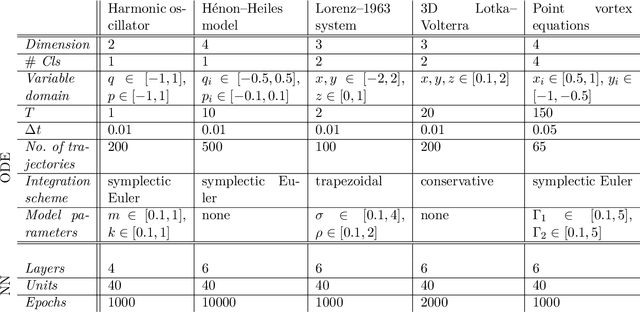
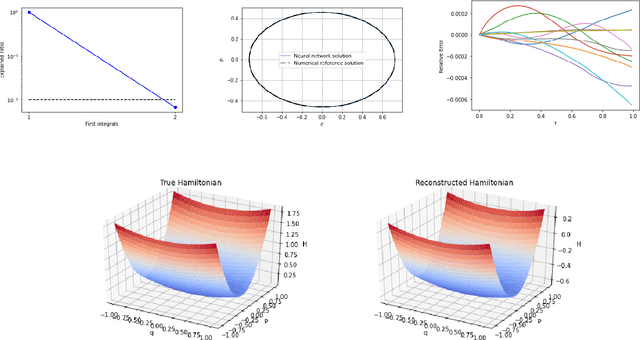
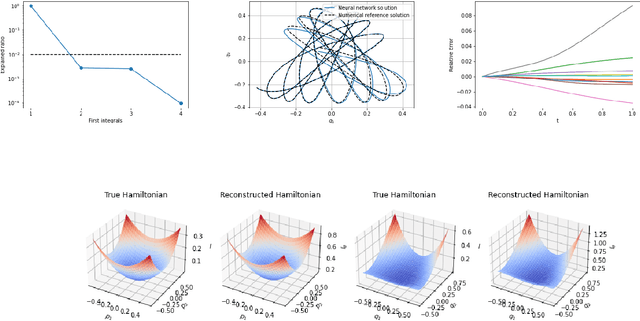

We present a machine learning based method for learning first integrals of systems of ordinary differential equations from given trajectory data. The method is model-free in that it does not require explicit knowledge of the underlying system of differential equations that generated the trajectories. As a by-product, once the first integrals have been learned, also the system of differential equations will be known. We illustrate our method by considering several classical problems from the mathematical sciences.