 Add to Chrome
 Add to Firefox
 Add to Edge
Chat-Driven Optimal Management for Virtual Network Services
Dec 31, 2025
This paper proposes a chat-driven network management framework that integrates natural language processing (NLP) with optimization-based virtual network allocation, enabling intuitive and reliable reconfiguration of virtual network services. Conventional intent-based networking (IBN) methods depend on statistical language models to interpret user intent but cannot guarantee the feasibility of generated configurations. To overcome this, we develop a two-stage framework consisting of an Interpreter, which extracts intent from natural language prompts using NLP, and an Optimizer, which computes feasible virtual machine (VM) placement and routing via an integer linear programming. In particular, the Interpreter translates user chats into update directions, i.e., whether to increase, decrease, or maintain parameters such as CPU demand and latency bounds, thereby enabling iterative refinement of the network configuration. In this paper, two intent extractors, which are a Sentence-BERT model with support vector machine (SVM) classifiers and a large language model (LLM), are introduced. Experiments in single-user and multi-user settings show that the framework dynamically updates VM placement and routing while preserving feasibility. The LLM-based extractor achieves higher accuracy with fewer labeled samples, whereas the Sentence-BERT with SVM classifiers provides significantly lower latency suitable for real-time operation. These results underscore the effectiveness of combining NLP-driven intent extraction with optimization-based allocation for safe, interpretable, and user-friendly virtual network management.

Extendable NFV-Integrated Control Method Using Reinforcement Learning
Dec 19, 2019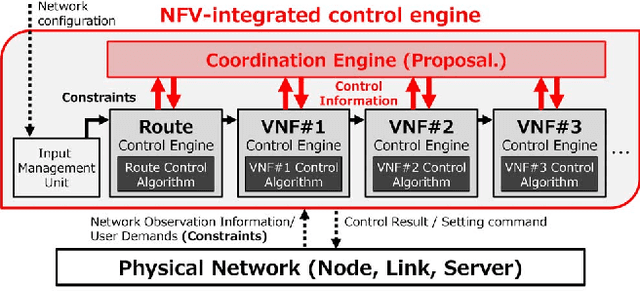
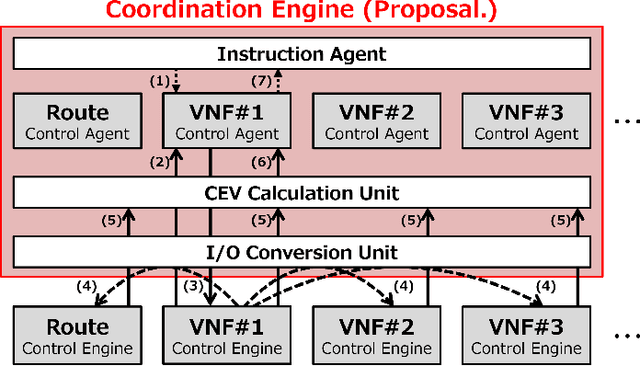
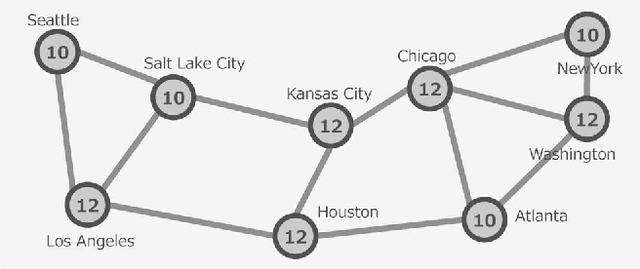

Network functions virtualization (NFV) enables telecommunications service providers to realize various network services by flexibly combining multiple virtual network functions (VNFs). To provide such services, an NFV control method should optimally allocate such VNFs into physical networks and servers by taking account of the combination(s) of objective functions and constraints for each metric defined for each VNF type, e.g., VNF placements and routes between the VNFs. The NFV control method should also be extendable for adding new metrics or changing the combination of metrics. One approach for NFV control to optimize allocations is to construct an algorithm that simultaneously solves the combined optimization problem. However, this approach is not extendable because the problem needs to be reformulated every time a new metric is added or a combination of metrics is changed. Another approach involves using an extendable network-control architecture that coordinates multiple control algorithms specified for individual metrics. However, to the best of our knowledge, no method has been developed that can optimize allocations through this kind of coordination. In this paper, we propose an extendable NFV-integrated control method by coordinating multiple control algorithms. We also propose an efficient coordination algorithm based on reinforcement learning. Finally, we evaluate the effectiveness of the proposed method through simulations.