 Add to Chrome
 Add to Firefox
 Add to Edge
When Anomalies Depend on Context: Learning Conditional Compatibility for Anomaly Detection
Jan 30, 2026
Anomaly detection is often formulated under the assumption that abnormality is an intrinsic property of an observation, independent of context. This assumption breaks down in many real-world settings, where the same object or action may be normal or anomalous depending on latent contextual factors (e.g., running on a track versus on a highway). We revisit \emph{contextual anomaly detection}, classically defined as context-dependent abnormality, and operationalize it in the visual domain, where anomaly labels depend on subject--context compatibility rather than intrinsic appearance. To enable systematic study of this setting, we introduce CAAD-3K, a benchmark that isolates contextual anomalies by controlling subject identity while varying context. We further propose a conditional compatibility learning framework that leverages vision--language representations to model subject--context relationships under limited supervision. Our method substantially outperforms existing approaches on CAAD-3K and achieves state-of-the-art performance on MVTec-AD and VisA, demonstrating that modeling context dependence complements traditional structural anomaly detection. Our code and dataset will be publicly released.

IMKD: Intensity-Aware Multi-Level Knowledge Distillation for Camera-Radar Fusion
Dec 17, 2025High-performance Radar-Camera 3D object detection can be achieved by leveraging knowledge distillation without using LiDAR at inference time. However, existing distillation methods typically transfer modality-specific features directly to each sensor, which can distort their unique characteristics and degrade their individual strengths. To address this, we introduce IMKD, a radar-camera fusion framework based on multi-level knowledge distillation that preserves each sensor's intrinsic characteristics while amplifying their complementary strengths. IMKD applies a three-stage, intensity-aware distillation strategy to enrich the fused representation across the architecture: (1) LiDAR-to-Radar intensity-aware feature distillation to enhance radar representations with fine-grained structural cues, (2) LiDAR-to-Fused feature intensity-guided distillation to selectively highlight useful geometry and depth information at the fusion level, fostering complementarity between the modalities rather than forcing them to align, and (3) Camera-Radar intensity-guided fusion mechanism that facilitates effective feature alignment and calibration. Extensive experiments on the nuScenes benchmark show that IMKD reaches 67.0% NDS and 61.0% mAP, outperforming all prior distillation-based radar-camera fusion methods. Our code and models are available at https://github.com/dfki-av/IMKD/.
RC-BEVFusion: A Plug-In Module for Radar-Camera Bird's Eye View Feature Fusion
May 25, 2023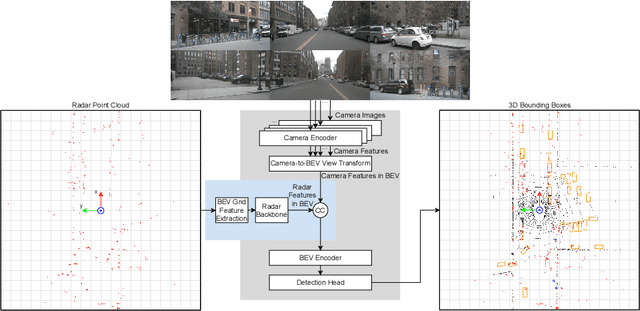
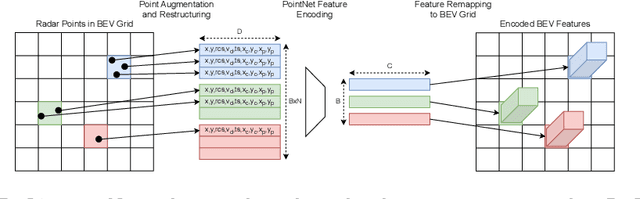
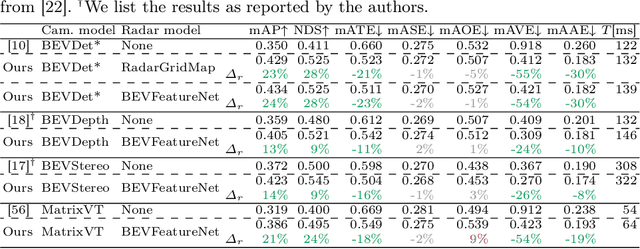

Radars and cameras belong to the most frequently used sensors for advanced driver assistance systems and automated driving research. However, there has been surprisingly little research on radar-camera fusion with neural networks. One of the reasons is a lack of large-scale automotive datasets with radar and unmasked camera data, with the exception of the nuScenes dataset. Another reason is the difficulty of effectively fusing the sparse radar point cloud on the bird's eye view (BEV) plane with the dense images on the perspective plane. The recent trend of camera-based 3D object detection using BEV features has enabled a new type of fusion, which is better suited for radars. In this work, we present RC-BEVFusion, a modular radar-camera fusion network on the BEV plane. We propose BEVFeatureNet, a novel radar encoder branch, and show that it can be incorporated into several state-of-the-art camera-based architectures. We show significant performance gains of up to 28% increase in the nuScenes detection score, which is an important step in radar-camera fusion research. Without tuning our model for the nuScenes benchmark, we achieve the best result among all published methods in the radar-camera fusion category.