 Add to Chrome
 Add to Firefox
 Add to Edge
Multi-LLM Adaptive Conformal Inference for Reliable LLM Responses
Feb 01, 2026
Ensuring factuality is essential for the safe use of Large Language Models (LLMs) in high-stakes domains such as medicine and law. Conformal inference provides distribution-free guarantees, but existing approaches are either overly conservative, discarding many true-claims, or rely on adaptive error rates and simple linear models that fail to capture complex group structures. To address these challenges, we reformulate conformal inference in a multiplicative filtering setting, modeling factuality as a product of claim-level scores. Our method, Multi-LLM Adaptive Conformal Inference (MACI), leverages ensembles to produce more accurate factuality-scores, which in our experiments led to higher retention, while validity is preserved through group-conditional calibration. Experiments show that MACI consistently achieves user-specified coverage with substantially higher retention and lower time cost than baselines. Our repository is available at https://github.com/MLAI-Yonsei/MACI

General Frameworks for Conditional Two-Sample Testing
Oct 22, 2024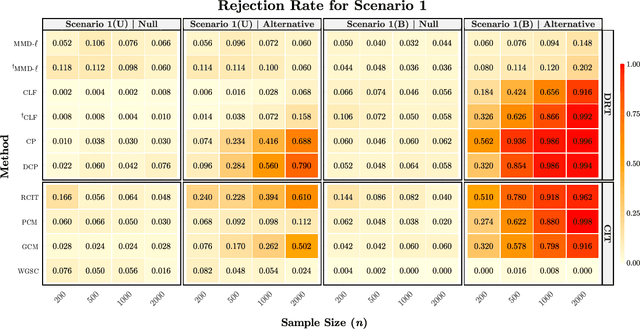

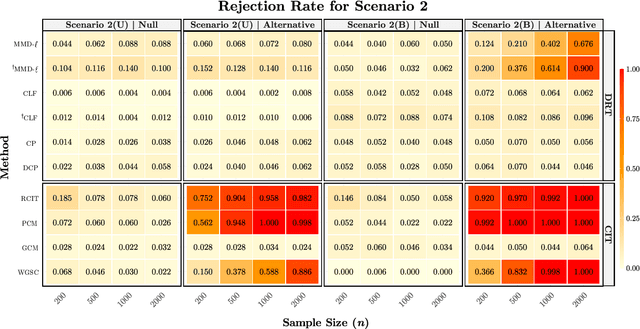
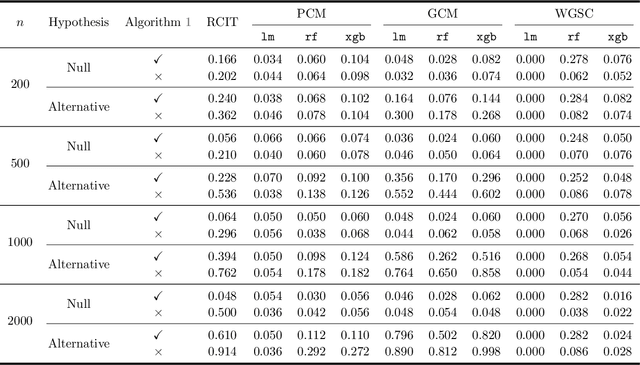
We study the problem of conditional two-sample testing, which aims to determine whether two populations have the same distribution after accounting for confounding factors. This problem commonly arises in various applications, such as domain adaptation and algorithmic fairness, where comparing two groups is essential while controlling for confounding variables. We begin by establishing a hardness result for conditional two-sample testing, demonstrating that no valid test can have significant power against any single alternative without proper assumptions. We then introduce two general frameworks that implicitly or explicitly target specific classes of distributions for their validity and power. Our first framework allows us to convert any conditional independence test into a conditional two-sample test in a black-box manner, while preserving the asymptotic properties of the original conditional independence test. The second framework transforms the problem into comparing marginal distributions with estimated density ratios, which allows us to leverage existing methods for marginal two-sample testing. We demonstrate this idea in a concrete manner with classification and kernel-based methods. Finally, simulation studies are conducted to illustrate the proposed frameworks in finite-sample scenarios.