 Add to Chrome
 Add to Firefox
 Add to Edge
MACA: A Framework for Distilling Trustworthy LLMs into Efficient Retrievers
Jan 01, 2026
Modern enterprise retrieval systems must handle short, underspecified queries such as ``foreign transaction fee refund'' and ``recent check status''. In these cases, semantic nuance and metadata matter but per-query large language model (LLM) re-ranking and manual labeling are costly. We present Metadata-Aware Cross-Model Alignment (MACA), which distills a calibrated metadata aware LLM re-ranker into a compact student retriever, avoiding online LLM calls. A metadata-aware prompt verifies the teacher's trustworthiness by checking consistency under permutations and robustness to paraphrases, then supplies listwise scores, hard negatives, and calibrated relevance margins. The student trains with MACA's MetaFusion objective, which combines a metadata conditioned ranking loss with a cross model margin loss so it learns to push the correct answer above semantically similar candidates with mismatched topic, sub-topic, or entity. On a proprietary consumer banking FAQ corpus and BankFAQs, the MACA teacher surpasses a MAFA baseline at Accuracy@1 by five points on the proprietary set and three points on BankFAQs. MACA students substantially outperform pretrained encoders; e.g., on the proprietary corpus MiniLM Accuracy@1 improves from 0.23 to 0.48, while keeping inference free of LLM calls and supporting retrieval-augmented generation.

ComplAI: Theory of A Unified Framework for Multi-factor Assessment of Black-Box Supervised Machine Learning Models
Dec 30, 2022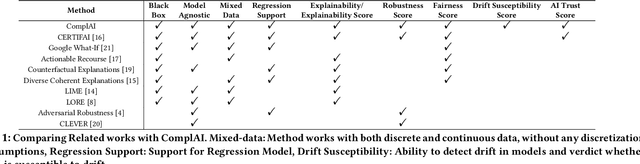
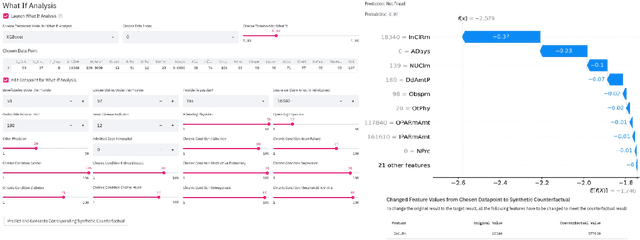
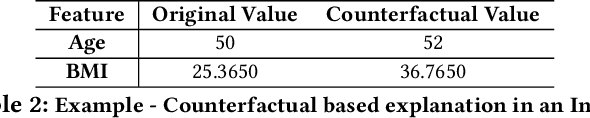
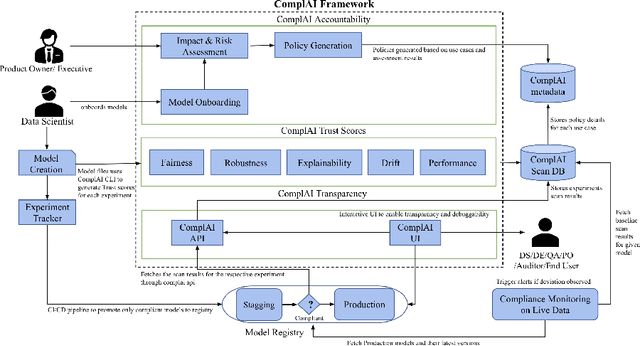
The advances in Artificial Intelligence are creating new opportunities to improve lives of people around the world, from business to healthcare, from lifestyle to education. For example, some systems profile the users using their demographic and behavioral characteristics to make certain domain-specific predictions. Often, such predictions impact the life of the user directly or indirectly (e.g., loan disbursement, determining insurance coverage, shortlisting applications, etc.). As a result, the concerns over such AI-enabled systems are also increasing. To address these concerns, such systems are mandated to be responsible i.e., transparent, fair, and explainable to developers and end-users. In this paper, we present ComplAI, a unique framework to enable, observe, analyze and quantify explainability, robustness, performance, fairness, and model behavior in drift scenarios, and to provide a single Trust Factor that evaluates different supervised Machine Learning models not just from their ability to make correct predictions but from overall responsibility perspective. The framework helps users to (a) connect their models and enable explanations, (b) assess and visualize different aspects of the model, such as robustness, drift susceptibility, and fairness, and (c) compare different models (from different model families or obtained through different hyperparameter settings) from an overall perspective thereby facilitating actionable recourse for improvement of the models. It is model agnostic and works with different supervised machine learning scenarios (i.e., Binary Classification, Multi-class Classification, and Regression) and frameworks. It can be seamlessly integrated with any ML life-cycle framework. Thus, this already deployed framework aims to unify critical aspects of Responsible AI systems for regulating the development process of such real systems.