 Add to Chrome
 Add to Firefox
 Add to Edge
MoRGS: Efficient Per-Gaussian Motion Reasoning for Streamable Dynamic 3D Scenes
Mar 26, 2026
Online reconstruction of dynamic scenes aims to learn from streaming multi-view inputs under low-latency constraints. The fast training and real-time rendering capabilities of 3D Gaussian Splatting have made on-the-fly reconstruction practically feasible, enabling online 4D reconstruction. However, existing online approaches, despite their efficiency and visual quality, fail to learn per-Gaussian motion that reflects true scene dynamics. Without explicit motion cues, appearance and motion are optimized solely under photometric loss, causing per-Gaussian motion to chase pixel residuals rather than true 3D motion. To address this, we propose MoRGS, an efficient online per-Gaussian motion reasoning framework that explicitly models per-Gaussian motion to improve 4D reconstruction quality. Specifically, we leverage optical flow on a sparse set of key views as lightweight motion cues that regularize per-Gaussian motion beyond photometric supervision. To compensate for the sparsity of flow supervision, we learn a per-Gaussian motion offset field that reconciles discrepancies between projected 3D motion and observed flow across views and time. In addition, we introduce a per-Gaussian motion confidence that separates dynamic from static Gaussians and weights Gaussian attribute residual updates, thereby suppressing redundant motion in static regions for better temporal consistency and accelerating the modeling of large motions. Extensive experiments demonstrate that MoRGS achieves state-of-the-art reconstruction quality and motion fidelity among online methods, while maintaining streamable performance.

NeoLightning: A Modern Reimagination of Gesture-Based Sound Design
May 15, 2025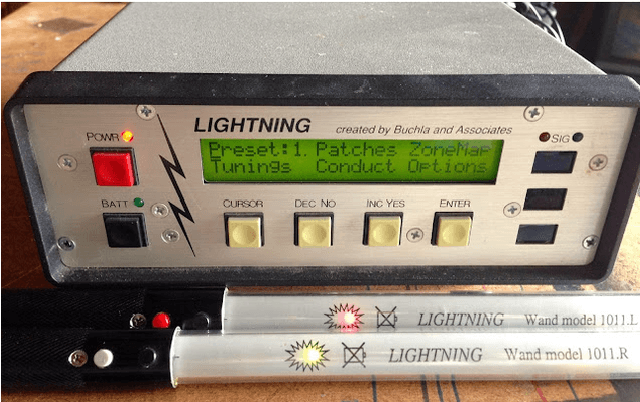
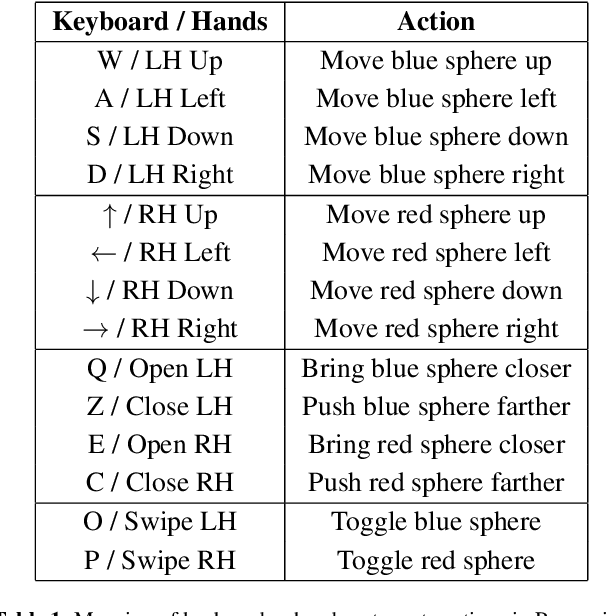
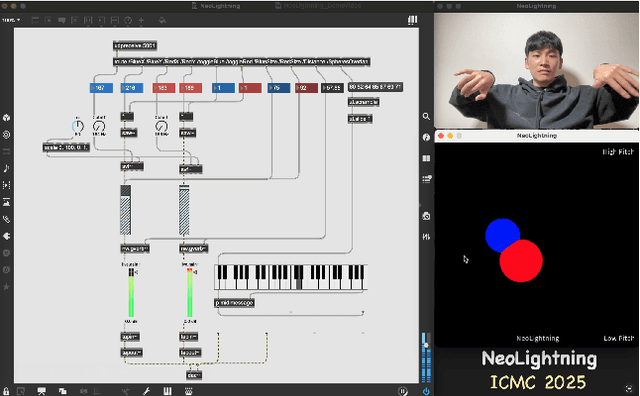
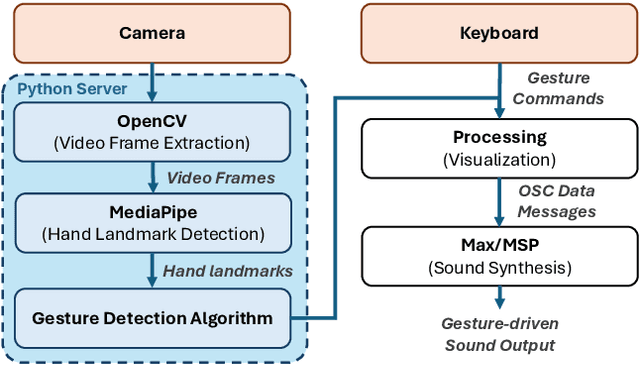
This paper introduces NeoLightning, a modern reinterpretation of the Buchla Lightning. NeoLightning preserves the innovative spirit of Don Buchla's "Buchla Lightning" (introduced in the 1990s) while making its gesture-based interaction accessible to contemporary users. While the original Buchla Lightning and many other historical instruments were groundbreaking in their time, they are now largely unsupported, limiting user interaction to indirect experiences. To address this, NeoLightning leverages MediaPipe for deep learning-based gesture recognition and employs Max/MSP and Processing for real-time multimedia processing. The redesigned system offers precise, low-latency gesture recognition and immersive 3D interaction. By merging the creative spirit of the original Lightning with modern advancements, NeoLightning redefines gesture-based musical interaction, expanding possibilities for expressive performance and interactive sound design.
Towards Computational Analysis of Pansori Singing
Oct 16, 2024Pansori is one of the most representative vocal genres of Korean traditional music, which has an elaborated vocal melody line with strong vibrato. Although the music is transmitted orally without any music notation, transcribing pansori music in Western staff notation has been introduced for several purposes, such as documentation of music, education, or research. In this paper, we introduce computational analysis of pansori based on both audio and corresponding transcription, how modern Music Information Retrieval tasks can be used in analyzing traditional music and how it revealed different audio characteristics of what pansori contains.