 Add to Chrome
 Add to Firefox
 Add to Edge
DefVINS: Visual-Inertial Odometry for Deformable Scenes
Jan 02, 2026
Deformable scenes violate the rigidity assumptions underpinning classical visual-inertial odometry (VIO), often leading to over-fitting to local non-rigid motion or severe drift when deformation dominates visual parallax. We introduce DefVINS, a visual-inertial odometry framework that explicitly separates a rigid, IMU-anchored state from a non--rigid warp represented by an embedded deformation graph. The system is initialized using a standard VIO procedure that fixes gravity, velocity, and IMU biases, after which non-rigid degrees of freedom are activated progressively as the estimation becomes well conditioned. An observability analysis is included to characterize how inertial measurements constrain the rigid motion and render otherwise unobservable modes identifiable in the presence of deformation. This analysis motivates the use of IMU anchoring and informs a conditioning-based activation strategy that prevents ill-posed updates under poor excitation. Ablation studies demonstrate the benefits of combining inertial constraints with observability-aware deformation activation, resulting in improved robustness under non-rigid environments.

GNSS-inertial state initialization by distance residuals
Jun 13, 2025Initializing the state of a sensorized platform can be challenging, as a limited set of initial measurements often carry limited information, leading to poor initial estimates that may converge to local minima during non-linear optimization. This paper proposes a novel GNSS-inertial initialization strategy that delays the use of global GNSS measurements until sufficient information is available to accurately estimate the transformation between the GNSS and inertial frames. Instead, the method initially relies on GNSS relative distance residuals. To determine the optimal moment for switching to global measurements, we introduce a criterion based on the evolution of the Hessian matrix singular values. Experiments on the EuRoC and GVINS datasets show that our approach consistently outperforms the naive strategy of using global GNSS data from the start, yielding more accurate and robust initializations.
SLAM&Render: A Benchmark for the Intersection Between Neural Rendering, Gaussian Splatting and SLAM
Apr 21, 2025Models and methods originally developed for novel view synthesis and scene rendering, such as Neural Radiance Fields (NeRF) and Gaussian Splatting, are increasingly being adopted as representations in Simultaneous Localization and Mapping (SLAM). However, existing datasets fail to include the specific challenges of both fields, such as multimodality and sequentiality in SLAM or generalization across viewpoints and illumination conditions in neural rendering. To bridge this gap, we introduce SLAM&Render, a novel dataset designed to benchmark methods in the intersection between SLAM and novel view rendering. It consists of 40 sequences with synchronized RGB, depth, IMU, robot kinematic data, and ground-truth pose streams. By releasing robot kinematic data, the dataset also enables the assessment of novel SLAM strategies when applied to robot manipulators. The dataset sequences span five different setups featuring consumer and industrial objects under four different lighting conditions, with separate training and test trajectories per scene, as well as object rearrangements. Our experimental results, obtained with several baselines from the literature, validate SLAM&Render as a relevant benchmark for this emerging research area.
Camera Motion Estimation from RGB-D-Inertial Scene Flow
Apr 26, 2024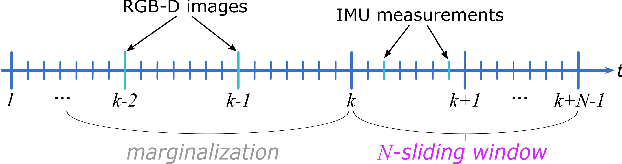
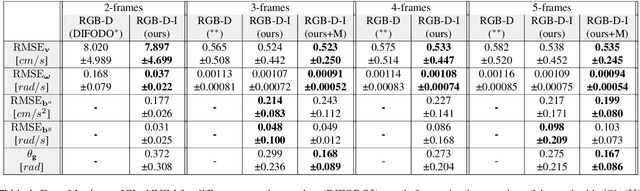
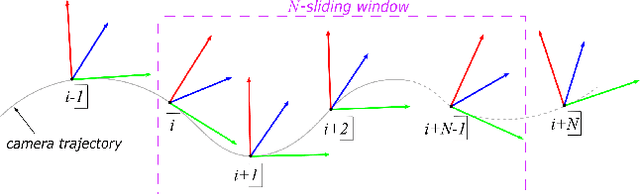
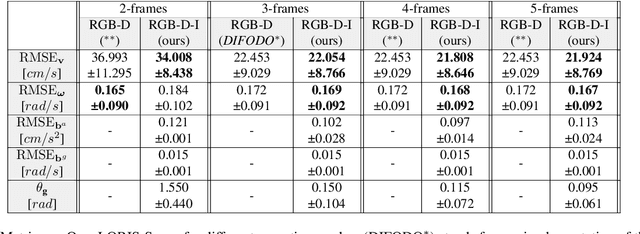
In this paper, we introduce a novel formulation for camera motion estimation that integrates RGB-D images and inertial data through scene flow. Our goal is to accurately estimate the camera motion in a rigid 3D environment, along with the state of the inertial measurement unit (IMU). Our proposed method offers the flexibility to operate as a multi-frame optimization or to marginalize older data, thus effectively utilizing past measurements. To assess the performance of our method, we conducted evaluations using both synthetic data from the ICL-NUIM dataset and real data sequences from the OpenLORIS-Scene dataset. Our results show that the fusion of these two sensors enhances the accuracy of camera motion estimation when compared to using only visual data.