 Add to Chrome
 Add to Firefox
 Add to Edge
Simulate, Reason, Decide: Scientific Reasoning with LLMs for Simulation-Driven Decision Making
Jun 03, 2026
Scientific simulators are increasingly being integrated into LLM-driven systems for high-stakes simulation-driven decision-making. However, existing frameworks primarily use LLMs to generate, calibrate, or execute simulators, treating them as black-box interfaces rather than as structured mechanistic systems that can be reasoned about. As a result, current approaches lack the ability to identify, represent, and reason about the assumptions and mechanisms underlying simulator behavior, limiting transparency, auditability, and decision justification. We introduce MechSim, a mechanism-grounded neuro-symbolic reasoning framework for executable scientific simulators. Unlike prior neuro-symbolic approaches that primarily reason over static symbolic structures, MechSim enables LLM agents to reason about the mechanisms, assumptions, and execution behavior of scientific simulators. Our framework represents simulators through a shared structured schema capturing assumptions, variables, mechanism dependencies, and execution traces. On top of this representation, LLM agents operate as constrained reasoning engines that generate structured, evidence-grounded explanations linking simulator outcomes to their underlying mechanisms. We evaluate our approach across multiple high-stakes domains and show that it improves mechanism-level explanation quality, simulator analysis, and downstream decision-making reliability.

Neural Conformal Control for Time Series Forecasting
Dec 24, 2024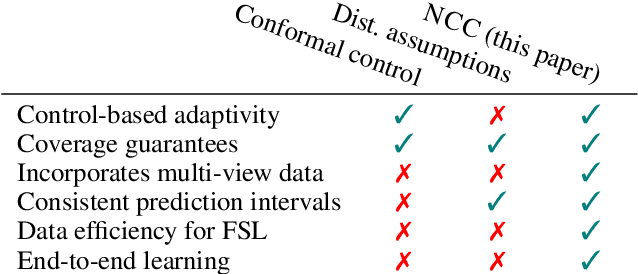
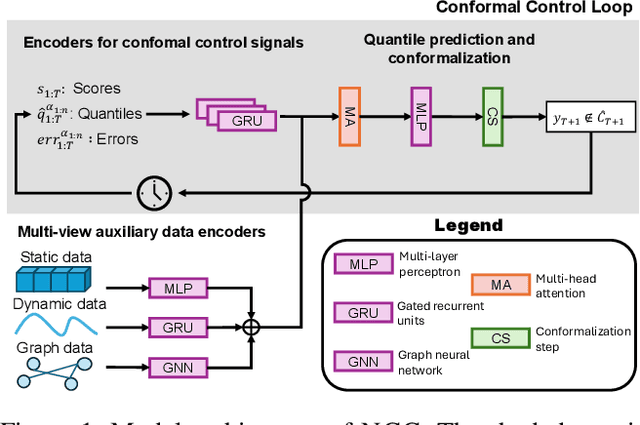
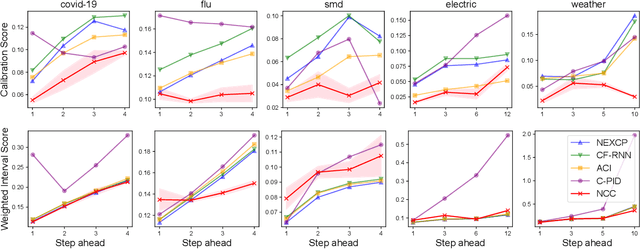
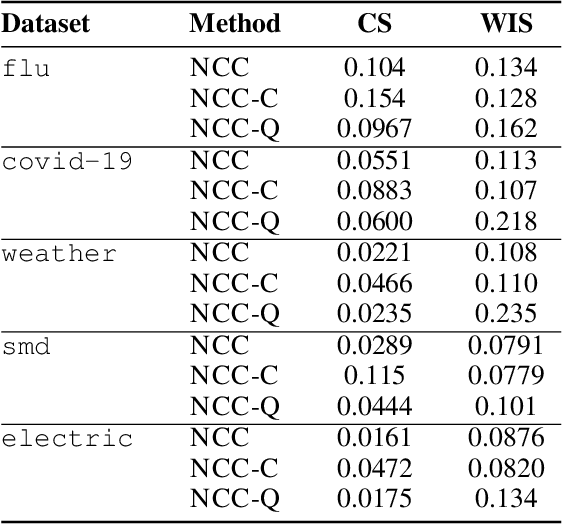
We introduce a neural network conformal prediction method for time series that enhances adaptivity in non-stationary environments. Our approach acts as a neural controller designed to achieve desired target coverage, leveraging auxiliary multi-view data with neural network encoders in an end-to-end manner to further enhance adaptivity. Additionally, our model is designed to enhance the consistency of prediction intervals in different quantiles by integrating monotonicity constraints and leverages data from related tasks to boost few-shot learning performance. Using real-world datasets from epidemics, electric demand, weather, and others, we empirically demonstrate significant improvements in coverage and probabilistic accuracy, and find that our method is the only one that combines good calibration with consistency in prediction intervals.