 Add to Chrome
 Add to Firefox
 Add to Edge
PaperTok: Exploring the Use of Generative AI for Creating Short-form Videos for Research Communication
Jan 26, 2026
The dissemination of scholarly research is critical, yet researchers often lack the time and skills to create engaging content for popular media such as short-form videos. To address this gap, we explore the use of generative AI to help researchers transform their academic papers into accessible video content. Informed by a formative study with science communicators and content creators (N=8), we designed PaperTok, an end-to-end system that automates the initial creative labor by generating script options and corresponding audiovisual content from a source paper. Researchers can then refine based on their preferences with further prompting. A mixed-methods user study (N=18) and crowdsourced evaluation (N=100) demonstrate that PaperTok's workflow can help researchers create engaging and informative short-form videos. We also identified the need for more fine-grained controls in the creation process. To this end, we offer implications for future generative tools that support science outreach.

Synthetic Heuristic Evaluation: A Comparison between AI- and Human-Powered Usability Evaluation
Jul 03, 2025Usability evaluation is crucial in human-centered design but can be costly, requiring expert time and user compensation. In this work, we developed a method for synthetic heuristic evaluation using multimodal LLMs' ability to analyze images and provide design feedback. Comparing our synthetic evaluations to those by experienced UX practitioners across two apps, we found our evaluation identified 73% and 77% of usability issues, which exceeded the performance of 5 experienced human evaluators (57% and 63%). Compared to human evaluators, the synthetic evaluation's performance maintained consistent performance across tasks and excelled in detecting layout issues, highlighting potential attentional and perceptual strengths of synthetic evaluation. However, synthetic evaluation struggled with recognizing some UI components and design conventions, as well as identifying across screen violations. Additionally, testing synthetic evaluations over time and accounts revealed stable performance. Overall, our work highlights the performance differences between human and LLM-driven evaluations, informing the design of synthetic heuristic evaluations.
AI-Assisted Causal Pathway Diagram for Human-Centered Design
Mar 12, 2024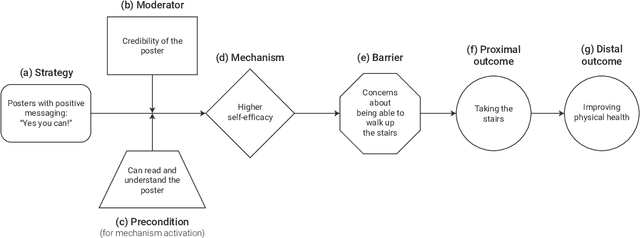
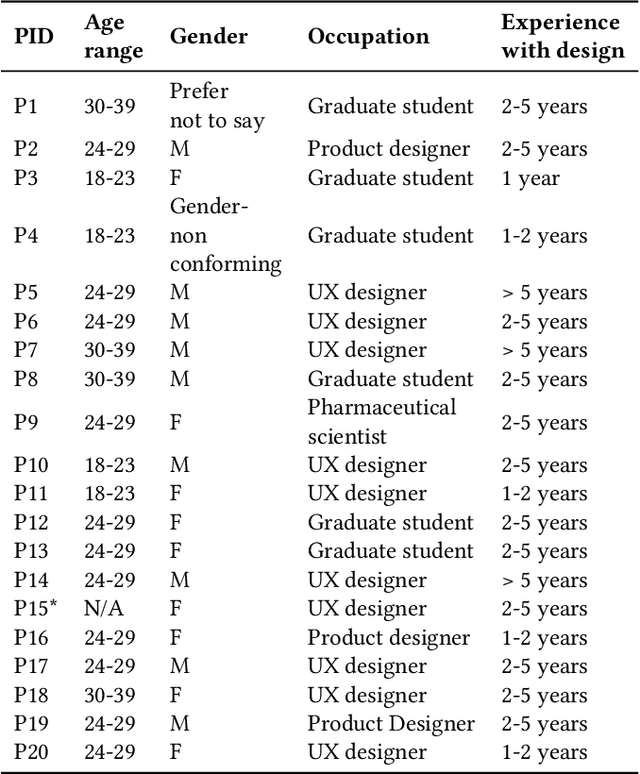
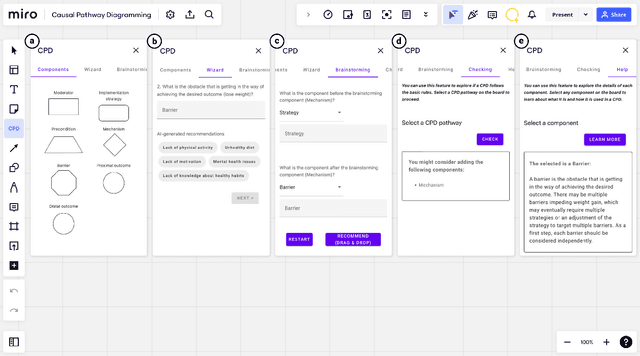
This paper explores the integration of causal pathway diagrams (CPD) into human-centered design (HCD), investigating how these diagrams can enhance the early stages of the design process. A dedicated CPD plugin for the online collaborative whiteboard platform Miro was developed to streamline diagram creation and offer real-time AI-driven guidance. Through a user study with designers (N=20), we found that CPD's branching and its emphasis on causal connections supported both divergent and convergent processes during design. CPD can also facilitate communication among stakeholders. Additionally, we found our plugin significantly reduces designers' cognitive workload and increases their creativity during brainstorming, highlighting the implications of AI-assisted tools in supporting creative work and evidence-based designs.