 Add to Chrome
 Add to Firefox
 Add to Edge
Efficient Channel Autoencoders for Wideband Communications leveraging Walsh-Hadamard interleaving
Jan 16, 2026
This paper investigates how end-to-end (E2E) channel autoencoders (AEs) can achieve energy-efficient wideband communications by leveraging Walsh-Hadamard (WH) interleaved converters. WH interleaving enables high sampling rate analog-digital conversion with reduced power consumption using an analog WH transformation. We demonstrate that E2E-trained neural coded modulation can transparently adapt to the WH-transceiver hardware without requiring algorithmic redesign. Focusing on the short block length regime, we train WH-domain AEs and benchmark them against standard neural and conventional baselines, including 5G Polar codes. We quantify the system-level energy tradeoffs among baseband compute, channel signal-to-noise ratio (SNR), and analog converter power. Our analysis shows that the proposed WH-AE system can approach conventional Polar code SNR performance within 0.14dB while consuming comparable or lower system power. Compared to the best neural baseline, WH-AE achieves, on average, 29% higher energy efficiency (in bit/J) for the same reliability. These findings establish WH-domain learning as a viable path to energy-efficient, high-throughput wideband communications by explicitly balancing compute complexity, SNR, and analog power consumption.

Inter-Cell Interference Rejection Based on Ultrawideband Walsh-Domain Wireless Autoencoding
Jan 16, 2026This paper proposes a novel technique for rejecting partial-in-band inter-cell interference (ICI) in ultrawideband communication systems. We present the design of an end-to-end wireless autoencoder architecture that jointly optimizes the transmitter and receiver encoding/decoding in the Walsh domain to mitigate interference from coexisting narrower-band 5G base stations. By exploiting the orthogonality and self-inverse properties of Walsh functions, the system distributes and learns to encode bit-words across parallel Walsh branches. Through analytical modeling and simulation, we characterize how 5G CPOFDM interference maps into the Walsh domain and identify optimal ratios of transmission frequencies and sampling rate where the end-to-end autoencoder achieves the highest rejection. Experimental results show that the proposed autoencoder achieves up to 12 dB of ICI rejection while maintaining a low block error rate (BLER) for the same baseline channel noise, i.e., baseline Signal-to-Noise-Ratio (SNR) without the interference.
Walsh-domain Neural Network for Power Amplifier Behavioral Modelling and Digital Predistortion
Feb 15, 2024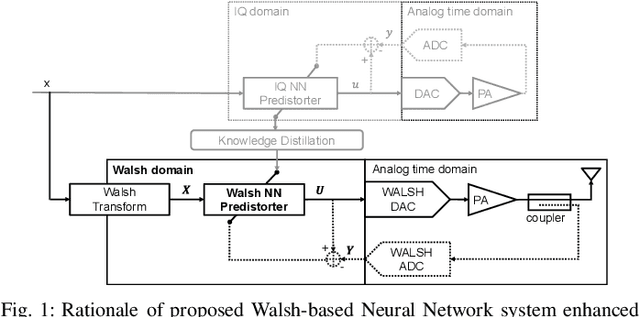
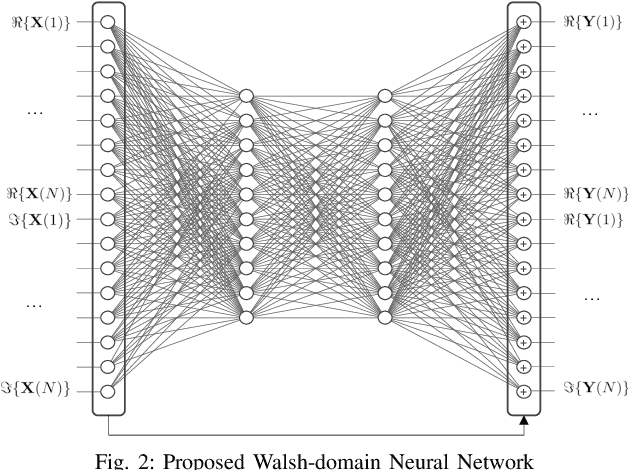
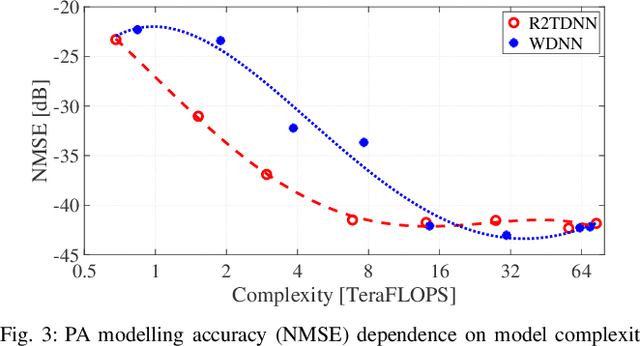
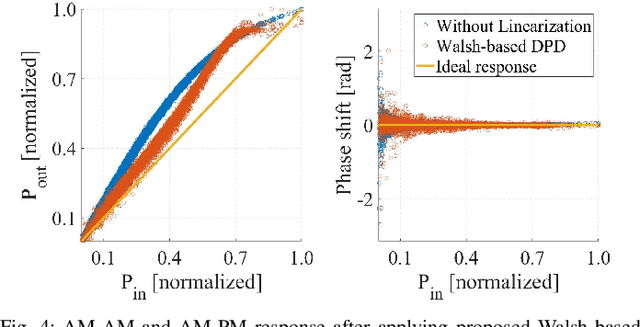
This paper investigates the use of Neural Network (NN) nonlinear modelling for Power Amplifier (PA) linearization in the Walsh-Hadamard transceiver architecture. This novel architecture has recently been proposed for ultra-high bandwidth systems to reduce the transceiver power consumption by extensive parallelization of the digital baseband hardware. The parallelization is achieved by replacing two-dimensional quadrature modulation with multi-dimensional Walsh-Hadamard modulation. The open research question for this architecture is whether conventional baseband signal processing algorithms can be similarly parallelized while retaining their performance. A key baseband algorithm, digital predistortion using NN models for PA linearization, will be adapted to the parallel Walsh architecture. A straighforward parallelization of the state-of-the-art NN architecture is extended with a cross-domain Knowledge Distillation pre-training method to achieve linearization performance on par with the quadrature implementation. This result paves the way for the entire baseband processing chain to be adapted into ultra-high bandwidth, low-power Walsh transceivers.