 Add to Chrome
 Add to Firefox
 Add to Edge
A Longitudinal, Multinational, and Multilingual Corpus of News Coverage of the Russo-Ukrainian War
Jan 22, 2026
We introduce DNIPRO, a novel longitudinal corpus of 246K news articles documenting the Russo-Ukrainian war from Feb 2022 to Aug 2024, spanning eleven media outlets across five nation states (Russia, Ukraine, U.S., U.K., and China) and three languages (English, Russian, and Mandarin Chinese). This multilingual resource features consistent and comprehensive metadata, and multiple types of annotation with rigorous human evaluations for downstream tasks relevant to systematic transnational analyses of contentious wartime discourse. DNIPRO's distinctive value lies in its inclusion of competing geopolitical perspectives, making it uniquely suited for studying narrative divergence, media framing, and information warfare. To demonstrate its utility, we include use case experiments using stance detection, sentiment analysis, topical framing, and contradiction analysis of major conflict events within the larger war. Our explorations reveal how outlets construct competing realities, with coverage exhibiting polarized interpretations that reflect geopolitical interests. Beyond supporting computational journalism research, DNIPRO provides a foundational resource for understanding how conflicting narratives emerge and evolve across global information ecosystems.

Class Distillation with Mahalanobis Contrast: An Efficient Training Paradigm for Pragmatic Language Understanding Tasks
May 17, 2025Detecting deviant language such as sexism, or nuanced language such as metaphors or sarcasm, is crucial for enhancing the safety, clarity, and interpretation of online social discourse. While existing classifiers deliver strong results on these tasks, they often come with significant computational cost and high data demands. In this work, we propose \textbf{Cla}ss \textbf{D}istillation (ClaD), a novel training paradigm that targets the core challenge: distilling a small, well-defined target class from a highly diverse and heterogeneous background. ClaD integrates two key innovations: (i) a loss function informed by the structural properties of class distributions, based on Mahalanobis distance, and (ii) an interpretable decision algorithm optimized for class separation. Across three benchmark detection tasks -- sexism, metaphor, and sarcasm -- ClaD outperforms competitive baselines, and even with smaller language models and orders of magnitude fewer parameters, achieves performance comparable to several large language models (LLMs). These results demonstrate ClaD as an efficient tool for pragmatic language understanding tasks that require gleaning a small target class from a larger heterogeneous background.
Paying Attention to Deflections: Mining Pragmatic Nuances for Whataboutism Detection in Online Discourse
Feb 15, 2024
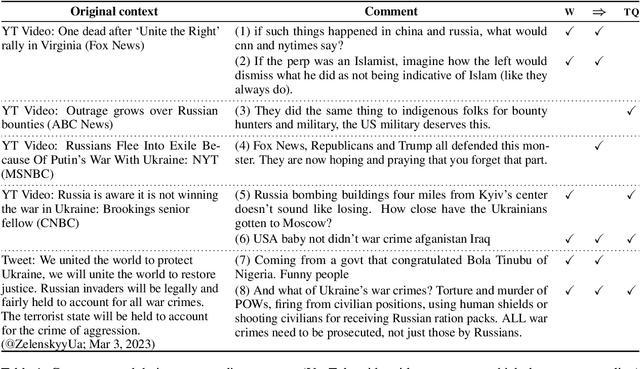
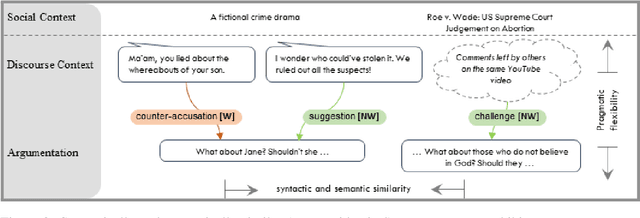

Whataboutism, a potent tool for disrupting narratives and sowing distrust, remains under-explored in quantitative NLP research. Moreover, past work has not distinguished its use as a strategy for misinformation and propaganda from its use as a tool for pragmatic and semantic framing. We introduce new datasets from Twitter and YouTube, revealing overlaps as well as distinctions between whataboutism, propaganda, and the tu quoque fallacy. Furthermore, drawing on recent work in linguistic semantics, we differentiate the `what about' lexical construct from whataboutism. Our experiments bring to light unique challenges in its accurate detection, prompting the introduction of a novel method using attention weights for negative sample mining. We report significant improvements of 4% and 10% over previous state-of-the-art methods in our Twitter and YouTube collections, respectively.