 Add to Chrome
 Add to Firefox
 Add to Edge
Pedestrians play chicken with an autonomous vehicle
Apr 27, 2026
Automated vehicles (AVs) are commonly programmed to yield unconditionally to pedestrians in the interest of safety. However, this design choice can give rise to the Freezing Robot Problem in which pedestrians learn to assert priority at every interaction, causing vehicles to stall and make no progress. The game theoretic Sequential Chicken model has shown that, like human drivers, AVs can resolve this problem by trading credible threats of very small risks of collision or larger risks of less severe invasion of personal space against the value of time due to yielding delays. This paper presents the first demonstration and evaluation of this approach using a real AV with human subjects and shows that pedestrian behavior under experimentally constrained safety conditions can be well fitted by Sequential Chicken, with a low time value of collision, suggestive of their planning to avoid proxemic personal space penalties as well as actual collisions.

OpenPodcar2: a robust, ROS2 vehicle for self-driving research
Apr 27, 2026OpenPodcar2 is a robust, ROS2-interfaced, low-cost, open source hardware and software, autonomous vehicle platform based on an off-the-shelf, hard-canopy, mobility scooter donor vehicle. It is a modification of the previous OpenPodcar design, which extends it with robust electronics and ROS2 interfacing, to enable both research and also potential deployment use cases. The platform consists of (a) hardware components: documented as a bill of materials and build instructions; (b) integration to the general purpose OSH R4 mechatronics board and a Gazebo simulation of the vehicle, both presenting a common ROS2 interface (c) higher-level ROS2 software implementations and configurations of standard robot autonomous planning and control, including the nav2 stack which performs SLAM and enacts commands to drive the vehicle from a current to a desired pose around obstacles. OpenPodcar2 can transport a human passenger or similar load at speeds up to 15km/h, for example for use as a last-mile autonomous taxi service or to transport delivery containers similarly around a city center. It is small and safe enough to be parked in a standard research lab robust enough for some deployment cases. Total build cost was around 7,000USD from new components, or 2,000USD with a used Donor Vehicle. OpenPodcar2 thus provides a research balance between real world utility, safety, cost and robustness.
R4: rapid reproducible robotics research open hardware control system
Feb 15, 2024
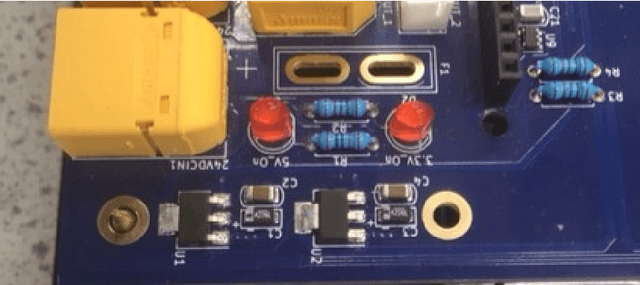
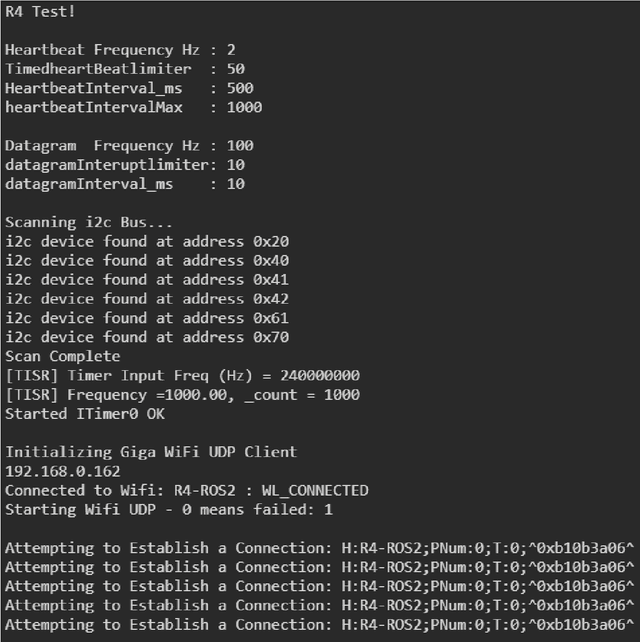
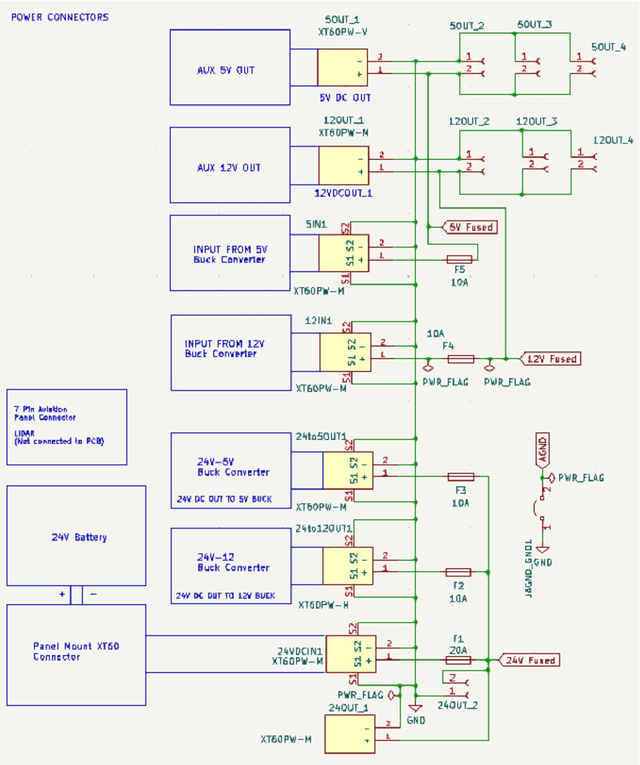
A key component of any robot is the interface between ROS2 software and physical motors. New robots often use arbitrary, messy mixtures of closed and open motor drivers and error-prone physical mountings, wiring, and connectors to interface them. There is a need for a standardizing OSH component to abstract this complexity, as Arduino did for interfacing to smaller components. We present a OSH printed circuit board to solve this problem once and for all. On the high-level side, it interfaces to Arduino Giga -- acting as an unusually large and robust shield -- and thus to existing open source ROS software stacks. On the lower-level side, it interfaces to existing emerging standard open hardware including OSH motor drivers and relays, which can already be used to drive fully open hardware wheeled and arm robots. This enables the creation of a family of standardized, fully open hardware, fully reproducible, research platforms.