 Add to Chrome
 Add to Firefox
 Add to Edge
Dependence of Equilibrium Propagation Training Success on Network Architecture
Jan 29, 2026
The rapid rise of artificial intelligence has led to an unsustainable growth in energy consumption. This has motivated progress in neuromorphic computing and physics-based training of learning machines as alternatives to digital neural networks. Many theoretical studies focus on simple architectures like all-to-all or densely connected layered networks. However, these may be challenging to realize experimentally, e.g. due to connectivity constraints. In this work, we investigate the performance of the widespread physics-based training method of equilibrium propagation for more realistic architectural choices, specifically, locally connected lattices. We train an XY model and explore the influence of architecture on various benchmark tasks, tracking the evolution of spatially distributed responses and couplings during training. Our results show that sparse networks with only local connections can achieve performance comparable to dense networks. Our findings provide guidelines for further scaling up architectures based on equilibrium propagation in realistic settings.

Training Coupled Phase Oscillators as a Neuromorphic Platform using Equilibrium Propagation
Feb 13, 2024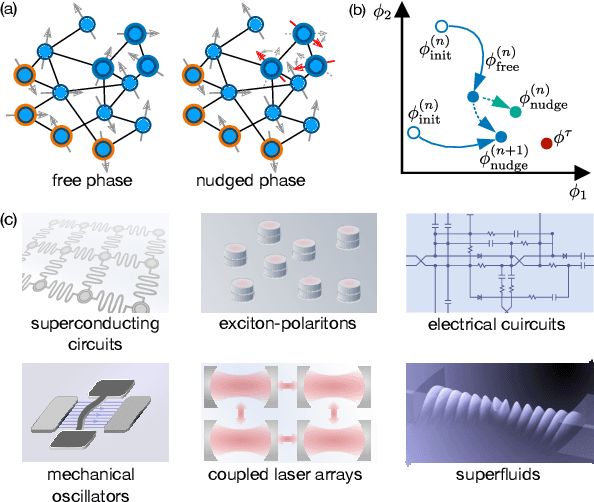
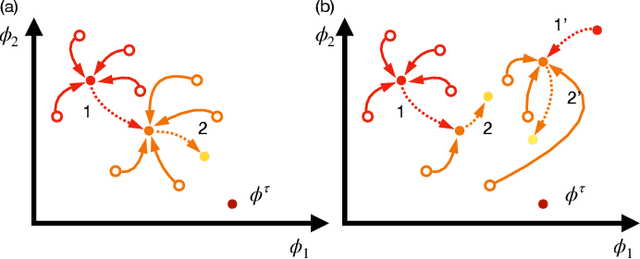
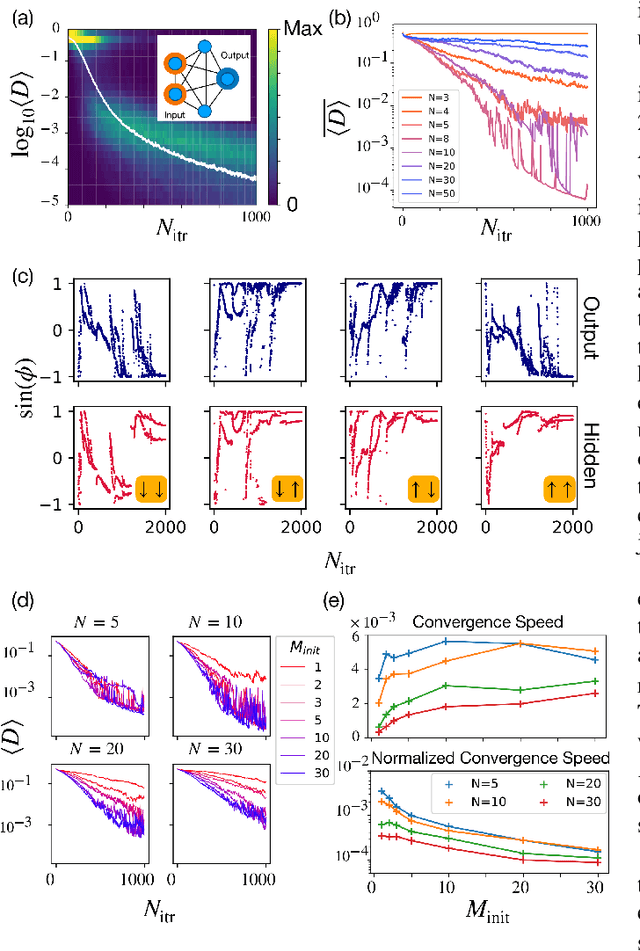
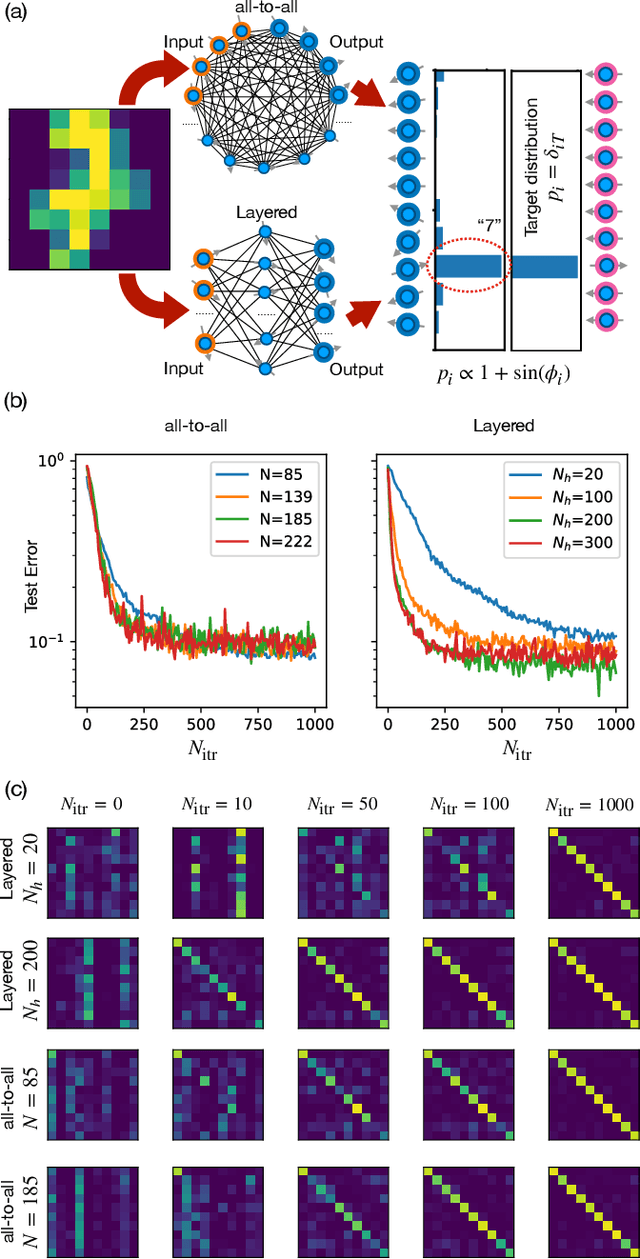
Given the rapidly growing scale and resource requirements of machine learning applications, the idea of building more efficient learning machines much closer to the laws of physics is an attractive proposition. One central question for identifying promising candidates for such neuromorphic platforms is whether not only inference but also training can exploit the physical dynamics. In this work, we show that it is possible to successfully train a system of coupled phase oscillators - one of the most widely investigated nonlinear dynamical systems with a multitude of physical implementations, comprising laser arrays, coupled mechanical limit cycles, superfluids, and exciton-polaritons. To this end, we apply the approach of equilibrium propagation, which permits to extract training gradients via a physical realization of backpropagation, based only on local interactions. The complex energy landscape of the XY/ Kuramoto model leads to multistability, and we show how to address this challenge. Our study identifies coupled phase oscillators as a new general-purpose neuromorphic platform and opens the door towards future experimental implementations.