 Add to Chrome
 Add to Firefox
 Add to Edge
AgenticSciML: Collaborative Multi-Agent Systems for Emergent Discovery in Scientific Machine Learning
Nov 10, 2025
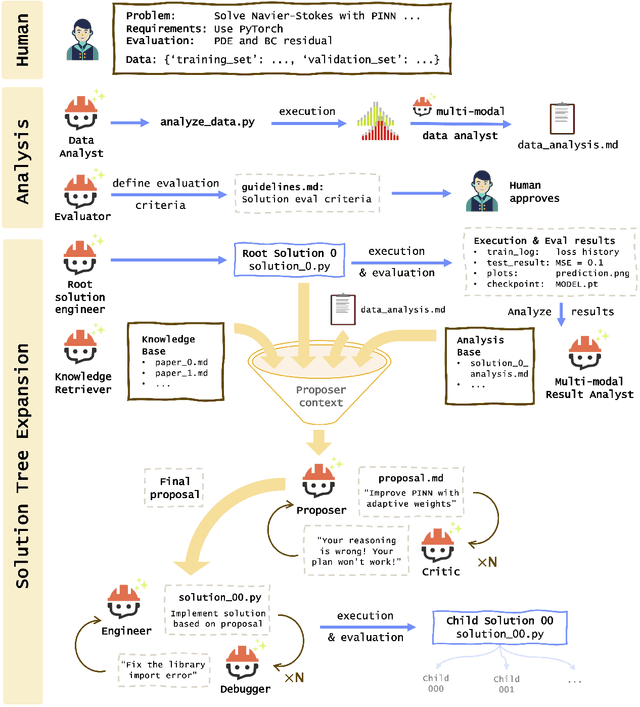
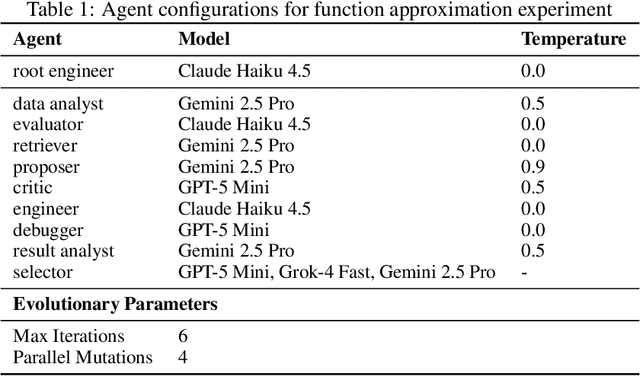
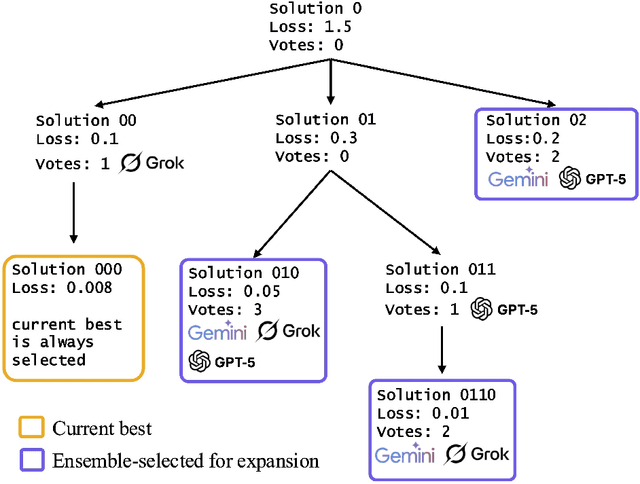
Scientific Machine Learning (SciML) integrates data-driven inference with physical modeling to solve complex problems in science and engineering. However, the design of SciML architectures, loss formulations, and training strategies remains an expert-driven research process, requiring extensive experimentation and problem-specific insights. Here we introduce AgenticSciML, a collaborative multi-agent system in which over 10 specialized AI agents collaborate to propose, critique, and refine SciML solutions through structured reasoning and iterative evolution. The framework integrates structured debate, retrieval-augmented method memory, and ensemble-guided evolutionary search, enabling the agents to generate and assess new hypotheses about architectures and optimization procedures. Across physics-informed learning and operator learning tasks, the framework discovers solution methods that outperform single-agent and human-designed baselines by up to four orders of magnitude in error reduction. The agents produce novel strategies -- including adaptive mixture-of-expert architectures, decomposition-based PINNs, and physics-informed operator learning models -- that do not appear explicitly in the curated knowledge base. These results show that collaborative reasoning among AI agents can yield emergent methodological innovation, suggesting a path toward scalable, transparent, and autonomous discovery in scientific computing.

DeepSeek vs. ChatGPT: A Comparative Study for Scientific Computing and Scientific Machine Learning Tasks
Feb 25, 2025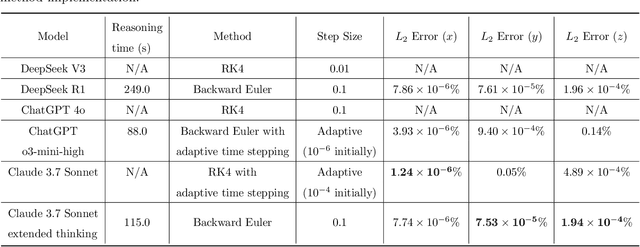
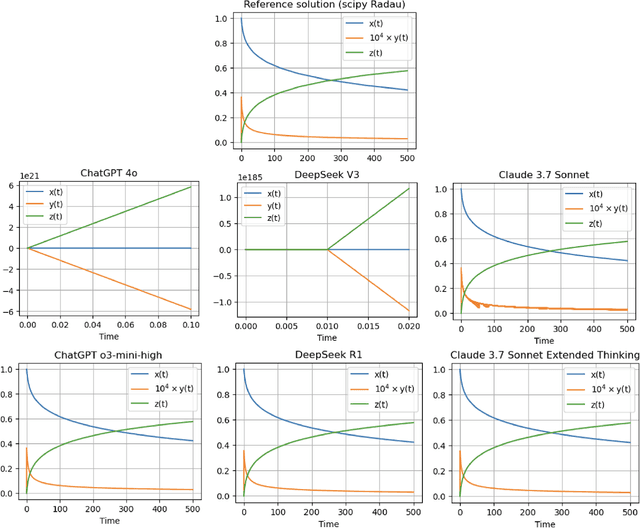
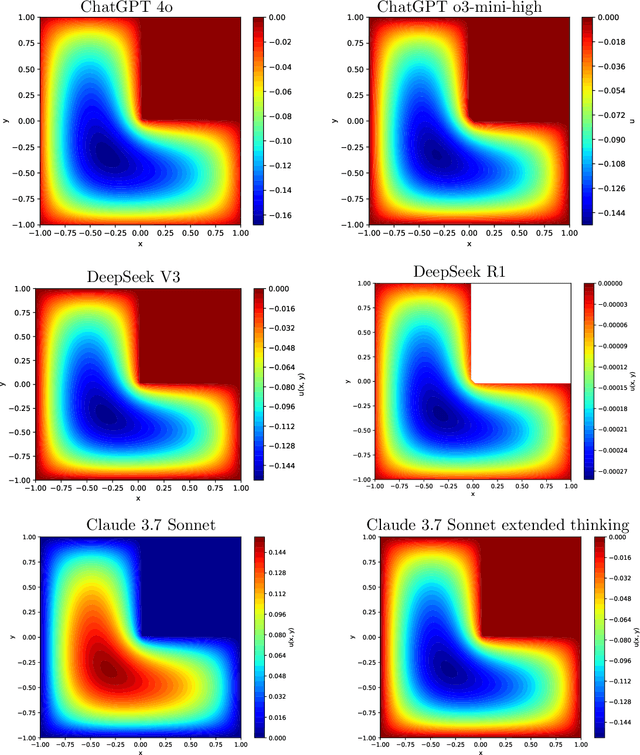
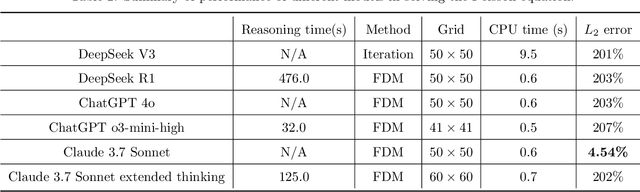
Large Language Models (LLMs) have emerged as powerful tools for tackling a wide range of problems, including those in scientific computing, particularly in solving partial differential equations (PDEs). However, different models exhibit distinct strengths and preferences, resulting in varying levels of performance. In this paper, we compare the capabilities of the most advanced LLMs--ChatGPT and DeepSeek--along with their reasoning-optimized versions in addressing computational challenges. Specifically, we evaluate their proficiency in solving traditional numerical problems in scientific computing as well as leveraging scientific machine learning techniques for PDE-based problems. We designed all our experiments so that a non-trivial decision is required, e.g. defining the proper space of input functions for neural operator learning. Our findings reveal that the latest model, ChatGPT o3-mini-high, usually delivers the most accurate results while also responding significantly faster than its reasoning counterpart, DeepSeek R1. This enhanced speed and accuracy make ChatGPT o3-mini-high a more practical and efficient choice for diverse computational tasks at this juncture.