 Add to Chrome
 Add to Firefox
 Add to Edge
UEOF: A Benchmark Dataset for Underwater Event-Based Optical Flow
Jan 15, 2026
Underwater imaging is fundamentally challenging due to wavelength-dependent light attenuation, strong scattering from suspended particles, turbidity-induced blur, and non-uniform illumination. These effects impair standard cameras and make ground-truth motion nearly impossible to obtain. On the other hand, event cameras offer microsecond resolution and high dynamic range. Nonetheless, progress on investigating event cameras for underwater environments has been limited due to the lack of datasets that pair realistic underwater optics with accurate optical flow. To address this problem, we introduce the first synthetic underwater benchmark dataset for event-based optical flow derived from physically-based ray-traced RGBD sequences. Using a modern video-to-event pipeline applied to rendered underwater videos, we produce realistic event data streams with dense ground-truth flow, depth, and camera motion. Moreover, we benchmark state-of-the-art learning-based and model-based optical flow prediction methods to understand how underwater light transport affects event formation and motion estimation accuracy. Our dataset establishes a new baseline for future development and evaluation of underwater event-based perception algorithms. The source code and dataset for this project are publicly available at https://robotic-vision-lab.github.io/ueof.

Inertia-Informed Orientation Priors for Event-Based Optical Flow Estimation
Nov 17, 2025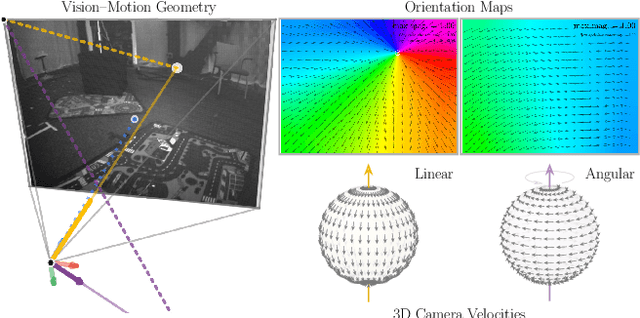
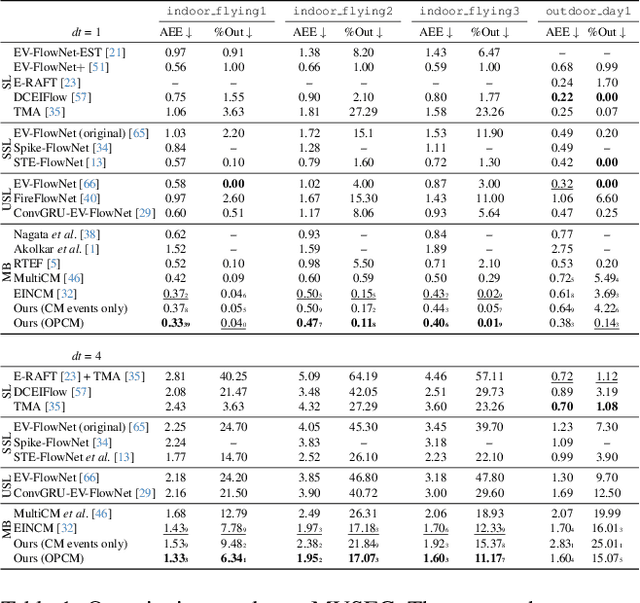
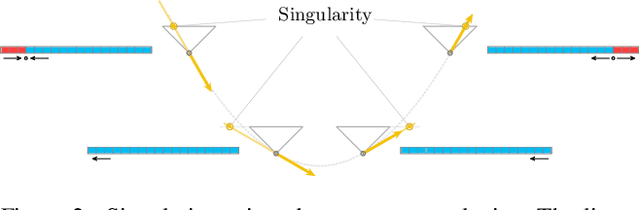
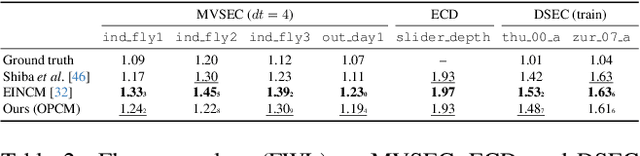
Event cameras, by virtue of their working principle, directly encode motion within a scene. Many learning-based and model-based methods exist that estimate event-based optical flow, however the temporally dense yet spatially sparse nature of events poses significant challenges. To address these issues, contrast maximization (CM) is a prominent model-based optimization methodology that estimates the motion trajectories of events within an event volume by optimally warping them. Since its introduction, the CM framework has undergone a series of refinements by the computer vision community. Nonetheless, it remains a highly non-convex optimization problem. In this paper, we introduce a novel biologically-inspired hybrid CM method for event-based optical flow estimation that couples visual and inertial motion cues. Concretely, we propose the use of orientation maps, derived from camera 3D velocities, as priors to guide the CM process. The orientation maps provide directional guidance and constrain the space of estimated motion trajectories. We show that this orientation-guided formulation leads to improved robustness and convergence in event-based optical flow estimation. The evaluation of our approach on the MVSEC, DSEC, and ECD datasets yields superior accuracy scores over the state of the art.
Secrets of Edge-Informed Contrast Maximization for Event-Based Vision
Sep 22, 2024Event cameras capture the motion of intensity gradients (edges) in the image plane in the form of rapid asynchronous events. When accumulated in 2D histograms, these events depict overlays of the edges in motion, consequently obscuring the spatial structure of the generating edges. Contrast maximization (CM) is an optimization framework that can reverse this effect and produce sharp spatial structures that resemble the moving intensity gradients by estimating the motion trajectories of the events. Nonetheless, CM is still an underexplored area of research with avenues for improvement. In this paper, we propose a novel hybrid approach that extends CM from uni-modal (events only) to bi-modal (events and edges). We leverage the underpinning concept that, given a reference time, optimally warped events produce sharp gradients consistent with the moving edge at that time. Specifically, we formalize a correlation-based objective to aid CM and provide key insights into the incorporation of multiscale and multireference techniques. Moreover, our edge-informed CM method yields superior sharpness scores and establishes new state-of-the-art event optical flow benchmarks on the MVSEC, DSEC, and ECD datasets.