 Add to Chrome
 Add to Firefox
 Add to Edge
All Required, In Order: Phase-Level Evaluation for AI-Human Dialogue in Healthcare and Beyond
Jan 13, 2026
Conversational AI is starting to support real clinical work, but most evaluation methods miss how compliance depends on the full course of a conversation. We introduce Obligatory-Information Phase Structured Compliance Evaluation (OIP-SCE), an evaluation method that checks whether every required clinical obligation is met, in the right order, with clear evidence for clinicians to review. This makes complex rules practical and auditable, helping close the gap between technical progress and what healthcare actually needs. We demonstrate the method in two case studies (respiratory history, benefits verification) and show how phase-level evidence turns policy into shared, actionable steps. By giving clinicians control over what to check and engineers a clear specification to implement, OIP-SCE provides a single, auditable evaluation surface that aligns AI capability with clinical workflow and supports routine, safe use.

HalluciNot: Hallucination Detection Through Context and Common Knowledge Verification
Apr 09, 2025
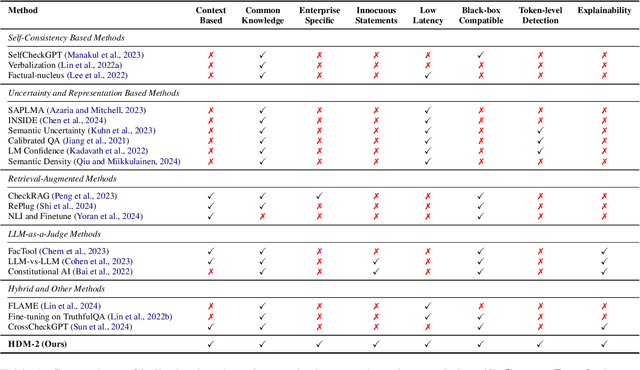
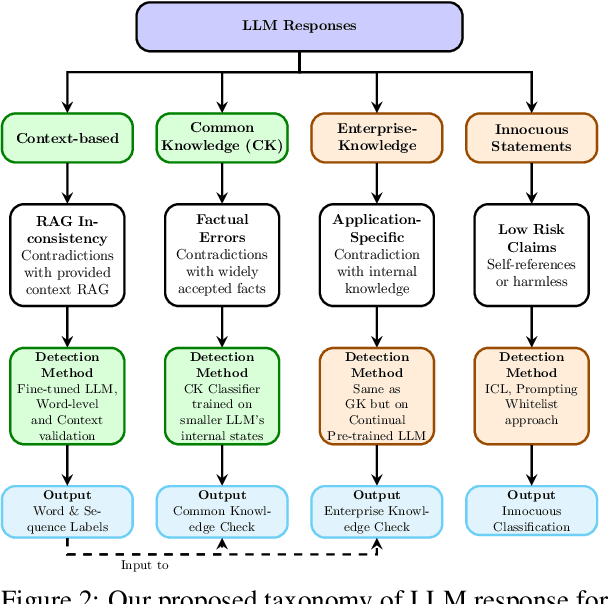
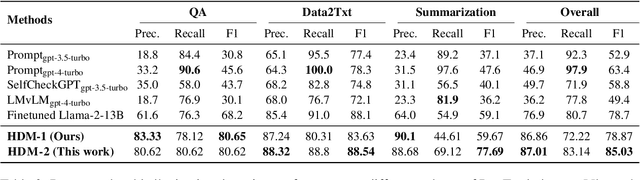
This paper introduces a comprehensive system for detecting hallucinations in large language model (LLM) outputs in enterprise settings. We present a novel taxonomy of LLM responses specific to hallucination in enterprise applications, categorizing them into context-based, common knowledge, enterprise-specific, and innocuous statements. Our hallucination detection model HDM-2 validates LLM responses with respect to both context and generally known facts (common knowledge). It provides both hallucination scores and word-level annotations, enabling precise identification of problematic content. To evaluate it on context-based and common-knowledge hallucinations, we introduce a new dataset HDMBench. Experimental results demonstrate that HDM-2 out-performs existing approaches across RagTruth, TruthfulQA, and HDMBench datasets. This work addresses the specific challenges of enterprise deployment, including computational efficiency, domain specialization, and fine-grained error identification. Our evaluation dataset, model weights, and inference code are publicly available.