 Add to Chrome
 Add to Firefox
 Add to Edge
Quantifying Ergonomics in the Elevate Soft Robotic Suit
Jan 24, 2026
Soft robotic suits have the potential to rehabilitate, assist, and augment the human body. The low weight, cost, and minimal form-factor of these devices make them ideal for daily use by both healthy and impaired individuals. However, challenges associated with data-driven, user-specific, and comfort-first design of human-robot interfaces using soft materials limit their widespread translation and adoption. In this work, we present the quantitative evaluation of ergonomics and comfort of the Elevate suit - a cable driven soft robotic suit that assists shoulder elevation. Using a motion-capture system and force sensors, we measured the suit's ergonomics during assisted shoulder elevation up to 70 degrees. Two 4-hour sessions were conducted with one subject, involving transmitting cable tensions of up to 200N with no discomfort reported. We estimated that the pressure applied to the shoulder during assisted movements was within the range seen in a human grasp (approximately 69.1-85.1kPa), and estimated volumetric compression of <3% and <8% across the torso and upper arm, respectively. These results provide early validation of Elevate's ergonomic design in preparation for future studies with patient groups.

Design and Preliminary Evaluation of a Torso Stabiliser for Individuals with Spinal Cord Injury
Mar 26, 2024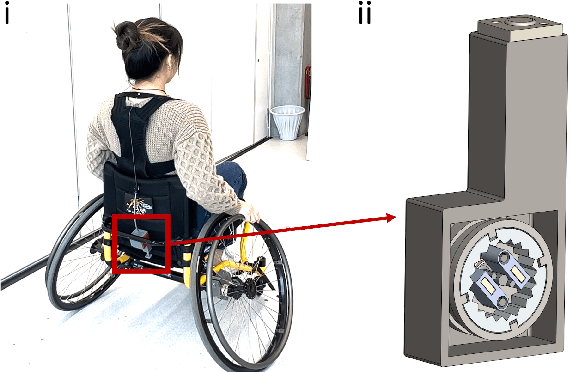
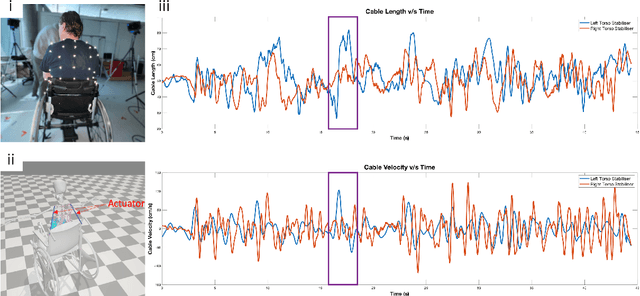
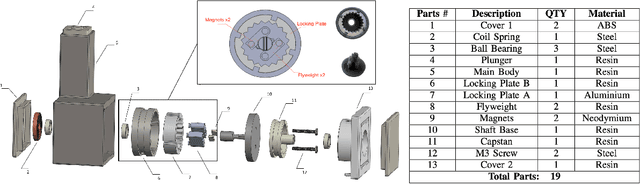
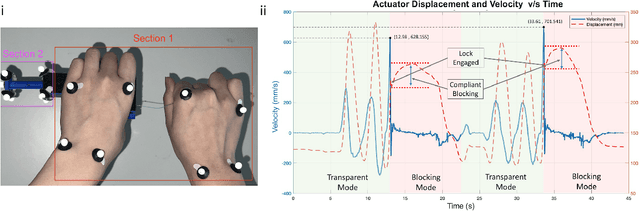
Spinal cord injuries (SCIs) generally result in sensory and mobility impairments, with torso instability being particularly debilitating. Existing torso stabilisers are often rigid and restrictive. This paper presents an early investigation into a non-restrictive 1 degree-of-freedom (DoF) mechanical torso stabiliser inspired by devices such as centrifugal clutches and seat-belt mechanisms. Firstly, the paper presents a motion-capture (MoCap) and OpenSim-based kinematic analysis of the cable-based system to understand requisite device characteristics. The simulated evaluation resulted in the cable-based device to require 55-60cm of unrestricted travel, and to lock at a threshold cable velocity of 80-100cm/sec. Next, the developed 1-DoF device is introduced. The proposed mechanical device is transparent during activities of daily living, and transitions to compliant blocking when incipient fall is detected. Prototype behaviour was then validated using a MoCap-based kinematic analysis to verify non-restrictive movement, reliable transition to blocking, and compliance of the blocking.