 Add to Chrome
 Add to Firefox
 Add to Edge
FAIR-ESI: Feature Adaptive Importance Refinement for Electrophysiological Source Imaging
Jan 22, 2026
An essential technique for diagnosing brain disorders is electrophysiological source imaging (ESI). While model-based optimization and deep learning methods have achieved promising results in this field, the accurate selection and refinement of features remains a central challenge for precise ESI. This paper proposes FAIR-ESI, a novel framework that adaptively refines feature importance across different views, including FFT-based spectral feature refinement, weighted temporal feature refinement, and self-attention-based patch-wise feature refinement. Extensive experiments on two simulation datasets with diverse configurations and two real-world clinical datasets validate our framework's efficacy, highlighting its potential to advance brain disorder diagnosis and offer new insights into brain function.

LV-CadeNet: Long View Feature Convolution-Attention Fusion Encoder-Decoder Network for Clinical MEG Spike Detection
Dec 12, 2024
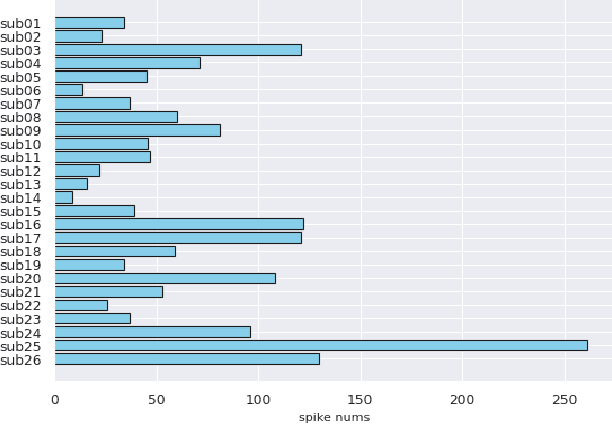
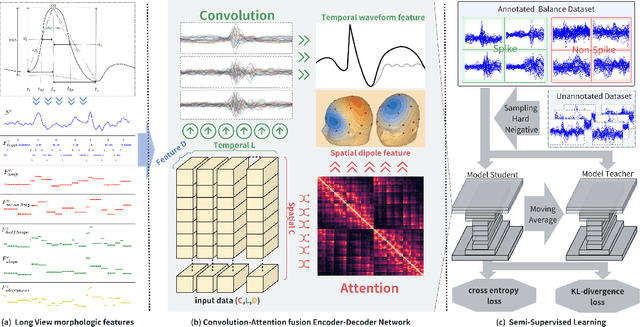
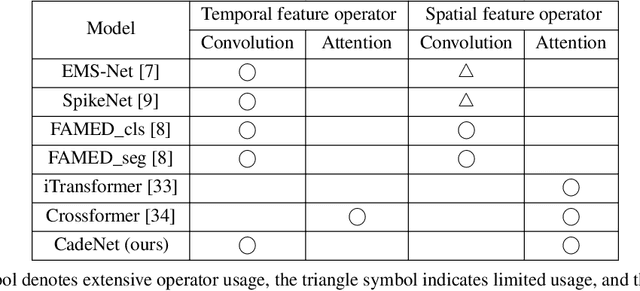
It is widely acknowledged that the epileptic foci can be pinpointed by source localizing interictal epileptic discharges (IEDs) via Magnetoencephalography (MEG). However, manual detection of IEDs, which appear as spikes in MEG data, is extremely labor intensive and requires considerable professional expertise, limiting the broader adoption of MEG technology. Numerous studies have focused on automatic detection of MEG spikes to overcome this challenge, but these efforts often validate their models on synthetic datasets with balanced positive and negative samples. In contrast, clinical MEG data is highly imbalanced, raising doubts on the real-world efficacy of these models. To address this issue, we introduce LV-CadeNet, a Long View feature Convolution-Attention fusion Encoder-Decoder Network, designed for automatic MEG spike detection in real-world clinical scenarios. Beyond addressing the disparity between training data distribution and clinical test data through semi-supervised learning, our approach also mimics human specialists by constructing long view morphological input data. Moreover, we propose an advanced convolution-attention module to extract temporal and spatial features from the input data. LV-CadeNet significantly improves the accuracy of MEG spike detection, boosting it from 42.31\% to 54.88\% on a novel clinical dataset sourced from Sanbo Brain Hospital Capital Medical University. This dataset, characterized by a highly imbalanced distribution of positive and negative samples, accurately represents real-world clinical scenarios.