 Add to Chrome
 Add to Firefox
 Add to Edge
Securing Time in Energy IoT: A Clock-Dynamics-Aware Spatio-Temporal Graph Attention Network for Clock Drift Attacks and Y2K38 Failures
Jan 30, 2026
The integrity of time in distributed Internet of Things (IoT) devices is crucial for reliable operation in energy cyber-physical systems, such as smart grids and microgrids. However, IoT systems are vulnerable to clock drift, time-synchronization manipulation, and timestamp discontinuities, such as the Year 2038 (Y2K38) Unix overflow, all of which disrupt temporal ordering. Conventional anomaly-detection models, which assume reliable timestamps, fail to capture temporal inconsistencies. This paper introduces STGAT (Spatio-Temporal Graph Attention Network), a framework that models both temporal distortion and inter-device consistency in energy IoT systems. STGAT combines drift-aware temporal embeddings and temporal self-attention to capture corrupted time evolution at individual devices, and uses graph attention to model spatial propagation of timing errors. A curvature-regularized latent representation geometrically separates normal clock evolution from anomalies caused by drift, synchronization offsets, and overflow events. Experimental results on energy IoT telemetry with controlled timing perturbations show that STGAT achieves 95.7% accuracy, outperforming recurrent, transformer, and graph-based baselines with significant improvements (d > 1.8, p < 0.001). Additionally, STGAT reduces detection delay by 26%, achieving a 2.3-time-step delay while maintaining stable performance under overflow, drift, and physical inconsistencies.

Tri-LLM Cooperative Federated Zero-Shot Intrusion Detection with Semantic Disagreement and Trust-Aware Aggregation
Jan 30, 2026Federated learning (FL) has become an effective paradigm for privacy-preserving, distributed Intrusion Detection Systems (IDS) in cyber-physical and Internet of Things (IoT) networks, where centralized data aggregation is often infeasible due to privacy and bandwidth constraints. Despite its advantages, most existing FL-based IDS assume closed-set learning and lack mechanisms such as uncertainty estimation, semantic generalization, and explicit modeling of epistemic ambiguity in zero-day attack scenarios. Additionally, robustness to heterogeneous and unreliable clients remains a challenge in practical applications. This paper introduces a semantics-driven federated IDS framework that incorporates language-derived semantic supervision into federated optimization, enabling open-set and zero-shot intrusion detection for previously unseen attack behaviors. The approach constructs semantic attack prototypes using a Tri-LLM ensemble of GPT-4o, DeepSeek-V3, and LLaMA-3-8B, aligning distributed telemetry features with high-level attack concepts. Inter-LLM semantic disagreement is modeled as epistemic uncertainty for zero-day risk estimation, while a trust-aware aggregation mechanism dynamically weights client updates based on reliability. Experimental results show stable semantic alignment across heterogeneous clients and consistent convergence. The framework achieves over 80% zero-shot detection accuracy on unseen attack patterns, improving zero-day discrimination by more than 10% compared to similarity-based baselines, while maintaining low aggregation instability in the presence of unreliable or compromised clients.
TempCharBERT: Keystroke Dynamics for Continuous Access Control Based on Pre-trained Language Models
Nov 11, 2024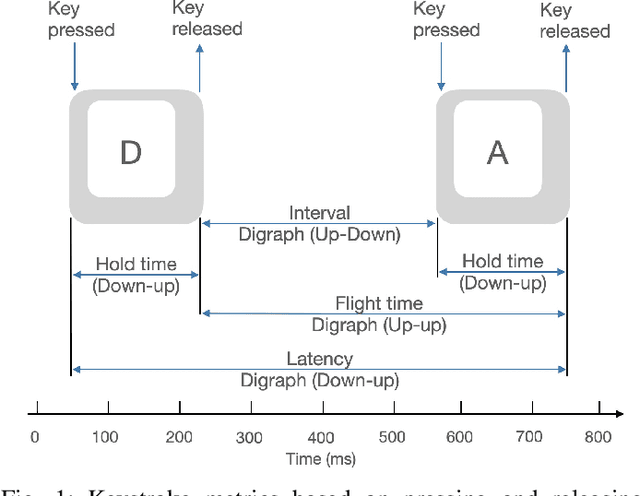
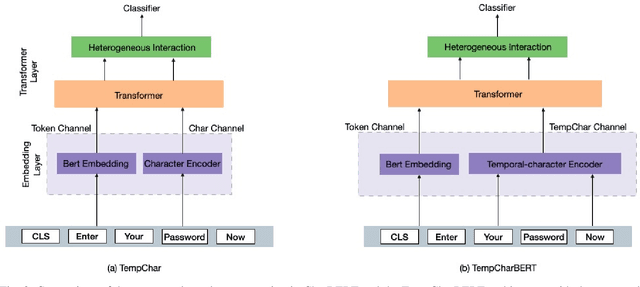
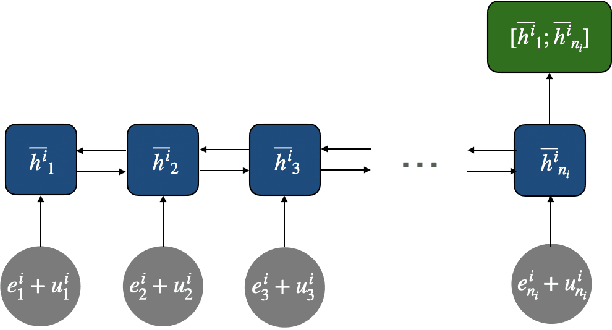
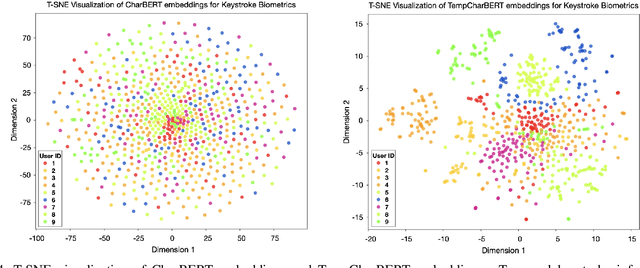
With the widespread of digital environments, reliable authentication and continuous access control has become crucial. It can minimize cyber attacks and prevent frauds, specially those associated with identity theft. A particular interest lies on keystroke dynamics (KD), which refers to the task of recognizing individuals' identity based on their unique typing style. In this work, we propose the use of pre-trained language models (PLMs) to recognize such patterns. Although PLMs have shown high performance on multiple NLP benchmarks, the use of these models on specific tasks requires customization. BERT and RoBERTa, for instance, rely on subword tokenization, and they cannot be directly applied to KD, which requires temporal-character information to recognize users. Recent character-aware PLMs are able to process both subwords and character-level information and can be an alternative solution. Notwithstanding, they are still not suitable to be directly fine-tuned for KD as they are not optimized to account for user's temporal typing information (e.g., hold time and flight time). To overcome this limitation, we propose TempCharBERT, an architecture that incorporates temporal-character information in the embedding layer of CharBERT. This allows modeling keystroke dynamics for the purpose of user identification and authentication. Our results show a significant improvement with this customization. We also showed the feasibility of training TempCharBERT on a federated learning settings in order to foster data privacy.