 Add to Chrome
 Add to Firefox
 Add to Edge
FIRE: Multi-fidelity Regression with Distribution-conditioned In-context Learning using Tabular Foundation Models
Jan 29, 2026
Multi-fidelity (MF) regression often operates in regimes of extreme data imbalance, where the commonly-used Gaussian-process (GP) surrogates struggle with cubic scaling costs and overfit to sparse high-fidelity observations, limiting efficiency and generalization in real-world applications. We introduce FIRE, a training-free MF framework that couples tabular foundation models (TFMs) to perform zero-shot in-context Bayesian inference via a high-fidelity correction model conditioned on the low-fidelity model's posterior predictive distributions. This cross-fidelity information transfer via distributional summaries captures heteroscedastic errors, enabling robust residual learning without model retraining. Across 31 benchmark problems spanning synthetic and real-world tasks (e.g., DrivAerNet, LCBench), FIRE delivers a stronger performance-time trade-off than seven state-of-the-art GP-based or deep learning MF regression methods, ranking highest in accuracy and uncertainty quantification with runtime advantages. Limitations include context window constraints and dependence on the quality of the pre-trained TFM's.

BlendedNet: A Blended Wing Body Aircraft Dataset and Surrogate Model for Aerodynamic Predictions
Sep 10, 2025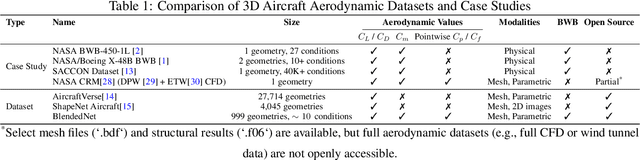
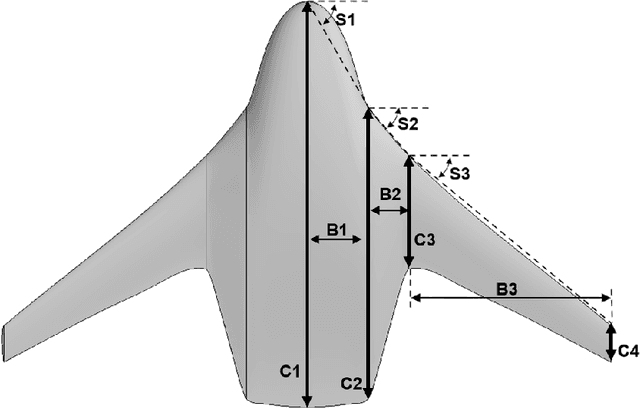
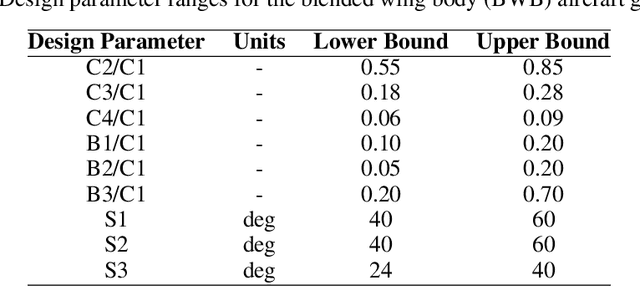
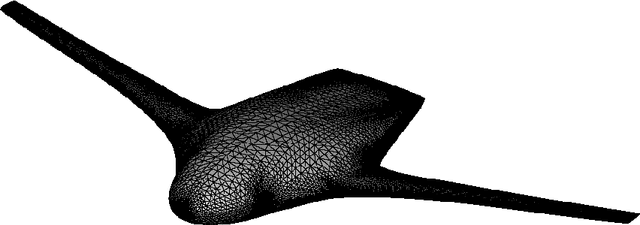
BlendedNet is a publicly available aerodynamic dataset of 999 blended wing body (BWB) geometries. Each geometry is simulated across about nine flight conditions, yielding 8830 converged RANS cases with the Spalart-Allmaras model and 9 to 14 million cells per case. The dataset is generated by sampling geometric design parameters and flight conditions, and includes detailed pointwise surface quantities needed to study lift and drag. We also introduce an end-to-end surrogate framework for pointwise aerodynamic prediction. The pipeline first uses a permutation-invariant PointNet regressor to predict geometric parameters from sampled surface point clouds, then conditions a Feature-wise Linear Modulation (FiLM) network on the predicted parameters and flight conditions to predict pointwise coefficients Cp, Cfx, and Cfz. Experiments show low errors in surface predictions across diverse BWBs. BlendedNet addresses data scarcity for unconventional configurations and enables research on data-driven surrogate modeling for aerodynamic design.
Cooling-Guide Diffusion Model for Battery Cell Arrangement
Mar 14, 2024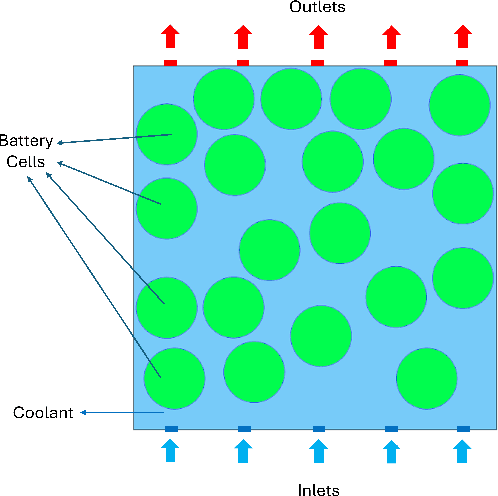
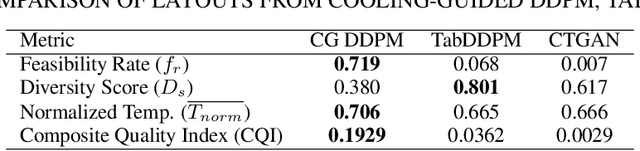
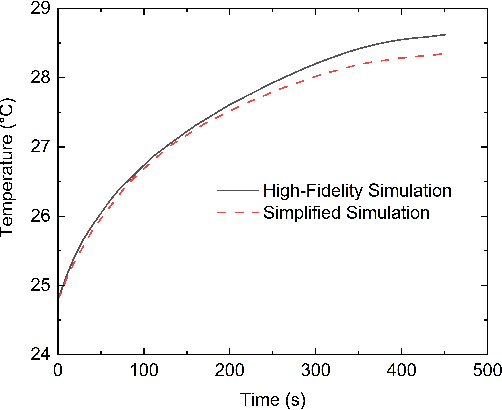
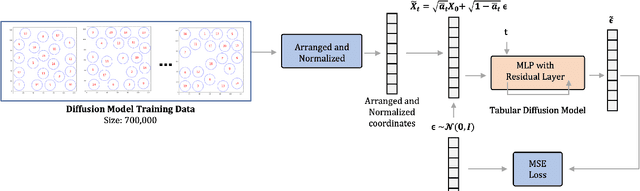
Our study introduces a Generative AI method that employs a cooling-guided diffusion model to optimize the layout of battery cells, a crucial step for enhancing the cooling performance and efficiency of battery thermal management systems. Traditional design processes, which rely heavily on iterative optimization and extensive guesswork, are notoriously slow and inefficient, often leading to suboptimal solutions. In contrast, our innovative method uses a parametric denoising diffusion probabilistic model (DDPM) with classifier and cooling guidance to generate optimized cell layouts with enhanced cooling paths, significantly lowering the maximum temperature of the cells. By incorporating position-based classifier guidance, we ensure the feasibility of generated layouts. Meanwhile, cooling guidance directly optimizes cooling-efficiency, making our approach uniquely effective. When compared to two advanced models, the Tabular Denoising Diffusion Probabilistic Model (TabDDPM) and the Conditional Tabular GAN (CTGAN), our cooling-guided diffusion model notably outperforms both. It is five times more effective than TabDDPM and sixty-six times better than CTGAN across key metrics such as feasibility, diversity, and cooling efficiency. This research marks a significant leap forward in the field, aiming to optimize battery cell layouts for superior cooling efficiency, thus setting the stage for the development of more effective and dependable battery thermal management systems.