 Add to Chrome
 Add to Firefox
 Add to Edge
The Roots of Performance Disparity in Multilingual Language Models: Intrinsic Modeling Difficulty or Design Choices?
Jan 12, 2026
Multilingual language models (LMs) promise broader NLP access, yet current systems deliver uneven performance across the world's languages. This survey examines why these gaps persist and whether they reflect intrinsic linguistic difficulty or modeling artifacts. We organize the literature around two questions: do linguistic disparities arise from representation and allocation choices (e.g., tokenization, encoding, data exposure, parameter sharing) rather than inherent complexity; and which design choices mitigate inequities across typologically diverse languages. We review linguistic features, such as orthography, morphology, lexical diversity, syntax, information density, and typological distance, linking each to concrete modeling mechanisms. Gaps often shrink when segmentation, encoding, and data exposure are normalized, suggesting much apparent difficulty stems from current modeling choices. We synthesize these insights into design recommendations for tokenization, sampling, architectures, and evaluation to support more balanced multilingual LMs.

Categorize Early, Integrate Late: Divergent Processing Strategies in Automatic Speech Recognition
Jan 11, 2026In speech language modeling, two architectures dominate the frontier: the Transformer and the Conformer. However, it remains unknown whether their comparable performance stems from convergent processing strategies or distinct architectural inductive biases. We introduce Architectural Fingerprinting, a probing framework that isolates the effect of architecture on representation, and apply it to a controlled suite of 24 pre-trained encoders (39M-3.3B parameters). Our analysis reveals divergent hierarchies: Conformers implement a "Categorize Early" strategy, resolving phoneme categories 29% earlier in depth and speaker gender by 16% depth. In contrast, Transformers "Integrate Late," deferring phoneme, accent, and duration encoding to deep layers (49-57%). These fingerprints suggest design heuristics: Conformers' front-loaded categorization may benefit low-latency streaming, while Transformers' deep integration may favor tasks requiring rich context and cross-utterance normalization.
In-Context Learning Boosts Speech Recognition via Human-like Adaptation to Speakers and Language Varieties
May 20, 2025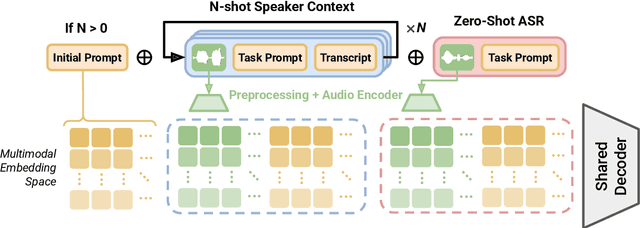

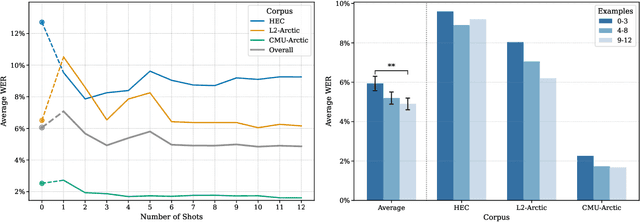
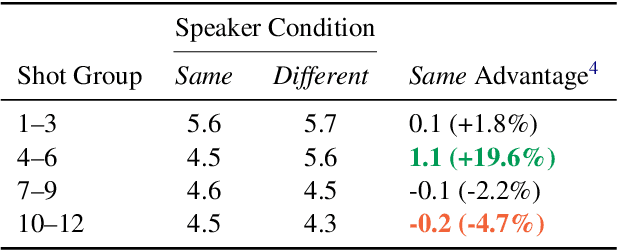
Human listeners readily adjust to unfamiliar speakers and language varieties through exposure, but do these adaptation benefits extend to state-of-the-art spoken language models? We introduce a scalable framework that allows for in-context learning (ICL) in Phi-4 Multimodal using interleaved task prompts and audio-text pairs, and find that as few as 12 example utterances (~50 seconds) at inference time reduce word error rates by a relative 19.7% (1.2 pp.) on average across diverse English corpora. These improvements are most pronounced in low-resource varieties, when the context and target speaker match, and when more examples are provided--though scaling our procedure yields diminishing marginal returns to context length. Overall, we find that our novel ICL adaptation scheme (1) reveals a similar performance profile to human listeners, and (2) demonstrates consistent improvements to automatic speech recognition (ASR) robustness across diverse speakers and language backgrounds. While adaptation succeeds broadly, significant gaps remain for certain varieties, revealing where current models still fall short of human flexibility. We release our prompts and code on GitHub.
PolyPrompt: Automating Knowledge Extraction from Multilingual Language Models with Dynamic Prompt Generation
Feb 27, 2025Large language models (LLMs) showcase increasingly impressive English benchmark scores, however their performance profiles remain inconsistent across multilingual settings. To address this gap, we introduce PolyPrompt, a novel, parameter-efficient framework for enhancing the multilingual capabilities of LLMs. Our method learns a set of trigger tokens for each language through a gradient-based search, identifying the input query's language and selecting the corresponding trigger tokens which are prepended to the prompt during inference. We perform experiments on two ~1 billion parameter models, with evaluations on the global MMLU benchmark across fifteen typologically and resource diverse languages, demonstrating accuracy gains of 3.7%-19.9% compared to naive and translation-pipeline baselines.
PSST! Prosodic Speech Segmentation with Transformers
Feb 03, 2023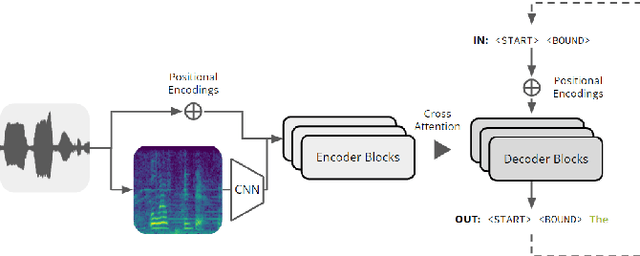
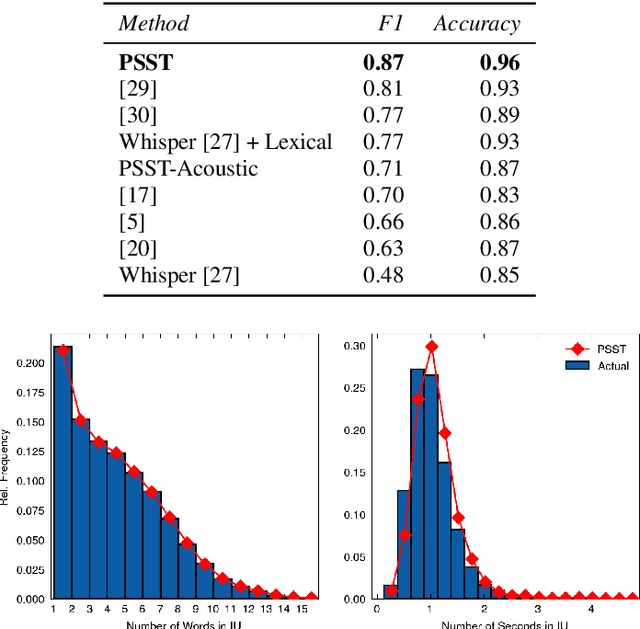
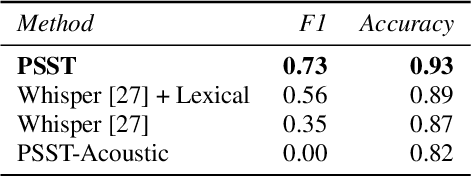
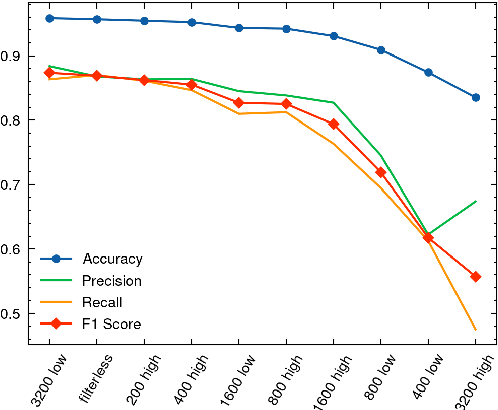
Self-attention mechanisms have enabled transformers to achieve superhuman-level performance on many speech-to-text (STT) tasks, yet the challenge of automatic prosodic segmentation has remained unsolved. In this paper we finetune Whisper, a pretrained STT model, to annotate intonation unit (IU) boundaries by repurposing low-frequency tokens. Our approach achieves an accuracy of 95.8%, outperforming previous methods without the need for large-scale labeled data or enterprise grade compute resources. We also diminish input signals by applying a series of filters, finding that low pass filters at a 3.2 kHz level improve segmentation performance in out of sample and out of distribution contexts. We release our model as both a transcription tool and a baseline for further improvements in prosodic segmentation.