 Add to Chrome
 Add to Firefox
 Add to Edge
NEST: Nested Event Stream Transformer for Sequences of Multisets
Feb 03, 2026
Event stream data often exhibit hierarchical structure in which multiple events co-occur, resulting in a sequence of multisets (i.e., bags of events). In electronic health records (EHRs), for example, medical events are grouped into a sequence of clinical encounters with well-defined temporal structure, but the order and timing of events within each encounter may be unknown or unreliable. Most existing foundation models (FMs) for event stream data flatten this hierarchy into a one-dimensional sequence, leading to (i) computational inefficiency associated with dense attention and learning spurious within-set relationships, and (ii) lower-quality set-level representations from heuristic post-training pooling for downstream tasks. Here, we show that preserving the original hierarchy in the FM architecture provides a useful inductive bias that improves both computational efficiency and representation quality. We then introduce Nested Event Stream Transformer (NEST), a FM for event streams comprised of sequences of multisets. Building on this architecture, we formulate Masked Set Modeling (MSM), an efficient paradigm that promotes improved set-level representation learning. Experiments on real-world multiset sequence data show that NEST captures real-world dynamics while improving both pretraining efficiency and downstream performance.

NoiseTrans: Point Cloud Denoising with Transformers
Apr 24, 2023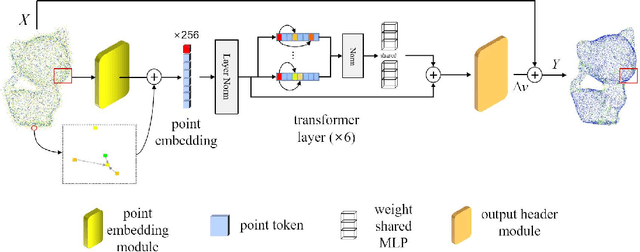
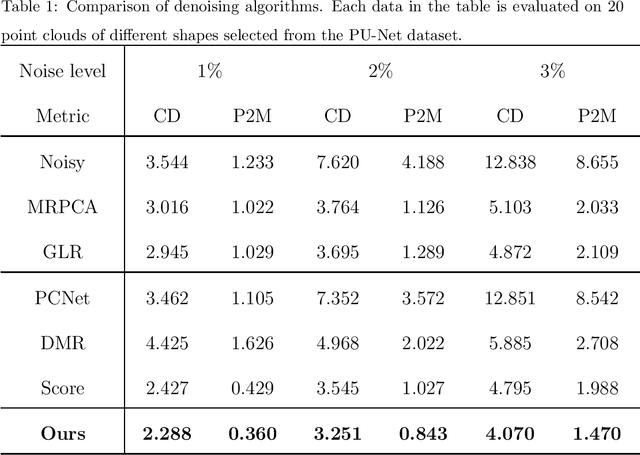
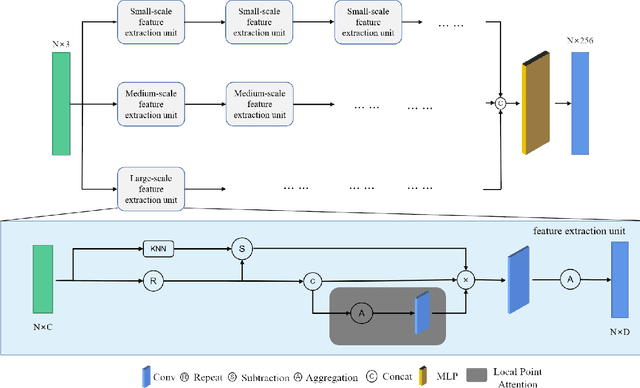
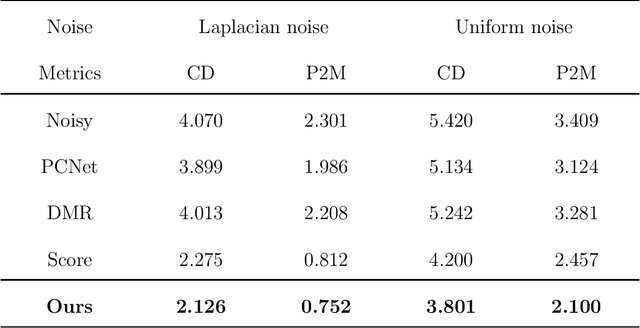
Point clouds obtained from capture devices or 3D reconstruction techniques are often noisy and interfere with downstream tasks. The paper aims to recover the underlying surface of noisy point clouds. We design a novel model, NoiseTrans, which uses transformer encoder architecture for point cloud denoising. Specifically, we obtain structural similarity of point-based point clouds with the assistance of the transformer's core self-attention mechanism. By expressing the noisy point cloud as a set of unordered vectors, we convert point clouds into point embeddings and employ Transformer to generate clean point clouds. To make the Transformer preserve details when sensing the point cloud, we design the Local Point Attention to prevent the point cloud from being over-smooth. In addition, we also propose sparse encoding, which enables the Transformer to better perceive the structural relationships of the point cloud and improve the denoising performance. Experiments show that our model outperforms state-of-the-art methods in various datasets and noise environments.