 Add to Chrome
 Add to Firefox
 Add to Edge
Autonomous Materials Exploration by Integrating Automated Phase Identification and AI-Assisted Human Reasoning
Jan 13, 2026
Autonomous experimentation holds the potential to accelerate materials development by combining artificial intelligence (AI) with modular robotic platforms to explore extensive combinatorial chemical and processing spaces. Such self-driving laboratories can not only increase the throughput of repetitive experiments, but also incorporate human domain expertise to drive the search towards user-defined objectives, including improved materials performance metrics. We present an autonomous materials synthesis extension to SARA, the Scientific Autonomous Reasoning Agent, utilizing phase information provided by an automated probabilistic phase labeling algorithm to expedite the search for targeted phase regions. By incorporating human input into an expanded SARA-H (SARA with human-in-the-loop) framework, we enhance the efficiency of the underlying reasoning process. Using synthetic benchmarks, we demonstrate the efficiency of our AI implementation and show that the human input can contribute to significant improvement in sampling efficiency. We conduct experimental active learning campaigns using robotic processing of thin-film samples of several oxide material systems, including Bi$_2$O$_3$, SnO$_x$, and Bi-Ti-O, using lateral-gradient laser spike annealing to synthesize and kinetically trap metastable phases. We showcase the utility of human-in-the-loop autonomous experimentation for the Bi-Ti-O system, where we identify extensive processing domains that stabilize $δ$-Bi$_2$O$_3$ and Bi$_2$Ti$_2$O$_7$, explore dwell-dependent ternary oxide phase behavior, and provide evidence confirming predictions that cationic substitutional doping of TiO$_2$ with Bi inhibits the unfavorable transformation of the metastable anatase to the ground-state rutile phase. The autonomous methods we have developed enable the discovery of new materials and new understanding of materials synthesis and properties.

Probabilistic Phase Labeling and Lattice Refinement for Autonomous Material Research
Aug 15, 2023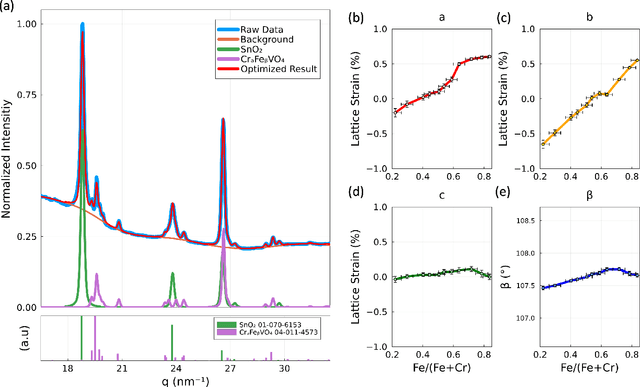
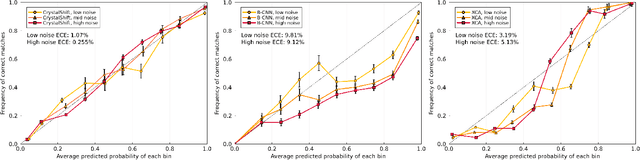
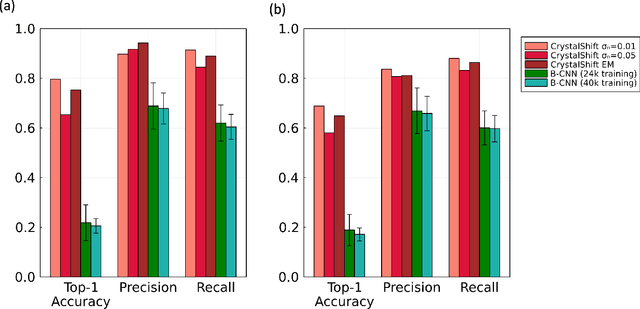
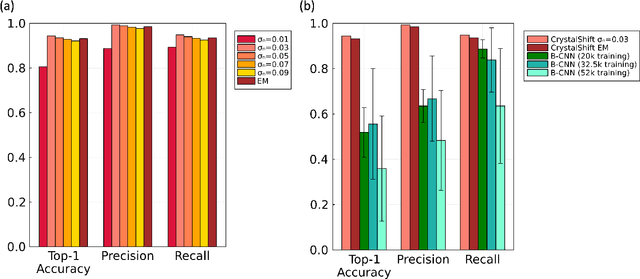
X-ray diffraction (XRD) is an essential technique to determine a material's crystal structure in high-throughput experimentation, and has recently been incorporated in artificially intelligent agents in autonomous scientific discovery processes. However, rapid, automated and reliable analysis method of XRD data matching the incoming data rate remains a major challenge. To address these issues, we present CrystalShift, an efficient algorithm for probabilistic XRD phase labeling that employs symmetry-constrained pseudo-refinement optimization, best-first tree search, and Bayesian model comparison to estimate probabilities for phase combinations without requiring phase space information or training. We demonstrate that CrystalShift provides robust probability estimates, outperforming existing methods on synthetic and experimental datasets, and can be readily integrated into high-throughput experimental workflows. In addition to efficient phase-mapping, CrystalShift offers quantitative insights into materials' structural parameters, which facilitate both expert evaluation and AI-based modeling of the phase space, ultimately accelerating materials identification and discovery.
Autonomous synthesis of metastable materials
Jan 19, 2021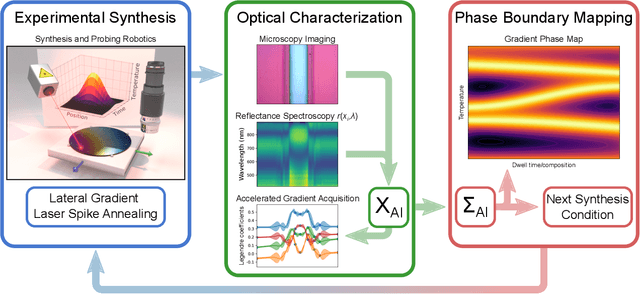
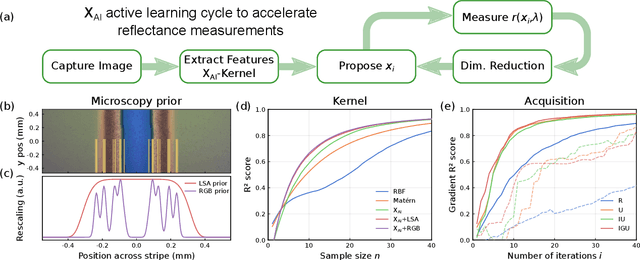
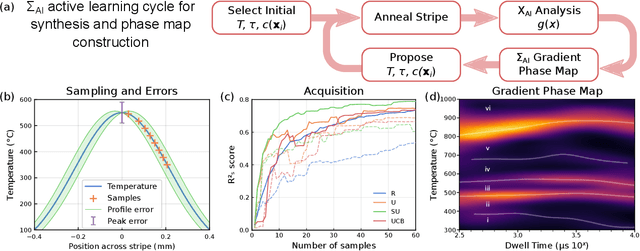
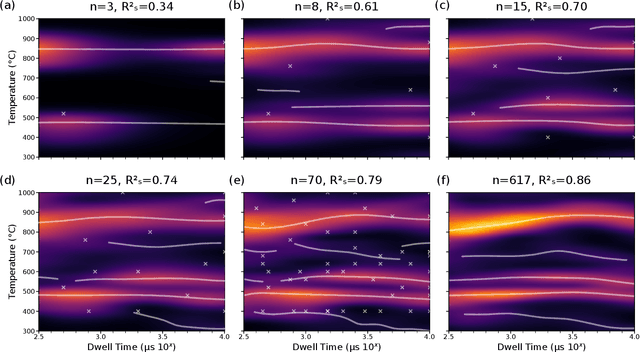
Autonomous experimentation enabled by artificial intelligence (AI) offers a new paradigm for accelerating scientific discovery. Non-equilibrium materials synthesis is emblematic of complex, resource-intensive experimentation whose acceleration would be a watershed for materials discovery and development. The mapping of non-equilibrium synthesis phase diagrams has recently been accelerated via high throughput experimentation but still limits materials research because the parameter space is too vast to be exhaustively explored. We demonstrate accelerated synthesis and exploration of metastable materials through hierarchical autonomous experimentation governed by the Scientific Autonomous Reasoning Agent (SARA). SARA integrates robotic materials synthesis and characterization along with a hierarchy of AI methods that efficiently reveal the structure of processing phase diagrams. SARA designs lateral gradient laser spike annealing (lg-LSA) experiments for parallel materials synthesis and employs optical spectroscopy to rapidly identify phase transitions. Efficient exploration of the multi-dimensional parameter space is achieved with nested active learning (AL) cycles built upon advanced machine learning models that incorporate the underlying physics of the experiments as well as end-to-end uncertainty quantification. With this, and the coordination of AL at multiple scales, SARA embodies AI harnessing of complex scientific tasks. We demonstrate its performance by autonomously mapping synthesis phase boundaries for the Bi$_2$O$_3$ system, leading to orders-of-magnitude acceleration in establishment of a synthesis phase diagram that includes conditions for kinetically stabilizing $\delta$-Bi$_2$O$_3$ at room temperature, a critical development for electrochemical technologies such as solid oxide fuel cells.