 Add to Chrome
 Add to Firefox
 Add to Edge
SparseLaneSTP: Leveraging Spatio-Temporal Priors with Sparse Transformers for 3D Lane Detection
Jan 08, 2026
3D lane detection has emerged as a critical challenge in autonomous driving, encompassing identification and localization of lane markings and the 3D road surface. Conventional 3D methods detect lanes from dense birds-eye-viewed (BEV) features, though erroneous transformations often result in a poor feature representation misaligned with the true 3D road surface. While recent sparse lane detectors have surpassed dense BEV approaches, they completely disregard valuable lane-specific priors. Furthermore, existing methods fail to utilize historic lane observations, which yield the potential to resolve ambiguities in situations of poor visibility. To address these challenges, we present SparseLaneSTP, a novel method that integrates both geometric properties of the lane structure and temporal information into a sparse lane transformer. It introduces a new lane-specific spatio-temporal attention mechanism, a continuous lane representation tailored for sparse architectures as well as temporal regularization. Identifying weaknesses of existing 3D lane datasets, we also introduce a precise and consistent 3D lane dataset using a simple yet effective auto-labeling strategy. Our experimental section proves the benefits of our contributions and demonstrates state-of-the-art performance across all detection and error metrics on existing 3D lane detection benchmarks as well as on our novel dataset.

LaneCPP: Continuous 3D Lane Detection using Physical Priors
Jun 12, 2024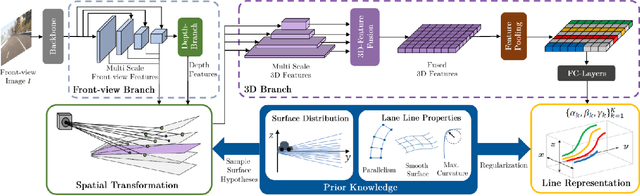
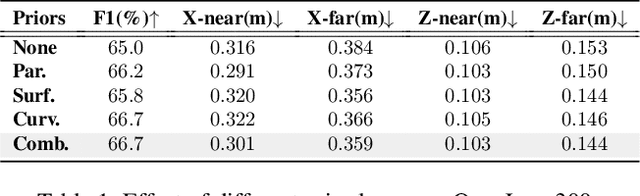
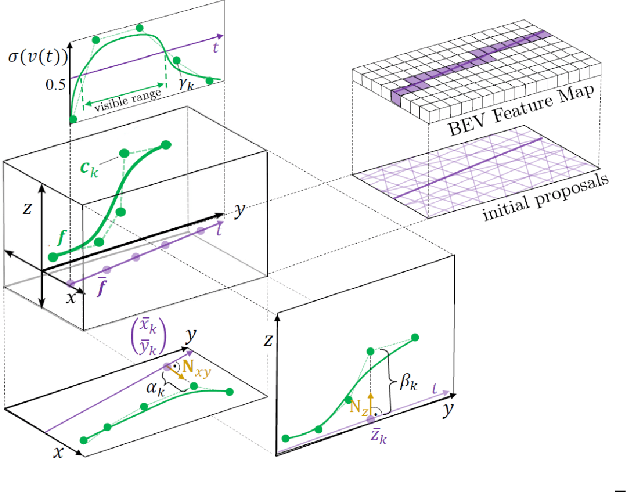
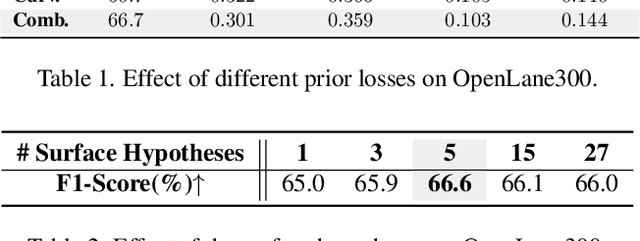
Monocular 3D lane detection has become a fundamental problem in the context of autonomous driving, which comprises the tasks of finding the road surface and locating lane markings. One major challenge lies in a flexible but robust line representation capable of modeling complex lane structures, while still avoiding unpredictable behavior. While previous methods rely on fully data-driven approaches, we instead introduce a novel approach LaneCPP that uses a continuous 3D lane detection model leveraging physical prior knowledge about the lane structure and road geometry. While our sophisticated lane model is capable of modeling complex road structures, it also shows robust behavior since physical constraints are incorporated by means of a regularization scheme that can be analytically applied to our parametric representation. Moreover, we incorporate prior knowledge about the road geometry into the 3D feature space by modeling geometry-aware spatial features, guiding the network to learn an internal road surface representation. In our experiments, we show the benefits of our contributions and prove the meaningfulness of using priors to make 3D lane detection more robust. The results show that LaneCPP achieves state-of-the-art performance in terms of F-Score and geometric errors.