 Add to Chrome
 Add to Firefox
 Add to Edge
Monostatic ISAC Without Full Buffers: Revisiting Spatial Trade-Offs Under Bursty Traffic
Jan 19, 2026
This work investigates the spatial trade-offs arising from the design of the transmit beamformer in a monostatic integrated sensing and communication (ISAC) base station (BS) under bursty traffic, a crucial aspect necessitated by the integration of communication and sensing functionalities in next-generation wireless systems. In this setting, the BS does not always have data available for transmission. This study compares different ISAC policies and reveals the presence of multiple effects influencing ISAC performance: signal-to-noise ratio (SNR) boosting of data-aided strategies compared to pilot-based ones, saturation of the probability of detection in data-aided strategies due to the non-full-buffer assumption, and, finally, directional masking of sensing targets due to the relative position between target and user. Simulation results demonstrate varying impact of these effects on ISAC trade-offs under different operating conditions, thus guiding the design of efficient ISAC transmission strategies.

6G OFDM Communications with High Mobility Transceivers and Scatterers via Angle-Domain Processing and Deep Learning
Jan 19, 2026High-mobility communications, which are crucial for next-generation wireless systems, cause the orthogonal frequency division multiplexing (OFDM) waveform to suffer from strong intercarrier interference (ICI) due to the Doppler effect. In this work, we propose a novel receiver architecture for OFDM that leverages the angular domain to separate multipaths. A block-type pilot is sent to estimate direction-of-arrivals (DoAs), propagation delays, and channel gains of the multipaths. Subsequently, a decision-directed (DD) approach is employed to estimate and iteratively refine the Dopplers. Two different approaches are investigated to provide initial Doppler estimates: an error vector magnitude (EVM)-based method and a deep learning (DL)-based method. Simulation results reveal that the DL-based approach allows for constant bit error rate (BER) performance up to the maximum 6G speed of 1000 km/h.
Robust 6G OFDM High-Mobility Communications Using Delay-Doppler Superimposed Pilots
Dec 18, 2025In this work, a novel receiver architecture for orthogonal frequency division multiplexing (OFDM) communications in 6G high-mobility scenarios is developed. In particular, a delay-Doppler superimposed pilot (SP) scheme is used for channel estimation (CE) by adding a single pilot in the delay-Doppler domain. Unlike previous research on delay-Doppler superimposed pilots in OFDM systems, intercarrier interference (ICI) effects, fractional delays, and Doppler shifts are considered. Consequently, a disjoint fractional delay-Doppler estimation algorithm is derived, and a reduced-complexity equalization method based on the Landweber iteration, which exploits intrinsic channel structure, is proposed. Simulation results reveal that the proposed receiver architecture achieves robust communication performance across various mobility conditions, with speeds of up to 1000 km/h, and increases the effective throughput compared to existing methods.
Disjoint Delay-Doppler Estimation in OTFS ISAC with Deep Learning-aided Path Detection
Apr 29, 2025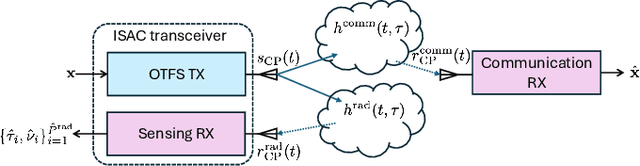
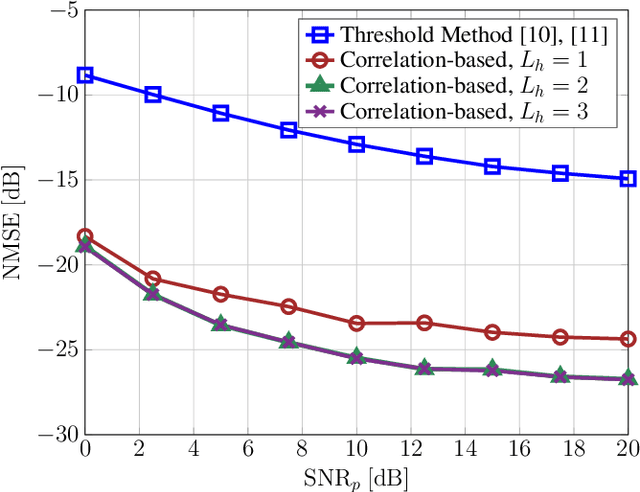
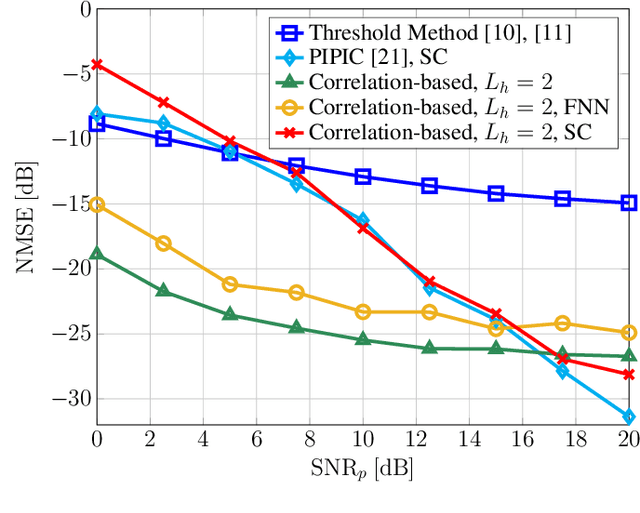
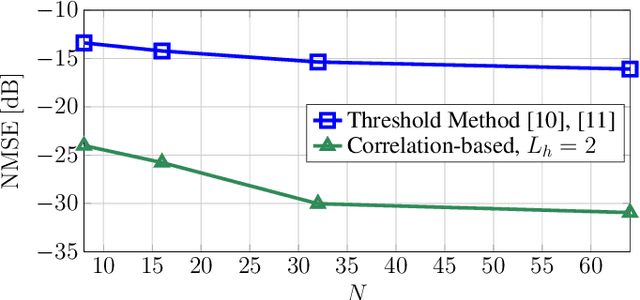
In this work, the problem of communication and radar sensing in orthogonal time frequency space (OTFS) with reduced cyclic prefix (RCP) is addressed. A monostatic integrated sensing and communications (ISAC) system is developed and, it is demonstrated that by leveraging the cyclic shift property inherent in the RCP, a delay-Doppler (DD) channel matrix that encapsulates the effects of propagation delays and Doppler shifts through unitary matrices can be derived. Consequently, a novel low-complexity correlation-based algorithm performing disjoint delay-Doppler estimation is proposed for channel estimation. Subsequently, this estimation approach is adapted to perform radar sensing on backscattered data frames. Moreover, channel estimation is complemented by a deep learning (DL) architecture that improves path detection and accuracy under low signal-to-noise ratio (SNR) conditions, compared to stopping criterion (SC) based multipath detection. Simulation results indicate that the proposed estimation scheme achieves lower normalized mean squared error (NMSE) compared to conventional channel estimation algorithms and sensing performance close to the Cramer-Rao lower bound (CRLB). Furthermore, an iterative data detection algorithm based on matched filter (MF) and combining is developed by exploiting the unitary property of delay-Doppler parameterized matrices. Simulation results reveal that this iterative scheme achieves performance comparable to that of the linear minimum mean squared error (LMMSE) estimator while significantly reducing computational complexity.
Reduced-latency DL-based Fractional Channel Estimation in OTFS Receivers
Mar 11, 2025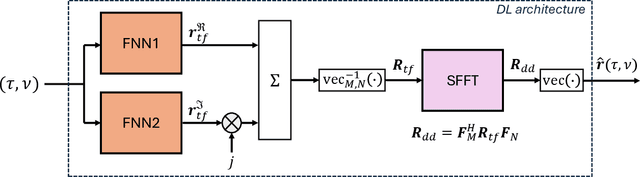
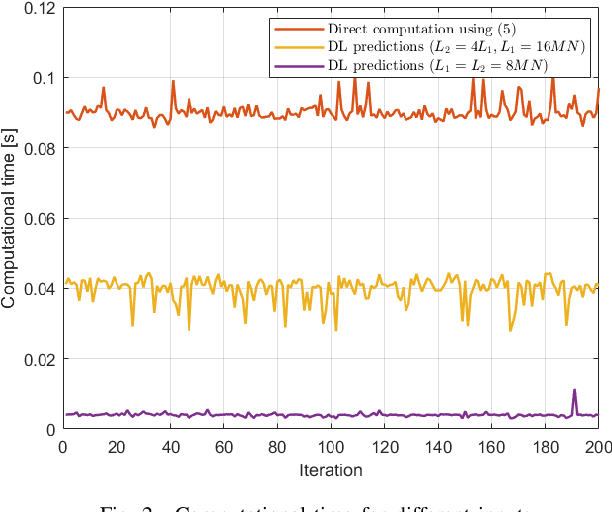
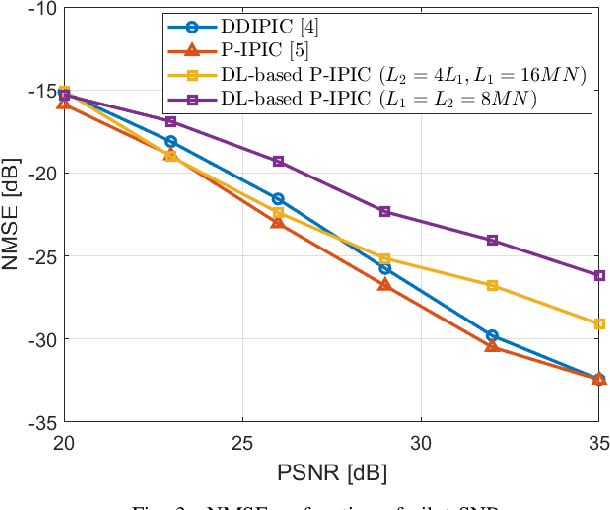
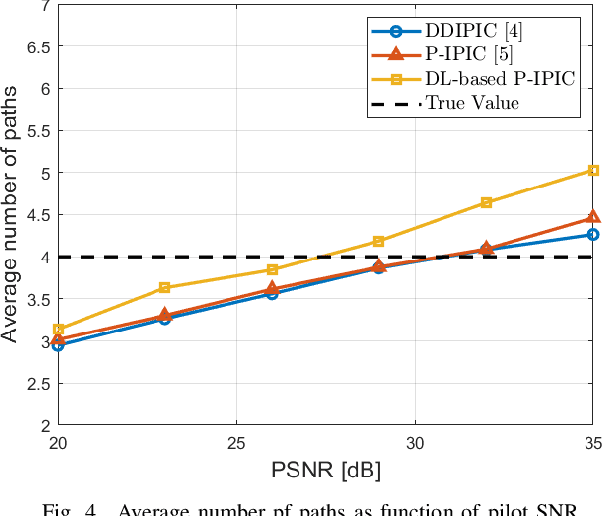
In this work, we propose a deep learning (DL)-based approach that integrates a state-of-the-art algorithm with a time-frequency (TF) learning framework to minimize overall latency. Meeting the stringent latency requirements of 6G orthogonal time-frequency space (OTFS) systems necessitates low-latency designs. The performance of the proposed approach is evaluated under challenging conditions: low delay and Doppler resolutions caused by limited time and frequency resources, and significant interpath interference (IPI) due to poor separability of propagation paths in the delay-Doppler (DD) domain. Simulation results demonstrate that the proposed method achieves high estimation accuracy while reducing latency by approximately 55\% during the maximization process. However, a performance trade-off is observed, with a maximum loss of 3 dB at high pilot SNR values.