 Add to Chrome
 Add to Firefox
 Add to Edge
Low-Power On-Device Gesture Recognition with Einsum Networks
Jan 23, 2026
We design a gesture-recognition pipeline for networks of distributed, resource constrained devices utilising Einsum Networks. Einsum Networks are probabilistic circuits that feature a tractable inference, explainability, and energy efficiency. The system is validated in a scenario of low-power, body-worn, passive Radio Frequency Identification-based gesture recognition. Each constrained device includes task-specific processing units responsible for Received Signal Strength (RSS) and phase processing or Angle of Arrival (AoA) estimation, along with feature extraction, as well as dedicated Einsum hardware that processes the extracted features. The output of all constrained devices is then fused in a decision aggregation module to predict gestures. Experimental results demonstrate that the method outperforms the benchmark models.

On Hardware-efficient Inference in Probabilistic Circuits
May 22, 2024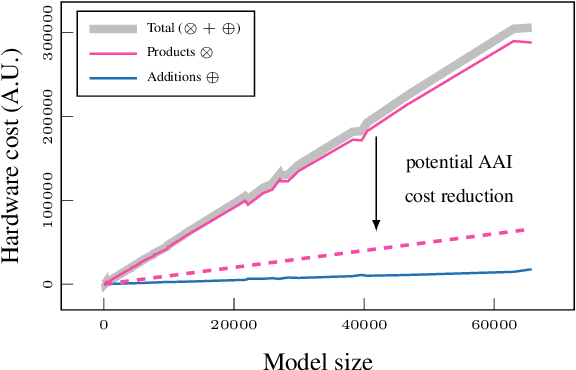
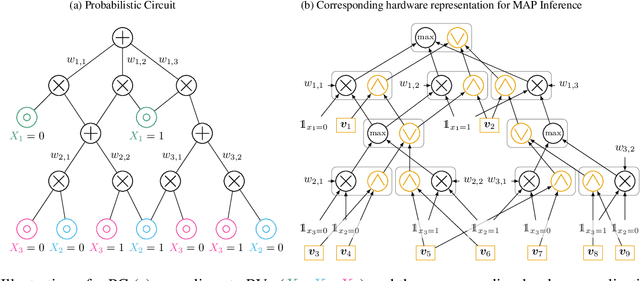
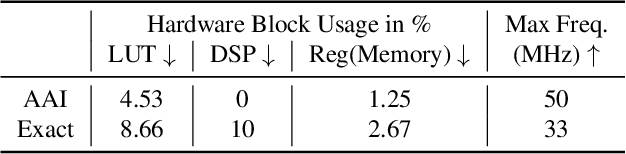
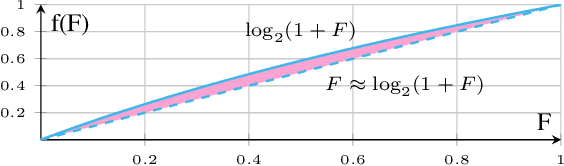
Probabilistic circuits (PCs) offer a promising avenue to perform embedded reasoning under uncertainty. They support efficient and exact computation of various probabilistic inference tasks by design. Hence, hardware-efficient computation of PCs is highly interesting for edge computing applications. As computations in PCs are based on arithmetic with probability values, they are typically performed in the log domain to avoid underflow. Unfortunately, performing the log operation on hardware is costly. Hence, prior work has focused on computations in the linear domain, resulting in high resolution and energy requirements. This work proposes the first dedicated approximate computing framework for PCs that allows for low-resolution logarithm computations. We leverage Addition As Int, resulting in linear PC computation with simple hardware elements. Further, we provide a theoretical approximation error analysis and present an error compensation mechanism. Empirically, our method obtains up to 357x and 649x energy reduction on custom hardware for evidence and MAP queries respectively with little or no computational error.