 Add to Chrome
 Add to Firefox
 Add to Edge
CrackSegFlow: Controllable Flow Matching Synthesis for Generalizable Crack Segmentation with a 50K Image-Mask Benchmark
Jan 08, 2026
Automated crack segmentation is essential for condition assessment, yet deployment is limited by scarce pixel-level labels and domain shift. We present CrackSegFlow, a controllable flow-matching synthesis framework that generates crack images conditioned on binary masks with mask-image alignment. The renderer combines topology-preserving mask injection with edge gating to maintain thin-structure continuity and suppress false positives. A class-conditional flow-matching mask model synthesizes masks with control over crack coverage, enabling balanced, topology-diverse data without manual annotation. We inject masks into crack-free backgrounds to diversify illumination and reduce false positives. On five datasets with a CNN-Transformer backbone, incorporating synthesized pairs improves in-domain performance by 5.37 mIoU and 5.13 F1, and target-guided cross-domain synthesis yields gains of 13.12 mIoU and 14.82 F1 using target mask statistics. We also release CSF-50K, 50,000 image-mask pairs for benchmarking.

LSD-StructureNet: Modeling Levels of Structural Detail in 3D Part Hierarchies
Sep 07, 2021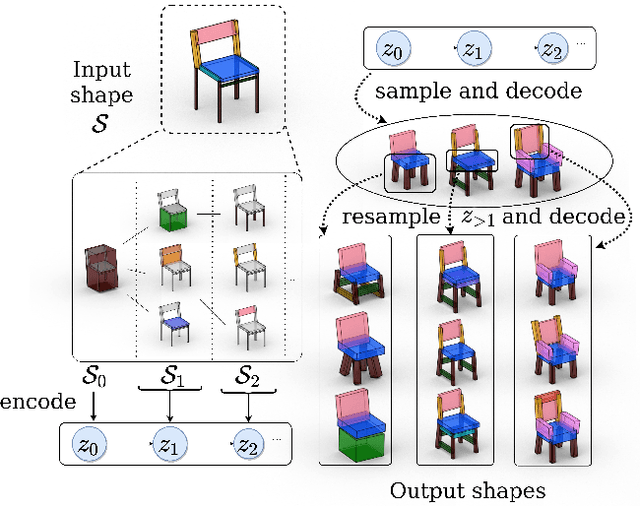
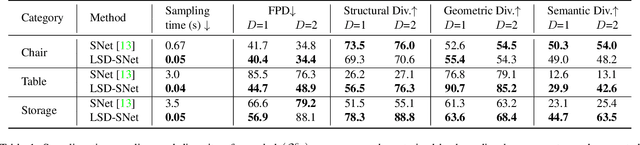
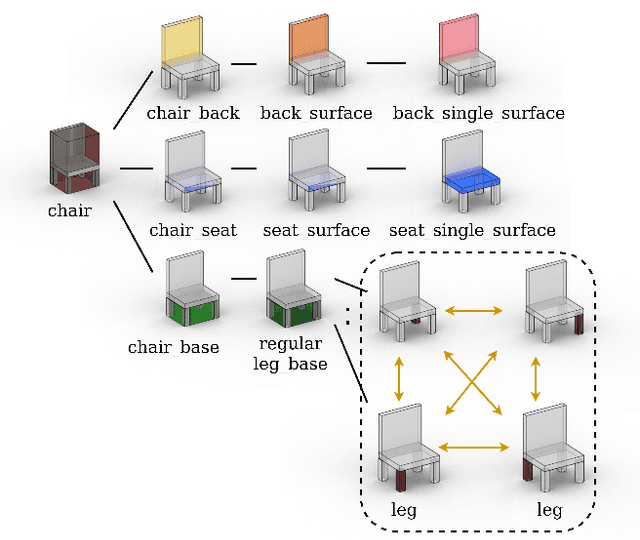
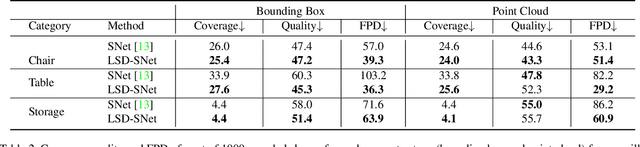
Generative models for 3D shapes represented by hierarchies of parts can generate realistic and diverse sets of outputs. However, existing models suffer from the key practical limitation of modelling shapes holistically and thus cannot perform conditional sampling, i.e. they are not able to generate variants on individual parts of generated shapes without modifying the rest of the shape. This is limiting for applications such as 3D CAD design that involve adjusting created shapes at multiple levels of detail. To address this, we introduce LSD-StructureNet, an augmentation to the StructureNet architecture that enables re-generation of parts situated at arbitrary positions in the hierarchies of its outputs. We achieve this by learning individual, probabilistic conditional decoders for each hierarchy depth. We evaluate LSD-StructureNet on the PartNet dataset, the largest dataset of 3D shapes represented by hierarchies of parts. Our results show that contrarily to existing methods, LSD-StructureNet can perform conditional sampling without impacting inference speed or the realism and diversity of its outputs.
Geometry-Informed Material Recognition
Jul 18, 2016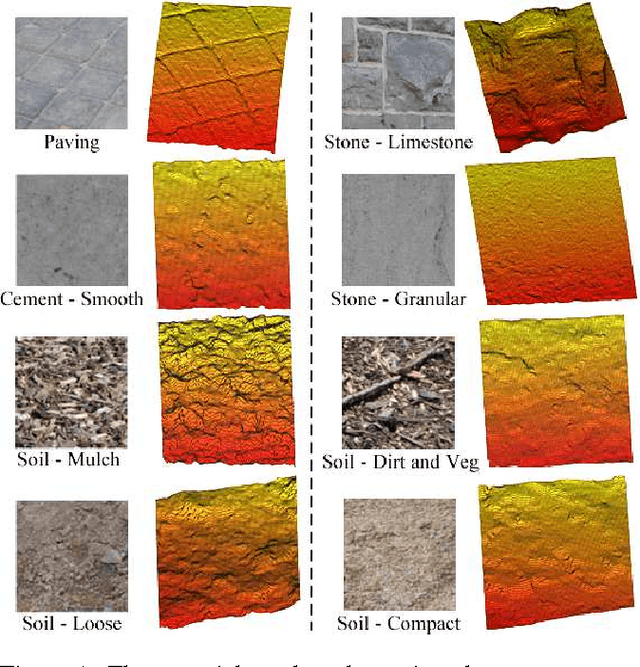

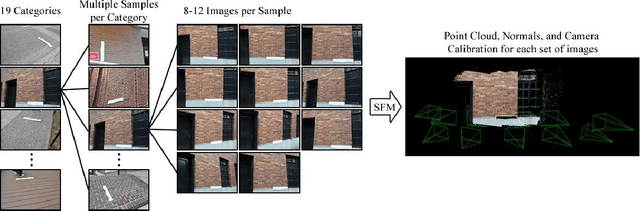

Our goal is to recognize material categories using images and geometry information. In many applications, such as construction management, coarse geometry information is available. We investigate how 3D geometry (surface normals, camera intrinsic and extrinsic parameters) can be used with 2D features (texture and color) to improve material classification. We introduce a new dataset, GeoMat, which is the first to provide both image and geometry data in the form of: (i) training and testing patches that were extracted at different scales and perspectives from real world examples of each material category, and (ii) a large scale construction site scene that includes 160 images and over 800,000 hand labeled 3D points. Our results show that using 2D and 3D features both jointly and independently to model materials improves classification accuracy across multiple scales and viewing directions for both material patches and images of a large scale construction site scene.