 Add to Chrome
 Add to Firefox
 Add to Edge
Atomic Depth Estimation From Noisy Electron Microscopy Data Via Deep Learning
Jan 27, 2026
We present a novel approach for extracting 3D atomic-level information from transmission electron microscopy (TEM) images affected by significant noise. The approach is based on formulating depth estimation as a semantic segmentation problem. We address the resulting segmentation problem by training a deep convolutional neural network to generate pixel-wise depth segmentation maps using simulated data corrupted by synthetic noise. The proposed method was applied to estimate the depth of atomic columns in CeO2 nanoparticles from simulated images and real-world TEM data. Our experiments show that the resulting depth estimates are accurate, calibrated and robust to noise.

Evaluating Unsupervised Denoising Requires Unsupervised Metrics
Oct 12, 2022
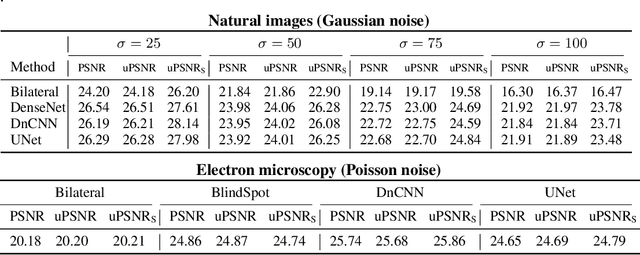
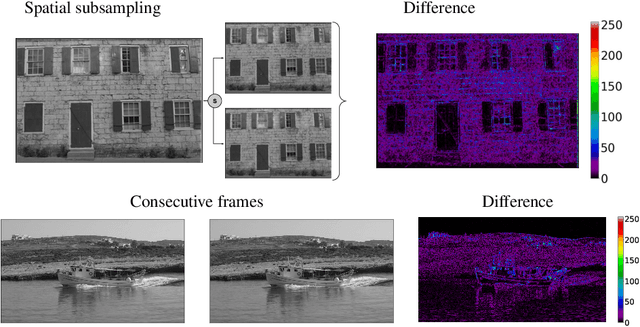
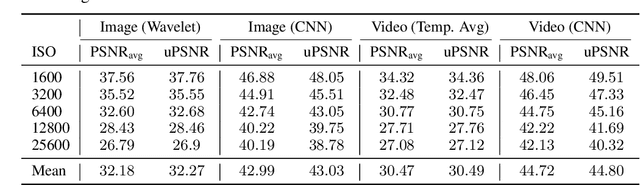
Unsupervised denoising is a crucial challenge in real-world imaging applications. Unsupervised deep-learning methods have demonstrated impressive performance on benchmarks based on synthetic noise. However, no metrics are available to evaluate these methods in an unsupervised fashion. This is highly problematic for the many practical applications where ground-truth clean images are not available. In this work, we propose two novel metrics: the unsupervised mean squared error (MSE) and the unsupervised peak signal-to-noise ratio (PSNR), which are computed using only noisy data. We provide a theoretical analysis of these metrics, showing that they are asymptotically consistent estimators of the supervised MSE and PSNR. Controlled numerical experiments with synthetic noise confirm that they provide accurate approximations in practice. We validate our approach on real-world data from two imaging modalities: videos in raw format and transmission electron microscopy. Our results demonstrate that the proposed metrics enable unsupervised evaluation of denoising methods based exclusively on noisy data.