 Add to Chrome
 Add to Firefox
 Add to Edge
A Multi-Agent Feedback System for Detecting and Describing News Events in Satellite Imagery
Apr 14, 2026
Changes in satellite imagery often occur over multiple time steps. Despite the emergence of bi-temporal change captioning datasets, there is a lack of multi-temporal event captioning datasets (at least two images per sequence) in remote sensing. This gap exists because (1) searching for visible events in satellite imagery and (2) labeling multi-temporal sequences require significant time and labor. To address these challenges, we present SkyScraper, an iterative multi-agent workflow that geocodes news articles and synthesizes captions for corresponding satellite image sequences. Our experiments show that SkyScraper successfully finds 5x more events than traditional geocoding methods, demonstrating that agentic feedback is an effective strategy for surfacing new multi-temporal events in satellite imagery. We apply our framework to a large database of global news articles, curating a new multi-temporal captioning dataset with 5,000 sequences. By automatically identifying imagery related to news events, our work also supports journalism and reporting efforts.

Measuring and Mitigating Hallucinations in Vision-Language Dataset Generation for Remote Sensing
Jan 24, 2025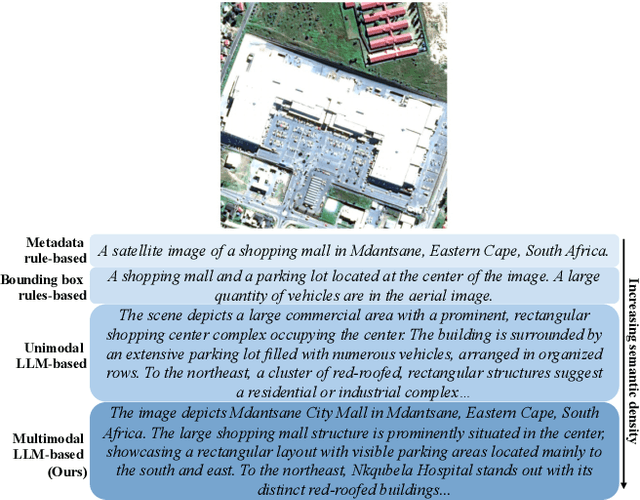
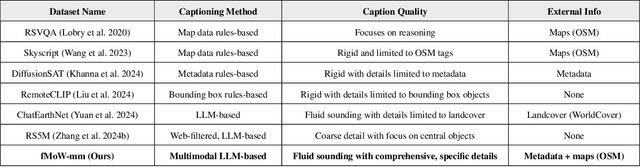
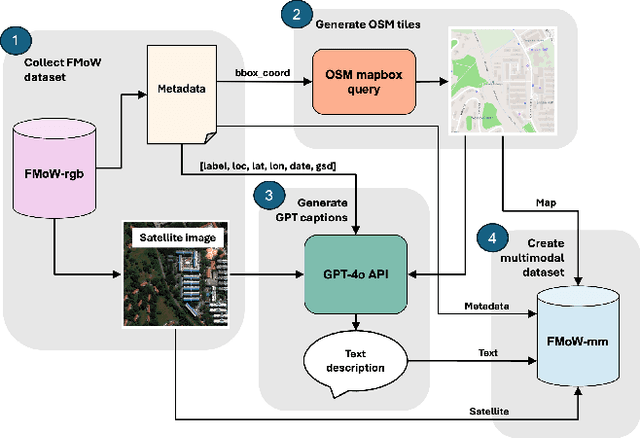
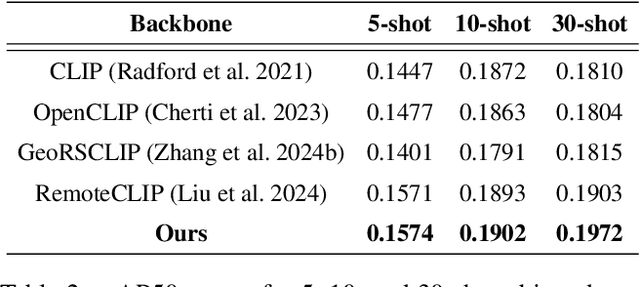
Vision language models have achieved impressive results across various fields. However, adoption in remote sensing remains limited, largely due to the scarcity of paired image-text data. To bridge this gap, synthetic caption generation has gained interest, traditionally relying on rule-based methods that use metadata or bounding boxes. While these approaches provide some description, they often lack the depth needed to capture complex wide-area scenes. Large language models (LLMs) offer a promising alternative for generating more descriptive captions, yet they can produce generic outputs and are prone to hallucination. In this paper, we propose a new method to enhance vision-language datasets for remote sensing by integrating maps as external data sources, enabling the generation of detailed, context-rich captions. Additionally, we present methods to measure and mitigate hallucinations in LLM-generated text. We introduce fMoW-mm, a multimodal dataset incorporating satellite imagery, maps, metadata, and text annotations. We demonstrate its effectiveness for automatic target recognition in few-shot settings, achieving superior performance compared to other vision-language remote sensing datasets.