 Add to Chrome
 Add to Firefox
 Add to Edge
Learning Temporally Consistent Turbulence Between Sparse Snapshots via Diffusion Models
Dec 31, 2025
We investigate the statistical accuracy of temporally interpolated spatiotemporal flow sequences between sparse, decorrelated snapshots of turbulent flow fields using conditional Denoising Diffusion Probabilistic Models (DDPMs). The developed method is presented as a proof-of-concept generative surrogate for reconstructing coherent turbulent dynamics between sparse snapshots, demonstrated on a 2D Kolmogorov Flow, and a 3D Kelvin-Helmholtz Instability (KHI). We analyse the generated flow sequences through the lens of statistical turbulence, examining the time-averaged turbulent kinetic energy spectra over generated sequences, and temporal decay of turbulent structures. For the non-stationary Kelvin-Helmholtz Instability, we assess the ability of the proposed method to capture evolving flow statistics across the most strongly time-varying flow regime. We additionally examine instantaneous fields and physically motivated metrics at key stages of the KHI flow evolution.

Super Resolution for Turbulent Flows in 2D: Stabilized Physics Informed Neural Networks
Apr 15, 2022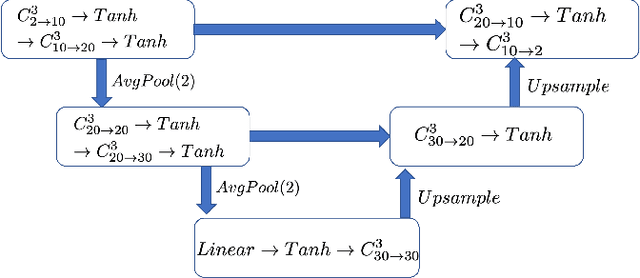

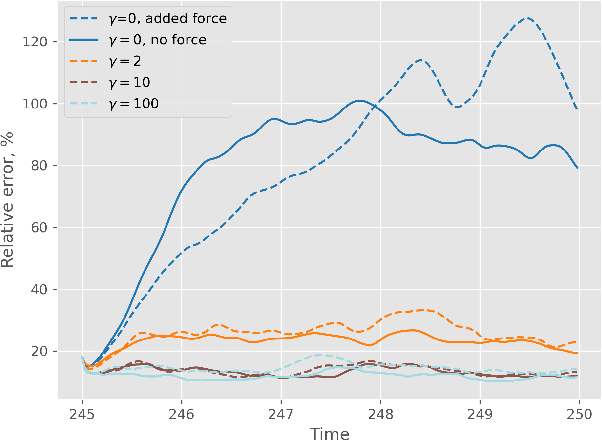

We propose a new design of a neural network for solving a zero shot super resolution problem for turbulent flows. We embed Luenberger-type observer into the network's architecture to inform the network of the physics of the process, and to provide error correction and stabilization mechanisms. In addition, to compensate for decrease of observer's performance due to the presence of unknown destabilizing forcing, the network is designed to estimate the contribution of the unknown forcing implicitly from the data over the course of training. By running a set of numerical experiments, we demonstrate that the proposed network does recover unknown forcing from data and is capable of predicting turbulent flows in high resolution from low resolution noisy observations.