 Add to Chrome
 Add to Firefox
 Add to Edge
LLMize: A Framework for Large Language Model-Based Numerical Optimization
Dec 30, 2025
Large language models (LLMs) have recently shown strong reasoning capabilities beyond traditional language tasks, motivating their use for numerical optimization. This paper presents LLMize, an open-source Python framework that enables LLM-driven optimization through iterative prompting and in-context learning. LLMize formulates optimization as a black-box process in which candidate solutions are generated in natural language, evaluated by an external objective function, and refined over successive iterations using solution-score feedback. The framework supports multiple optimization strategies, including Optimization by Prompting (OPRO) and hybrid LLM-based methods inspired by evolutionary algorithms and simulated annealing. A key advantage of LLMize is the ability to inject constraints, rules, and domain knowledge directly through natural language descriptions, allowing practitioners to define complex optimization problems without requiring expertise in mathematical programming or metaheuristic design. LLMize is evaluated on convex optimization, linear programming, the Traveling Salesman Problem, neural network hyperparameter tuning, and nuclear fuel lattice optimization. Results show that while LLM-based optimization is not competitive with classical solvers for simple problems, it provides a practical and accessible approach for complex, domain-specific tasks where constraints and heuristics are difficult to formalize.

Optimization through In-Context Learning and Iterative LLM Prompting for Nuclear Engineering Design Problems
Mar 25, 2025

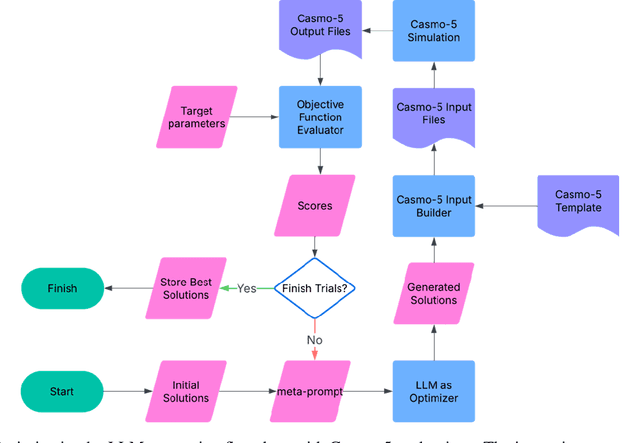

The optimization of nuclear engineering designs, such as nuclear fuel assembly configurations, involves managing competing objectives like reactivity control and power distribution. This study explores the use of Optimization by Prompting, an iterative approach utilizing large language models (LLMs), to address these challenges. The method is straightforward to implement, requiring no hyperparameter tuning or complex mathematical formulations. Optimization problems can be described in plain English, with only an evaluator and a parsing script needed for execution. The in-context learning capabilities of LLMs enable them to understand problem nuances, therefore, they have the potential to surpass traditional metaheuristic optimization methods. This study demonstrates the application of LLMs as optimizers to Boiling Water Reactor (BWR) fuel lattice design, showing the capability of commercial LLMs to achieve superior optimization results compared to traditional methods.