 Add to Chrome
 Add to Firefox
 Add to Edge
On the Relation of State Space Models and Hidden Markov Models
Jan 19, 2026
State Space Models (SSMs) and Hidden Markov Models (HMMs) are foundational frameworks for modeling sequential data with latent variables and are widely used in signal processing, control theory, and machine learning. Despite their shared temporal structure, they differ fundamentally in the nature of their latent states, probabilistic assumptions, inference procedures, and training paradigms. Recently, deterministic state space models have re-emerged in natural language processing through architectures such as S4 and Mamba, raising new questions about the relationship between classical probabilistic SSMs, HMMs, and modern neural sequence models. In this paper, we present a unified and systematic comparison of HMMs, linear Gaussian state space models, Kalman filtering, and contemporary NLP state space models. We analyze their formulations through the lens of probabilistic graphical models, examine their inference algorithms -- including forward-backward inference and Kalman filtering -- and contrast their learning procedures via Expectation-Maximization and gradient-based optimization. By highlighting both structural similarities and semantic differences, we clarify when these models are equivalent, when they fundamentally diverge, and how modern NLP SSMs relate to classical probabilistic models. Our analysis bridges perspectives from control theory, probabilistic modeling, and modern deep learning.

Kernel VICReg for Self-Supervised Learning in Reproducing Kernel Hilbert Space
Sep 08, 2025Self-supervised learning (SSL) has emerged as a powerful paradigm for representation learning by optimizing geometric objectives--such as invariance to augmentations, variance preservation, and feature decorrelation--without requiring labels. However, most existing methods operate in Euclidean space, limiting their ability to capture nonlinear dependencies and geometric structures. In this work, we propose Kernel VICReg, a novel self-supervised learning framework that lifts the VICReg objective into a Reproducing Kernel Hilbert Space (RKHS). By kernelizing each term of the loss-variance, invariance, and covariance--we obtain a general formulation that operates on double-centered kernel matrices and Hilbert-Schmidt norms, enabling nonlinear feature learning without explicit mappings. We demonstrate that Kernel VICReg not only avoids representational collapse but also improves performance on tasks with complex or small-scale data. Empirical evaluations across MNIST, CIFAR-10, STL-10, TinyImageNet, and ImageNet100 show consistent gains over Euclidean VICReg, with particularly strong improvements on datasets where nonlinear structures are prominent. UMAP visualizations further confirm that kernel-based embeddings exhibit better isometry and class separation. Our results suggest that kernelizing SSL objectives is a promising direction for bridging classical kernel methods with modern representation learning.
Self-Supervised Learning Using Nonlinear Dependence
Jan 31, 2025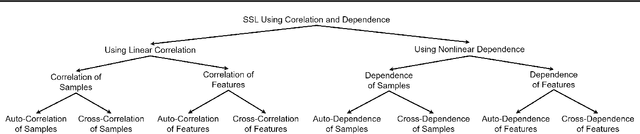
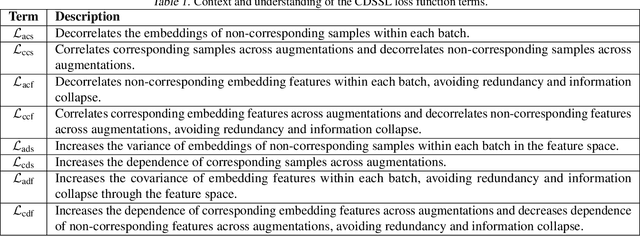
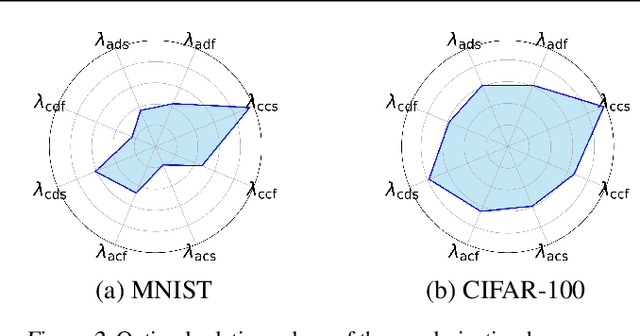
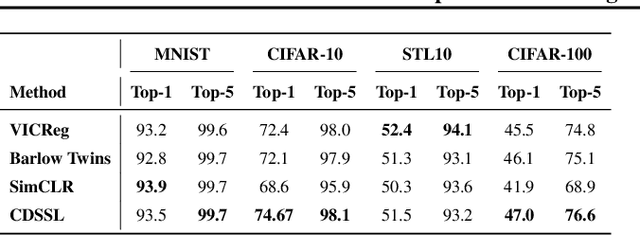
Self-supervised learning has gained significant attention in contemporary applications, particularly due to the scarcity of labeled data. While existing SSL methodologies primarily address feature variance and linear correlations, they often neglect the intricate relations between samples and the nonlinear dependencies inherent in complex data. In this paper, we introduce Correlation-Dependence Self-Supervised Learning (CDSSL), a novel framework that unifies and extends existing SSL paradigms by integrating both linear correlations and nonlinear dependencies, encapsulating sample-wise and feature-wise interactions. Our approach incorporates the Hilbert-Schmidt Independence Criterion (HSIC) to robustly capture nonlinear dependencies within a Reproducing Kernel Hilbert Space, enriching representation learning. Experimental evaluations on diverse benchmarks demonstrate the efficacy of CDSSL in improving representation quality.