 Add to Chrome
 Add to Firefox
 Add to Edge
xDNN(ASP): Explanation Generation System for Deep Neural Networks powered by Answer Set Programming
Jan 07, 2026
Explainable artificial intelligence (xAI) has gained significant attention in recent years. Among other things, explainablility for deep neural networks has been a topic of intensive research due to the meteoric rise in prominence of deep neural networks and their "black-box" nature. xAI approaches can be characterized along different dimensions such as their scope (global versus local explanations) or underlying methodologies (statistic-based versus rule-based strategies). Methods generating global explanations aim to provide reasoning process applicable to all possible output classes while local explanation methods focus only on a single, specific class. SHAP (SHapley Additive exPlanations), a well-known statistical technique, identifies important features of a network. Deep neural network rule extraction method constructs IF-THEN rules that link input conditions to a class. Another approach focuses on generating counterfactuals which help explain how small changes to an input can affect the model's predictions. However, these techniques primarily focus on the input-output relationship and thus neglect the structure of the network in explanation generation. In this work, we propose xDNN(ASP), an explanation generation system for deep neural networks that provides global explanations. Given a neural network model and its training data, xDNN(ASP) extracts a logic program under answer set semantics that-in the ideal case-represents the trained model, i.e., answer sets of the extracted program correspond one-to-one to input-output pairs of the network. We demonstrate experimentally, using two synthetic datasets, that not only the extracted logic program maintains a high-level of accuracy in the prediction task, but it also provides valuable information for the understanding of the model such as the importance of features as well as the impact of hidden nodes on the prediction. The latter can be used as a guide for reducing the number of nodes used in hidden layers, i.e., providing a means for optimizing the network.
* In Proceedings ICLP 2025, arXiv:2601.00047

Explanations for Answer Set Programming
Aug 30, 2023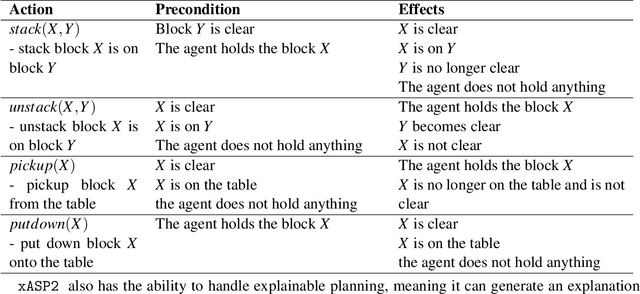
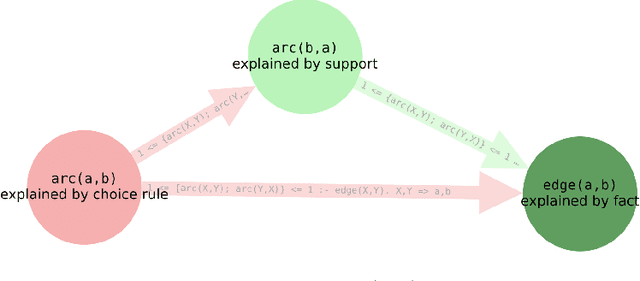
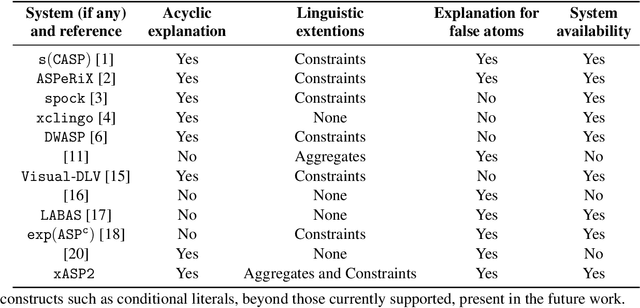
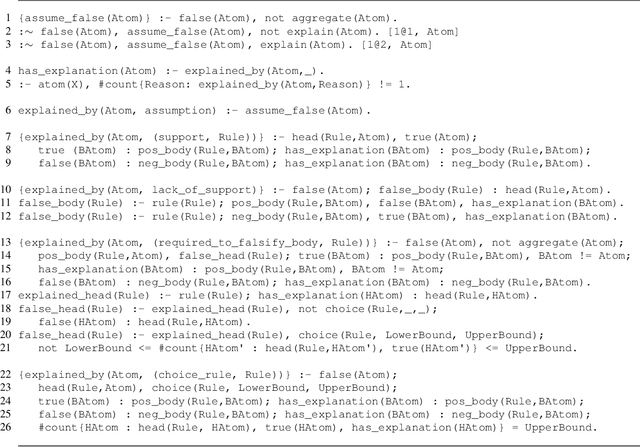
The paper presents an enhancement of xASP, a system that generates explanation graphs for Answer Set Programming (ASP). Different from xASP, the new system, xASP2, supports different clingo constructs like the choice rules, the constraints, and the aggregates such as #sum, #min. This work formalizes and presents an explainable artificial intelligence system for a broad fragment of ASP, capable of shrinking as much as possible the set of assumptions and presenting explanations in terms of directed acyclic graphs.
* In Proceedings ICLP 2023, arXiv:2308.14898
exp : Explaining ASP Programs with Choice Atoms and Constraint Rules
Sep 17, 2021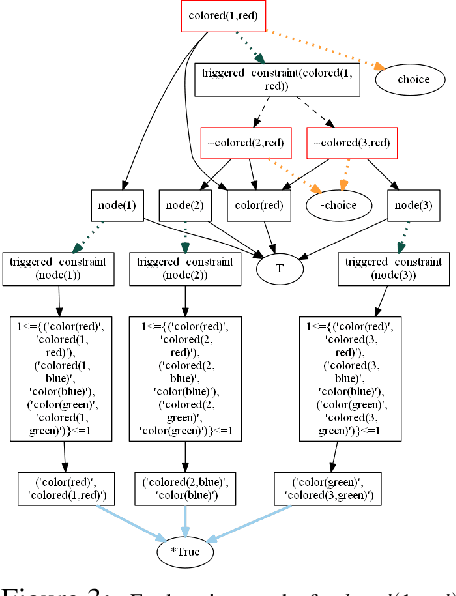
We present an enhancement of exp(ASP), a system that generates explanation graphs for a literal l - an atom a or its default negation ~a - given an answer set A of a normal logic program P, which explain why l is true (or false) given A and P. The new system, exp(ASPc), differs from exp(ASP) in that it supports choice rules and utilizes constraint rules to provide explanation graphs that include information about choices and constraints.
* In Proceedings ICLP 2021, arXiv:2109.07914. In Proceedings the 37th International Conference on Logic Programming (ICLP 2021)
Generating explanations for answer set programming applications
Apr 18, 2021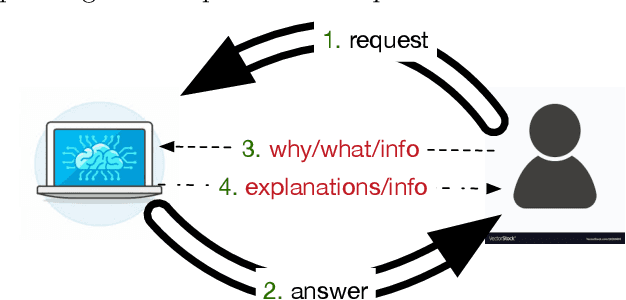
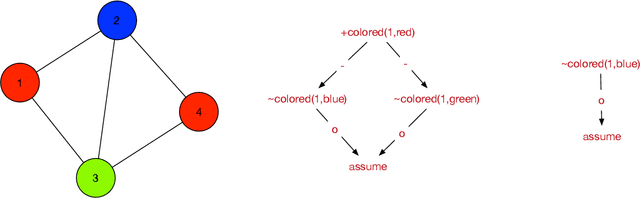
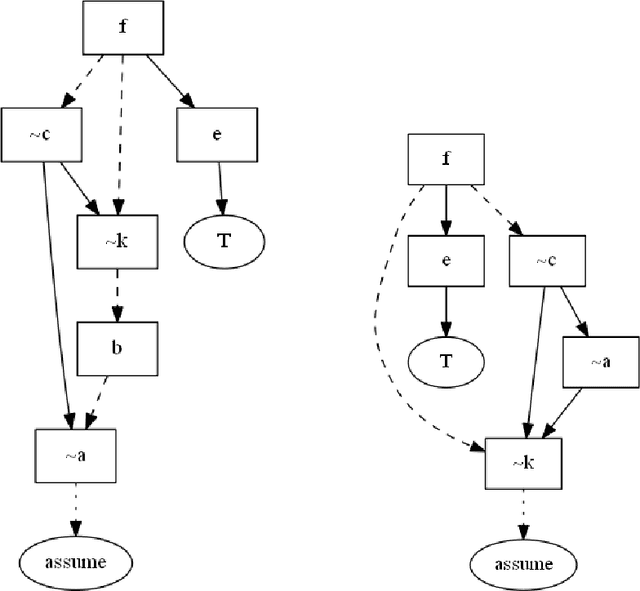
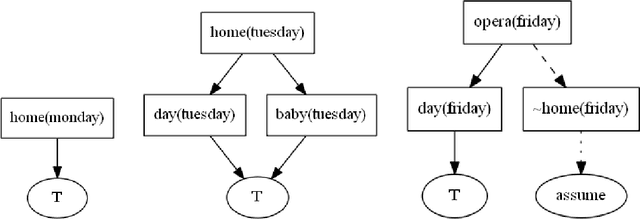
We present an explanation system for applications that leverage Answer Set Programming (ASP). Given a program P, an answer set A of P, and an atom a in the program P, our system generates all explanation graphs of a which help explain why a is true (or false) given the program P and the answer set A. We illustrate the functionality of the system using some examples from the literature.