 Add to Chrome
 Add to Firefox
 Add to Edge
Media Framing Moderates Risk-Benefit Perceptions and Value Tradeoffs in Human-Robot Collaboration
Feb 13, 2026
Public acceptance of industrial human-robot collaboration (HRC) is shaped by how risks and benefits are perceived by affected employees. Positive or negative media framing may shape and shift how individuals evaluate HRC. This study examines how message framing moderates the effects of perceived risks and perceived benefits on overall attributed value. In a pre-registered study, participants (N = 1150) were randomly assigned to read either a positively or negatively framed newspaper article in one of three industrial contexts (autonomy, employment, safety) about HRC in production. Subsequently, perceived risks, benefits, and value were measured using reliable and publicly available psychometric scales. Two multiple regressions (one per framing condition) tested for main and interaction effects. Framing influenced absolute evaluations of risk, benefits, and value. In both frames, risks and benefits significantly predicted attributed value. Under positive framing, only main effects were observed (risks: beta = -0.52; benefits: beta = 0.45). Under negative framing, both predictors had stronger main effects (risks: beta = -0.69; benefits: beta = 0.63) along with a significant negative interaction (beta = -0.32), indicating that higher perceived risk diminishes the positive effect of perceived benefits. Model fit was higher for the positive frame (R^2 = 0.715) than for the negative frame (R^2 = 0.583), indicating greater explained variance in value attributions. Framing shapes the absolute evaluation of HRC and how risks and benefits are cognitively integrated in trade-offs. Negative framing produces stronger but interdependent effects, whereas positive framing supports additive evaluations. These findings highlight the role of strategic communication in fostering acceptance of HRC and underscore the need to consider framing in future HRC research.

Trust and Human Autonomy after Cobot Failures: Communication is Key for Industry 5.0
Sep 26, 2025Collaborative robots (cobots) are a core technology of Industry 4.0. Industry 4.0 uses cyber-physical systems, IoT and smart automation to improve efficiency and data-driven decision-making. Cobots, as cyber-physical systems, enable the introduction of lightweight automation to smaller companies through their flexibility, low cost and ability to work alongside humans, while keeping humans and their skills in the loop. Industry 5.0, the evolution of Industry 4.0, places the worker at the centre of its principles: The physical and mental well-being of the worker is the main goal of new technology design, not just productivity, efficiency and safety standards. Within this concept, human trust in cobots and human autonomy are important. While trust is essential for effective and smooth interaction, the workers' perception of autonomy is key to intrinsic motivation and overall well-being. As failures are an inevitable part of technological systems, this study aims to answer the question of how system failures affect trust in cobots as well as human autonomy, and how they can be recovered afterwards. Therefore, a VR experiment (n = 39) was set up to investigate the influence of a cobot failure and its severity on human autonomy and trust in the cobot. Furthermore, the influence of transparent communication about the failure and next steps was investigated. The results show that both trust and autonomy suffer after cobot failures, with the severity of the failure having a stronger negative impact on trust, but not on autonomy. Both trust and autonomy can be partially restored by transparent communication.
AI Perceptions Across Cultures: Similarities and Differences in Expectations, Risks, Benefits, Tradeoffs, and Value in Germany and China
Dec 18, 2024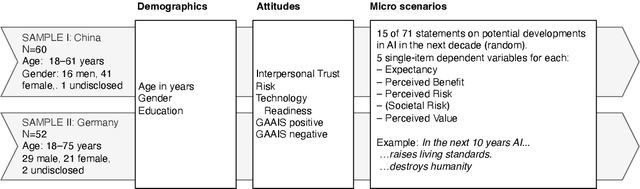
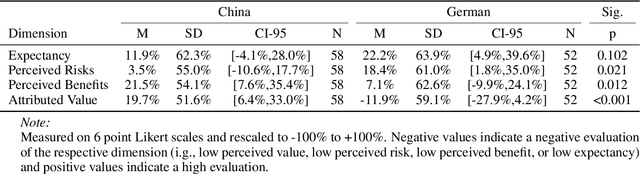
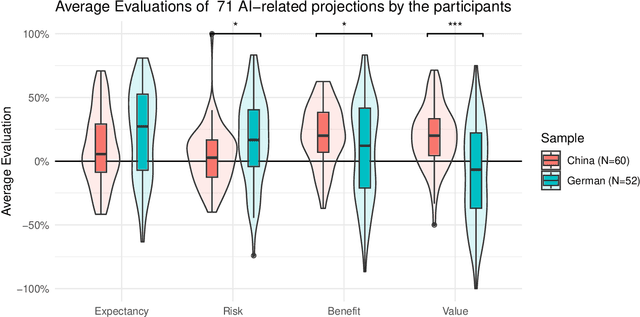
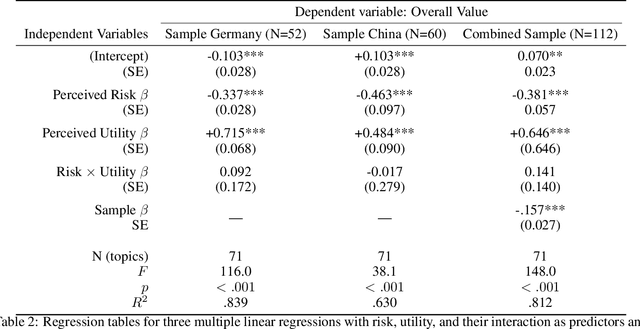
As artificial intelligence (AI) continues to advance, understanding public perceptions -- including biases, risks, and benefits -- is critical for guiding research priorities, shaping public discourse, and informing policy. This study explores public mental models of AI using micro scenarios to assess reactions to 71 statements about AI's potential future impacts. Drawing on cross-cultural samples from Germany (N=52) and China (N=60), we identify significant differences in expectations, evaluations, and risk-utility tradeoffs. German participants tended toward more cautious assessments, whereas Chinese participants expressed greater optimism regarding AI's societal benefits. Chinese participants exhibited relatively balanced risk-benefit tradeoffs ($\beta=-0.463$ for risk and $\beta=+0.484$ for benefit, $r^2=.630$). In contrast, German participants showed a stronger emphasis on AI benefits and less on risks ($\beta=-0.337$ for risk and $\beta=+0.715$ for benefit, $r^2=.839$). Visual cognitive maps illustrate these contrasts, offering new perspectives on how cultural contexts shape AI acceptance. Our findings underline key factors influencing public perception and provide actionable insights for fostering equitable and culturally sensitive integration of AI technologies.
Misalignments in AI Perception: Quantitative Findings and Visual Mapping of How Experts and the Public Differ in Expectations and Risks, Benefits, and Value Judgments
Dec 02, 2024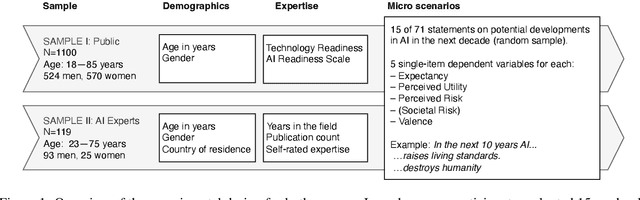
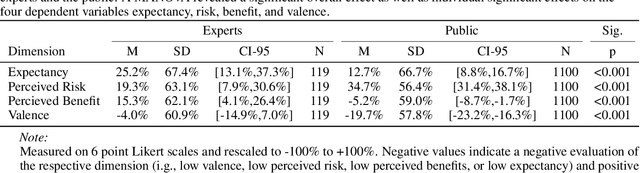
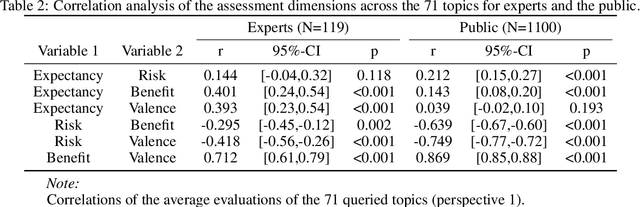
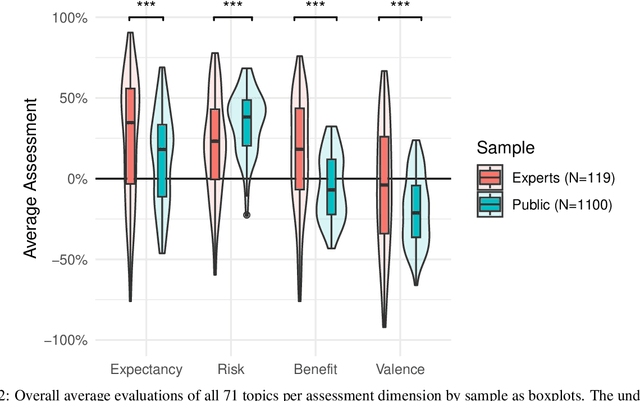
Artificial Intelligence (AI) is transforming diverse societal domains, raising critical questions about its risks and benefits and the misalignments between public expectations and academic visions. This study examines how the general public (N=1110) -- people using or being affected by AI -- and academic AI experts (N=119) -- people shaping AI development -- perceive AI's capabilities and impact across 71 scenarios, including sustainability, healthcare, job performance, societal divides, art, and warfare. Participants evaluated each scenario on four dimensions: expected probability, perceived risk and benefit, and overall sentiment (or value). The findings reveal significant quantitative differences: experts anticipate higher probabilities, perceive lower risks, report greater utility, and express more favorable sentiment toward AI compared to the non-experts. Notably, risk-benefit tradeoffs differ: the public assigns risk half the weight of benefits, while experts assign it only a third. Visual maps of these evaluations highlight areas of convergence and divergence, identifying potential sources of public concern. These insights offer actionable guidance for researchers and policymakers to align AI development with societal values, fostering public trust and informed governance.
Mapping Public Perception of Artificial Intelligence: Expectations, Risk-Benefit Tradeoffs, and Value As Determinants for Societal Acceptance
Nov 28, 2024Understanding public perception of artificial intelligence (AI) and the tradeoffs between potential risks and benefits is crucial, as these perceptions might shape policy decisions, influence innovation trajectories for successful market strategies, and determine individual and societal acceptance of AI technologies. Using a representative sample of 1100 participants from Germany, this study examines mental models of AI. Participants quantitatively evaluated 71 statements about AI's future capabilities (e.g., autonomous driving, medical care, art, politics, warfare, and societal divides), assessing the expected likelihood of occurrence, perceived risks, benefits, and overall value. We present rankings of these projections alongside visual mappings illustrating public risk-benefit tradeoffs. While many scenarios were deemed likely, participants often associated them with high risks, limited benefits, and low overall value. Across all scenarios, 96.4% ($r^2=96.4\%$) of the variance in value assessment can be explained by perceived risks ($\beta=-.504$) and perceived benefits ($\beta=+.710$), with no significant relation to expected likelihood. Demographics and personality traits influenced perceptions of risks, benefits, and overall evaluations, underscoring the importance of increasing AI literacy and tailoring public information to diverse user needs. These findings provide actionable insights for researchers, developers, and policymakers by highlighting critical public concerns and individual factors essential to align AI development with individual values.