 Add to Chrome
 Add to Firefox
 Add to Edge
Autonomous Self-Healing UAV Swarms for Robust 6G Non-Terrestrial Networks
Jan 19, 2026
Recent years have seen an increased interest in the use of Non-terrestrial networks (NTNs), especially the unmanned aerial vehicles (UAVs) to provide cost-effective global connectivity in next-generation wireless networks. We introduce a resilient, adaptive, self-healing network design (RASHND) to optimize signal quality under dynamic interference and adversarial conditions. RASHND leverages inter-node communication and an intelligent algorithm selection process, incorporating combining techniques like distributed-Maximal Ratio Combining (d-MRC), distributed-Linear Minimum Mean Squared Error Estimation(d-LMMSE), and Selection Combining (SC). These algorithms are selected to improve performance by adapting to changing network conditions. To evaluate the effectiveness of the proposed RASHND solutions, a software-defined radio (SDR)-based hardware testbed afforded initial testing and evaluations. Additionally, we present results from UAV tests conducted on the AERPAW testbed to validate our solutions in real-world scenarios. The results demonstrate that RASHND significantly enhances the reliability and interference resilience of UAV networks, making them well-suited for critical communications.

6G-AUTOR: Autonomic CSI-Free Transceiver via Realtime On-Device Signal Analytics
Jun 07, 2022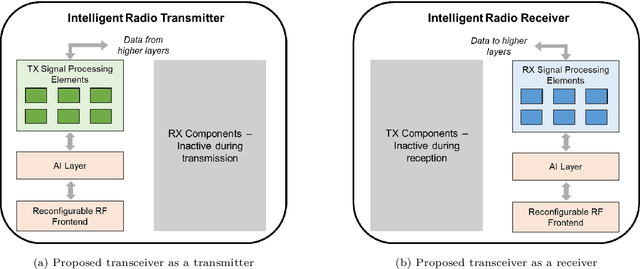
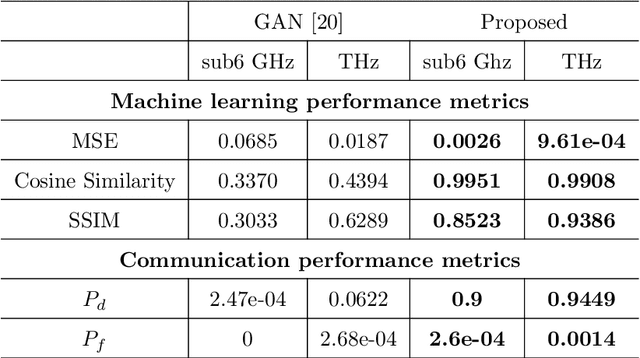

Next-generation wireless systems aim at fulfilling diverse application requirements but fundamentally rely on point-to-point transmission qualities. Aligning with recent AI-enabled wireless implementations, this paper introduces autonomic radios, 6G-AUTOR, that leverage novel algorithm-hardware separation platforms, softwarization of transmission (TX) and reception (RX) operations, and automatic reconfiguration of RF frontends, to support link performance and resilience. As a comprehensive transceiver solution, our design encompasses several ML-driven models, each enhancing a specific aspect of either TX or RX, leading to robust transceiver operation under tight constraints of future wireless systems. A data-driven radio management module was developed via deep Q-networks to support fast-reconfiguration of TX resource blocks (RB) and proactive multi-agent access. Also, a ResNet-inspired fast-beamforming solution was employed to enable robust communication to multiple receivers over the same RB, which has potential applications in realisation of cell-free infrastructures. As a receiver the system was equipped with a capability of ultra-broadband spectrum recognition. Apart from this, a fundamental tool - automatic modulation classification (AMC) which involves a complex correntropy extraction, followed by a convolutional neural network (CNN)-based classification, and a deep learning-based LDPC decoder were added to improve the reception quality and radio performance. Simulations of individual algorithms demonstrate that under appropriate training, each of the corresponding radio functions have either outperformed or have performed on-par with the benchmark solutions.