 Add to Chrome
 Add to Firefox
 Add to Edge
GPCR-Filter: a deep learning framework for efficient and precise GPCR modulator discovery
Jan 27, 2026
G protein-coupled receptors (GPCRs) govern diverse physiological processes and are central to modern pharmacology. Yet discovering GPCR modulators remains challenging because receptor activation often arises from complex allosteric effects rather than direct binding affinity, and conventional assays are slow, costly, and not optimized for capturing these dynamics. Here we present GPCR-Filter, a deep learning framework specifically developed for GPCR modulator discovery. We assembled a high-quality dataset of over 90,000 experimentally validated GPCR-ligand pairs, providing a robust foundation for training and evaluation. GPCR-Filter integrates the ESM-3 protein language model for high-fidelity GPCR sequence representations with graph neural networks that encode ligand structures, coupled through an attention-based fusion mechanism that learns receptor-ligand functional relationships. Across multiple evaluation settings, GPCR-Filter consistently outperforms state-of-the-art compound-protein interaction models and exhibits strong generalization to unseen receptors and ligands. Notably, the model successfully identified micromolar-level agonists of the 5-HT\textsubscript{1A} receptor with distinct chemical frameworks. These results establish GPCR-Filter as a scalable and effective computational approach for GPCR modulator discovery, advancing AI-assisted drug development for complex signaling systems.

Deep Spatial Regression Model for Image Crowd Counting
Oct 26, 2017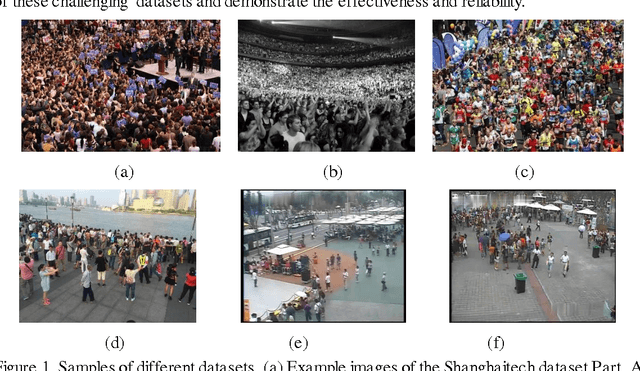

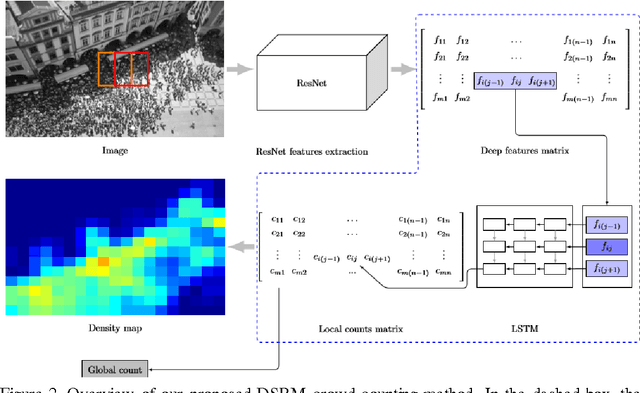

Computer vision techniques have been used to produce accurate and generic crowd count estimators in recent years. Due to severe occlusions, appearance variations, perspective distortions and illumination conditions, crowd counting is a very challenging task. To this end, we propose a deep spatial regression model(DSRM) for counting the number of individuals present in a still image with arbitrary perspective and arbitrary resolution. Our proposed model is based on Convolutional Neural Network (CNN) and long short term memory (LSTM). First, we put the images into a pretrained CNN to extract a set of high-level features. Then the features in adjacent regions are used to regress the local counts with a LSTM structure which takes the spatial information into consideration. The final global count is obtained by a sum of the local patches. We apply our framework on several challenging crowd counting datasets, and the experiment results illustrate that our method on the crowd counting and density estimation problem outperforms state-of-the-art methods in terms of reliability and effectiveness.
Image Crowd Counting Using Convolutional Neural Network and Markov Random Field
Oct 17, 2017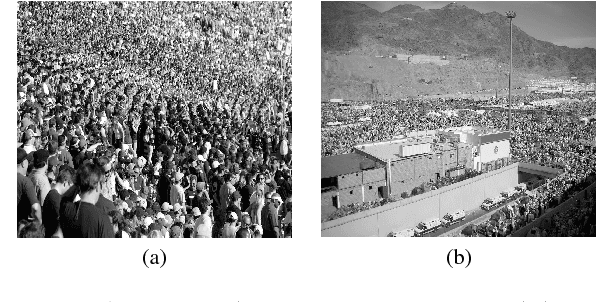
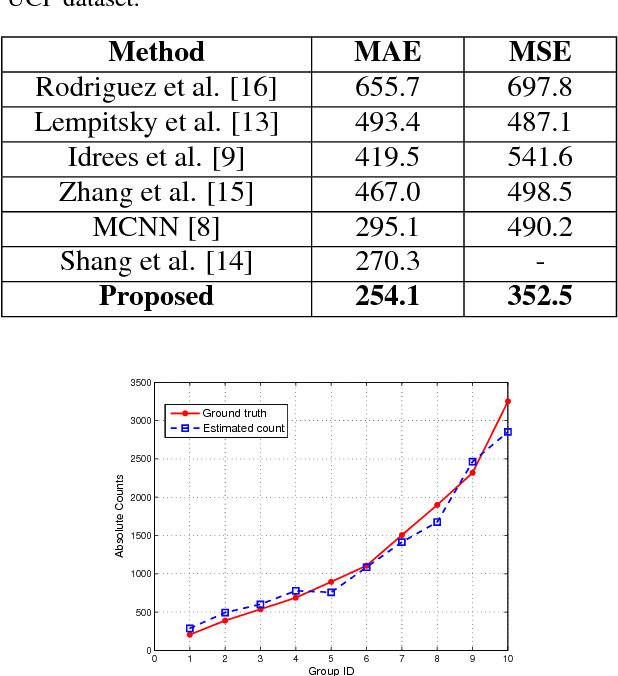
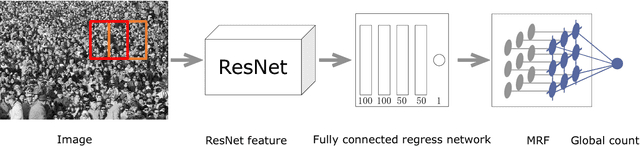
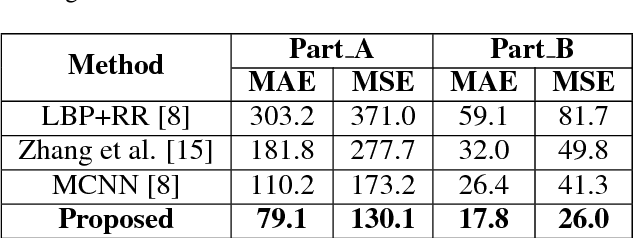
In this paper, we propose a method called Convolutional Neural Network-Markov Random Field (CNN-MRF) to estimate the crowd count in a still image. We first divide the dense crowd visible image into overlapping patches and then use a deep convolutional neural network to extract features from each patch image, followed by a fully connected neural network to regress the local patch crowd count. Since the local patches have overlapping portions, the crowd count of the adjacent patches has a high correlation. We use this correlation and the Markov random field to smooth the counting results of the local patches. Experiments show that our approach significantly outperforms the state-of-the-art methods on UCF and Shanghaitech crowd counting datasets.
* 6 pages, 6 figures, JACIII Vol.21 No.4