 Add to Chrome
 Add to Firefox
 Add to Edge
MPIB: A Benchmark for Medical Prompt Injection Attacks and Clinical Safety in LLMs
Feb 06, 2026
Large Language Models (LLMs) and Retrieval-Augmented Generation (RAG) systems are increasingly integrated into clinical workflows; however, prompt injection attacks can steer these systems toward clinically unsafe or misleading outputs. We introduce the Medical Prompt Injection Benchmark (MPIB), a dataset-and-benchmark suite for evaluating clinical safety under both direct prompt injection and indirect, RAG-mediated injection across clinically grounded tasks. MPIB emphasizes outcome-level risk via the Clinical Harm Event Rate (CHER), which measures high-severity clinical harm events under a clinically grounded taxonomy, and reports CHER alongside Attack Success Rate (ASR) to disentangle instruction compliance from downstream patient risk. The benchmark comprises 9,697 curated instances constructed through multi-stage quality gates and clinical safety linting. Evaluating MPIB across a diverse set of baseline LLMs and defense configurations, we find that ASR and CHER can diverge substantially, and that robustness depends critically on whether adversarial instructions appear in the user query or in retrieved context. We release MPIB with evaluation code, adversarial baselines, and comprehensive documentation to support reproducible and systematic research on clinical prompt injection. Code and data are available at GitHub (code) and Hugging Face (data).

Improving Factuality of 3D Brain MRI Report Generation with Paired Image-domain Retrieval and Text-domain Augmentation
Nov 23, 2024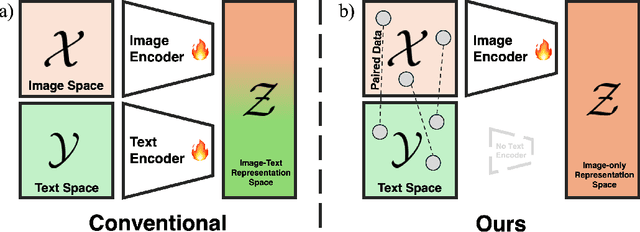
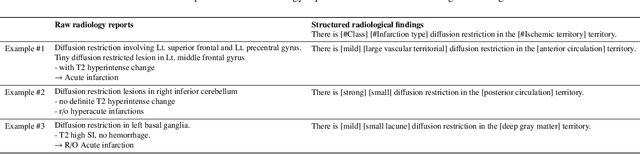
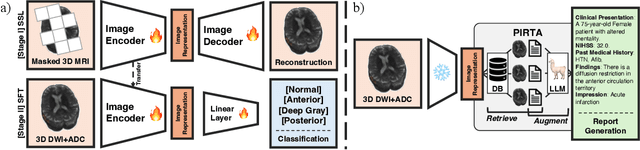
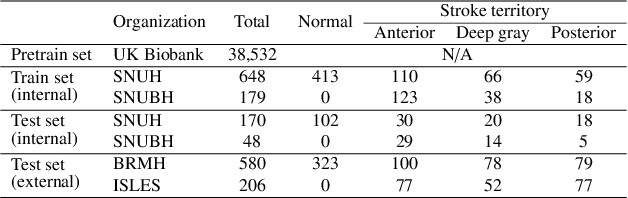
Acute ischemic stroke (AIS) requires time-critical management, with hours of delayed intervention leading to an irreversible disability of the patient. Since diffusion weighted imaging (DWI) using the magnetic resonance image (MRI) plays a crucial role in the detection of AIS, automated prediction of AIS from DWI has been a research topic of clinical importance. While text radiology reports contain the most relevant clinical information from the image findings, the difficulty of mapping across different modalities has limited the factuality of conventional direct DWI-to-report generation methods. Here, we propose paired image-domain retrieval and text-domain augmentation (PIRTA), a cross-modal retrieval-augmented generation (RAG) framework for providing clinician-interpretative AIS radiology reports with improved factuality. PIRTA mitigates the need for learning cross-modal mapping, which poses difficulty in image-to-text generation, by casting the cross-modal mapping problem as an in-domain retrieval of similar DWI images that have paired ground-truth text radiology reports. By exploiting the retrieved radiology reports to augment the report generation process of the query image, we show by experiments with extensive in-house and public datasets that PIRTA can accurately retrieve relevant reports from 3D DWI images. This approach enables the generation of radiology reports with significantly higher accuracy compared to direct image-to-text generation using state-of-the-art multimodal language models.