 Add to Chrome
 Add to Firefox
 Add to Edge
Explaining Group Recommendations via Counterfactuals
Jan 26, 2026
Group recommender systems help users make collective choices but often lack transparency, leaving group members uncertain about why items are suggested. Existing explanation methods focus on individuals, offering limited support for groups where multiple preferences interact. In this paper, we propose a framework for group counterfactual explanations, which reveal how removing specific past interactions would change a group recommendation. We formalize this concept, introduce utility and fairness measures tailored to groups, and design heuristic algorithms, such as Pareto-based filtering and grow-and-prune strategies, for efficient explanation discovery. Experiments on MovieLens and Amazon datasets show clear trade-offs: low-cost methods produce larger, less fair explanations, while other approaches yield concise and balanced results at higher cost. Furthermore, the Pareto-filtering heuristic demonstrates significant efficiency improvements in sparse settings.

Auditing for Spatial Fairness
Feb 23, 2023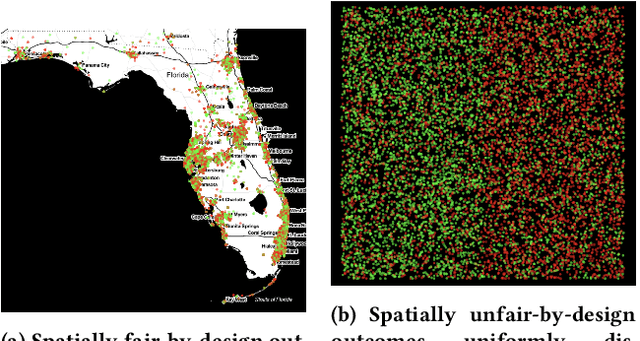
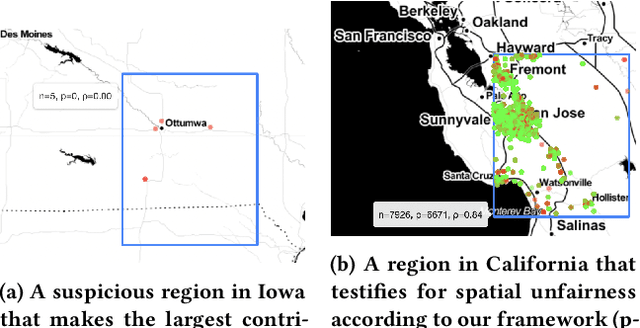
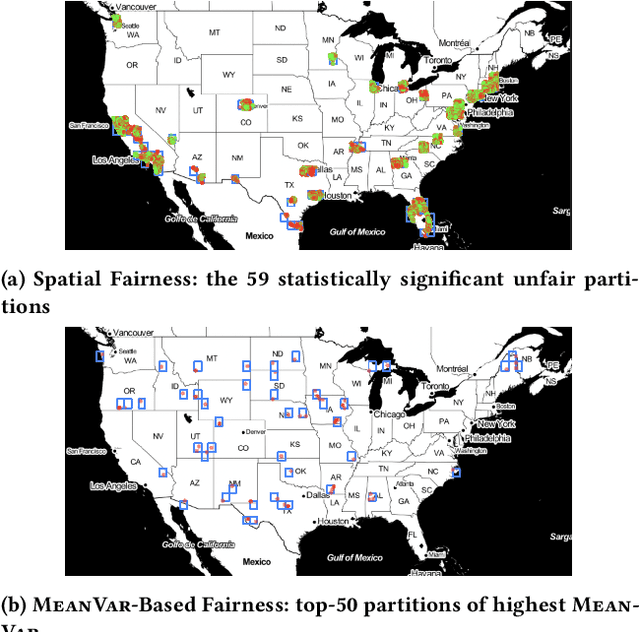
This paper studies algorithmic fairness when the protected attribute is location. To handle protected attributes that are continuous, such as age or income, the standard approach is to discretize the domain into predefined groups, and compare algorithmic outcomes across groups. However, applying this idea to location raises concerns of gerrymandering and may introduce statistical bias. Prior work addresses these concerns but only for regularly spaced locations, while raising other issues, most notably its inability to discern regions that are likely to exhibit spatial unfairness. Similar to established notions of algorithmic fairness, we define spatial fairness as the statistical independence of outcomes from location. This translates into requiring that for each region of space, the distribution of outcomes is identical inside and outside the region. To allow for localized discrepancies in the distribution of outcomes, we compare how well two competing hypotheses explain the observed outcomes. The null hypothesis assumes spatial fairness, while the alternate allows different distributions inside and outside regions. Their goodness of fit is then assessed by a likelihood ratio test. If there is no significant difference in how well the two hypotheses explain the observed outcomes, we conclude that the algorithm is spatially fair.